Introduction
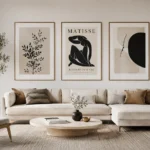
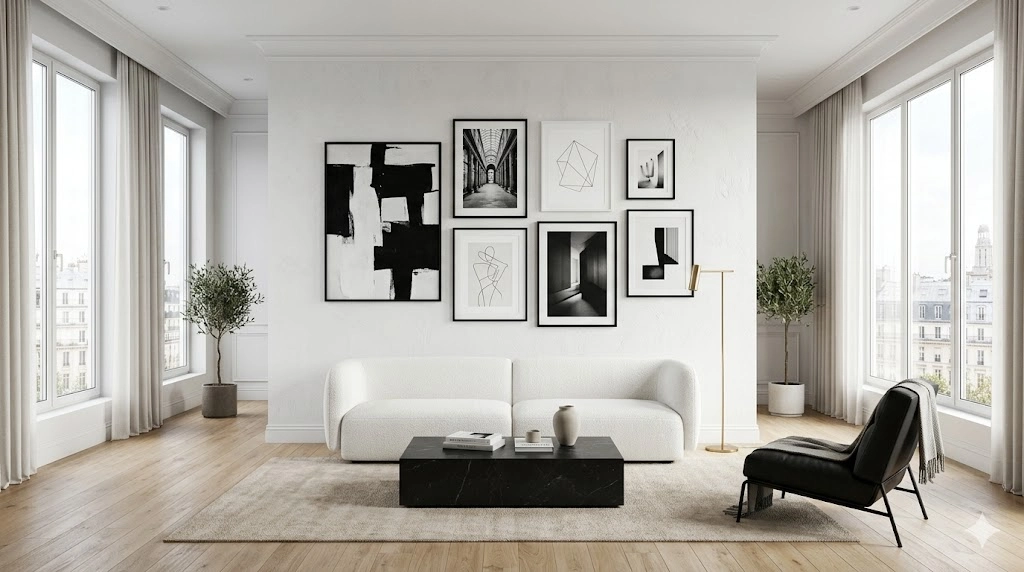
Black and white wall decor has undergone a major transformation in modern interior architecture. What once was considered a simple aesthetic preference has now evolved into a structured visual design language system that dominates European residential styling, luxury apartments, boutique hotels, and contemporary minimalist architecture.
In 2026, monochrome wall styling is no longer treated as decorative randomness. Instead, it is recognized as a spatial cognition framework—a method that influences how humans perceive space, interpret visual hierarchy, and experience emotional balance inside interiors.
Across Europe, from the calm, nature-inspired homes of Scandinavia to the precise geometric interiors of Germany and the refined elegance of French luxury apartments, black and white wall decor has become a continent-wide architectural communication system.
This guide breaks down the entire system into a structured professional framework:
- Functional logic behind monochrome interiors
- Cognitive psychology of contrast-based design
- European regional interior methodologies
- Room-by-room implementation strategies
- Gallery wall engineering principles
- 2026 design evolution trends
- Structural mistakes and optimization errors
- Expert-level interior styling systems
By the end of this guide, black and white wall decor will no longer appear as “art on walls,” but rather as a controlled environmental design system that regulates emotion, attention, and spatial harmony.
What Is Black and White Wall Decor?
Black and white wall decor refers to a monochromatic spatial organization framework that utilizes contrast polarity instead of chromatic variation to manage visual perception, emotional tone, and architectural rhythm.
From a Natural Language Processing (NLP)-inspired interpretation of design systems, it can be defined as:
A contrast-driven visual encoding structure that minimizes cognitive overload while maximizing spatial pattern recognition, perceptual clarity, and emotional stabilization.
Functional System Breakdown
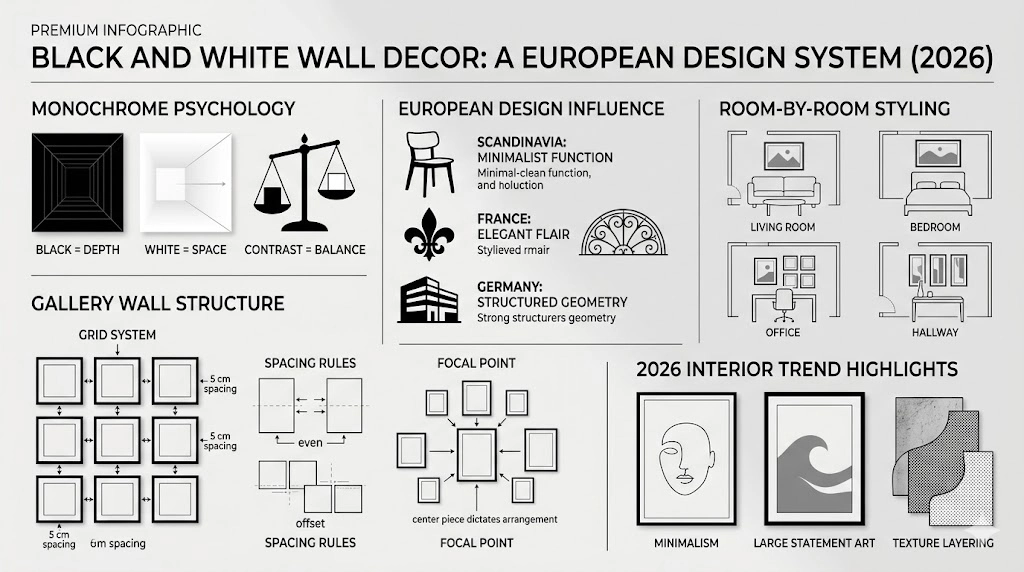
- Black elements → structural anchors, depth generation, visual grounding, emphasis points
- White elements → spatial expansion, clarity enhancement, light diffusion, visual relief zones
- Combined system → equilibrium state of perception, balanced readability, aesthetic neutrality
This combination forms what designers refer to as a dual-channel cognitive visual processing system, where the human brain interprets contrast rather than color complexity.
Why Black and White Wall Decor Dominates European Interiors
Europe has historically led global interior innovation due to its strong architectural traditions, environmental constraints, and cultural emphasis on minimalism and functionality.
Black and white wall decor thrives in Europe because it aligns with three core design principles:
- Environmental psychology optimization
- Architectural discipline and structure
- Cultural preference for restrained elegance
Scandinavian Minimalism
Scandinavian interiors prioritize:
- Maximum daylight utilization
- Visual silence and reduced noise
- Functional simplicity
- Emotional calm environments
Within this framework, monochrome wall decor acts as a visual filtering system, removing unnecessary stimulation and allowing architectural space to breathe naturally.
It enhances:
- Spatial clarity
- Natural light diffusion
- Emotional neutrality
German Precision Design System
German interior design is defined by:
- Mathematical alignment
- Grid-based structure systems
- Functional spatial organization
- Precision-driven visual hierarchy
Black and white wall decor supports this ideology by:
- Strengthening geometric consistency
- Enhancing predictable visual mapping
- Reinforcing structural discipline
It functions like a visual engineering blueprint applied to interior spaces.
French Luxury Minimalism
French interiors prioritize:
- Controlled elegance
- Emotional storytelling through restraint
- Selective decoration
- Subtle luxury expression
Monochrome decor in this context becomes:
A refined expression of visual sophistication achieved through limitation rather than excess.
It delivers a timeless editorial aesthetic associated with luxury fashion and boutique interiors.
Psychology of Black and White Wall Decor
Black and white environments directly influence human cognitive behavior, emotional perception, and visual processing efficiency.
Contrast-Based Attention Engineering System
High contrast environments naturally:
- Direct gaze movement flow
- Prioritize visual focal points
- Improve spatial structure recognition
- Enhance depth perception accuracy
This creates a biological navigation system for visual attention.
Cognitive Load Reduction Mechanism
Monochrome interiors significantly reduce:
- Color decision fatigue
- Sensory overstimulation
- Visual fragmentation
- Mental clutter perception
Resulting effect:
A measurable increase in mental clarity, relaxation, and perceptual stability.
Emotional Duality Equilibrium Model
- Black represents: depth, grounding, seriousness, structural intensity
- White represents: openness, calmness, mental relief, spatial expansion
Together they form:
A balanced emotional field that stabilizes psychological experience inside interiors.
European 70/30 Design System
European interior designers rarely rely on randomness. Instead, they use proportional design systems that ensure balance and consistency.
70% Structural Foundation Layer
Includes:
- Wall surfaces
- Large furniture forms
- Primary artwork pieces
- Dominant architectural planes
Purpose:
To establish spatial stability, grounding, and visual hierarchy.
30% Accent Modulation Layer
Includes:
- Frames and borders
- Decorative micro-elements
- Texture variations
- Secondary visual highlights
Purpose:
To introduce controlled complexity and personality into the system.
System Outcome
- Prevents chaotic visual distribution
- Enhances aesthetic consistency
- Maintains architectural clarity
- Improves spatial readability
Types of Black and White Wall Decor in Europe
Minimalist Photography Systems
- Architectural structure photography
- Urban geometric compositions
- Light and shadow studies
- European cityscape visuals
Abstract Monochrome Art Systems
- Fluid ink compositions
- Emotional brush movement art
- Geometric abstraction
- Non-representational visual storytelling
Line Art Minimal Systems
- Continuous contour drawings
- Human silhouette abstraction
- Minimal facial outlines
- Simplified emotional sketches
Gallery Wall Architecture Systems
- Grid-based structured layouts
- Controlled asymmetrical composition
- Multi-frame proportional scaling
- Rhythm-based visual sequencing
Room-by-Room Black and White Wall Decor System
Living Room
Purpose: First impression creation and spatial identity
Strategy:
- One dominant focal artwork
- Strong contrast centerpiece
- Symmetrical balance for stability
Bedroom
Purpose: Relaxation and cognitive decompression
Strategy:
- Soft monochrome contrast
- Low visual intensity artwork
- Minimal frame complexity
Home Office
Purpose: Focus, productivity, and mental clarity
Strategy:
- Structured grid alignment
- Architectural photography
- Predictable visual rhythm
Hallways & Entryways
Purpose: Flow and sequential visual storytelling
Strategy:
- Vertical alignment patterns
- Sequential artwork progression
- Controlled contrast rhythm
Gallery Wall Engineering System
Gallery walls are not decorative arrangements—they are structured visual architecture systems.
Small Wall Systems
- 1–2 dominant frames
- Single focal hierarchy
- Minimal visual complexity
Medium Wall Systems
- 3–5 frames
- Balanced spacing design
- Controlled asymmetry or symmetry
Large Wall Systems
- Full grid architectural layout
- Repetitive modular rhythm
- Layered visual depth structure
European Spacing Standard
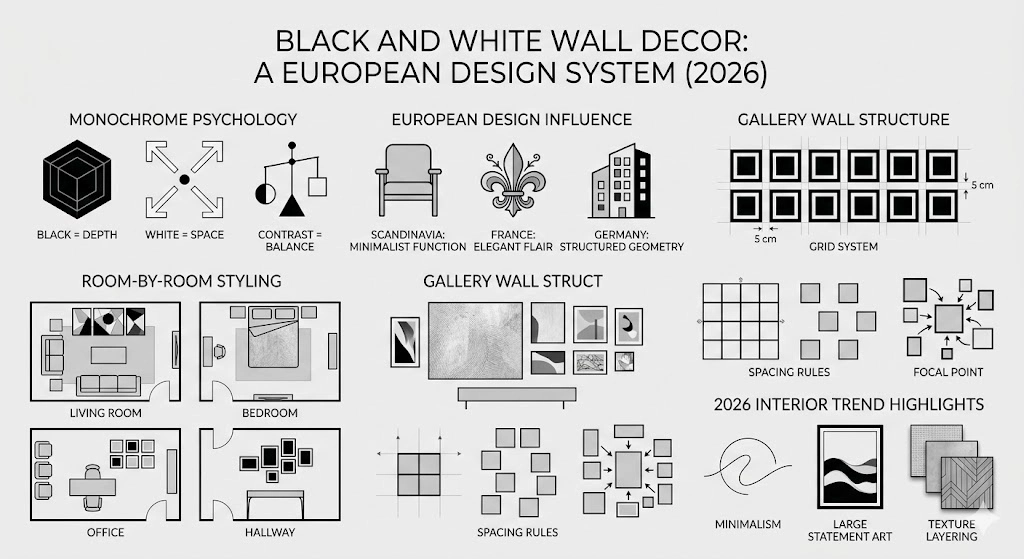
- 5–10 cm frame spacing
- Alignment with furniture geometry
- Consistent baseline anchoring
European Style Comparison Matrix
| Style | Region | Design Logic | Emotional Effect |
| Scandinavian Minimalism | Sweden | Light optimization | Calm clarity |
| Parisian Elegance | France | Curated restraint | Refined luxury |
| German Precision | Germany | Structural geometry | Stability |
| Mediterranean Modern | Southern Europe | Texture blending | Warm expression |
Pros and Cons
Advantages
- Timeless visual identity
- High architectural adaptability
- Strong spatial enhancement
- Easy maintenance system
- Supports minimalist living structures
Limitations
- Risk of emotional rigidity
- Requires texture balancing
- Depends heavily on lighting quality
- May feel sterile if poorly executed
Common Design Mistakes
Overcrowding Visual Elements
Too many frames reduce clarity and hierarchy.
Mixing Incompatible Styles
Breaks system coherence and visual logic.
Improper Spacing
Disrupts rhythm and spatial balance.
No Focal Anchor
Eliminates visual direction and attention flow.
Weak Lighting Strategy
Destroys contrast effectiveness.
2026 Black and White Wall Decor Trends
Architectural Monochrome Rise
Focus on geometry and structural visuals.
Emotional Minimalism Growth
Reduced decor for cognitive clarity.
Statement Art Dominance
One large artwork replaces multiple small pieces.
Mixed Material Systems
Integration of canvas, metal, matte, and glass textures.
Expert-Level Styling Principles
- Define one dominant visual anchor
- Preserve intentional negative space
- Align artwork with architecture
- Balance soft and hard contrasts
- Use natural lighting as a design tool
Why This System Works in Modern Homes
Modern interiors are shaped by:
- Smaller living spaces
- Increased digital overstimulation
- Faster cognitive environments
Black and white wall decor solves these issues by:
- Reducing sensory overload
- Enhancing spatial perception
- Creating emotional grounding systems
It is not merely decoration—it is applied environmental psychology integrated into interior architecture.
FAQs
Yes. It enhances spatial perception through contrast clarity.
Minimalist, Scandinavian, industrial, and modern luxury interiors.
Yes, when combined with textures like wood and soft lighting.
Yes, because it is based on timeless contrast principles.
Treating it as decoration instead of a structured system.
Conclusion
Black and white wall decor is no longer a stylistic preference—it is a European interior design system rooted in psychology, architecture, and cognitive science principles.
It transforms interior environments by:
- Structuring visual perception
- Reducing mental overload
- Enhancing emotional stability
- Creating timeless luxury identity
In 2026, it stands as one of the most scientifically aligned and architecturally stable interior design systems for modern living spaces worldwide.