Introduction
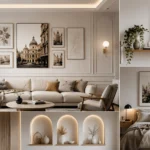
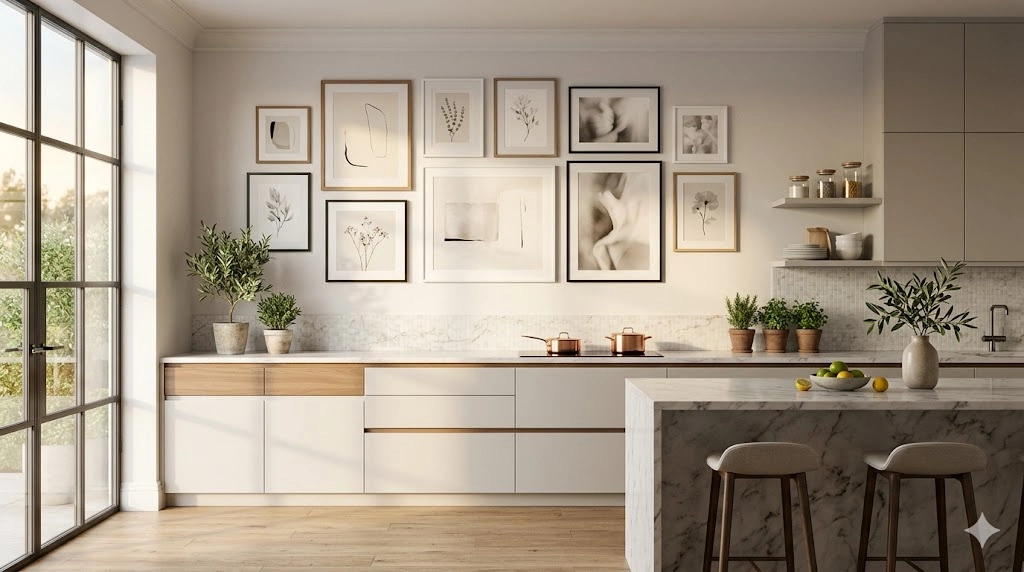
The concept of an art wall for kitchen design has evolved into one of the most influential interior styling movements across Europe in 2026. Modern kitchens are no longer treated as purely functional cooking environments. Instead, they have transformed into multi-purpose lifestyle zones, where cooking, social interaction, emotional comfort, and aesthetic identity all merge into a unified spatial experience.
Today, kitchens are considered architectural storytelling zones, and wall art plays a critical role in shaping that narrative.
A carefully structured kitchen art wall can:
- Optically expand compact kitchen layouts
- Add emotional passion and psychological comfort
- Introduce luxury aesthetics without renovation
- Create peace between furniture, lighting, and architecture
However, most homeowners misunderstand kitchen wall art as simple decoration. In professional interior design systems, it is treated as a spatial optimization strategy combined with optical psychology principles.
This guide provides a complete European design framework for creating an optimized, modern, and optically balanced kitchen art wall system.
What is an Art Wall for Kitchen?
An art wall for kitchen refers to a deliberately structured visual composition placed on a kitchen wall using artwork elements such as prints, canvases, frames, feelings, and optical graphics to enhance:
- Spatial balance and proportional alignment
- Emotional resonance and mood elevation
- Interior cohesion and design consistency
- Aesthetic identity and architectural storytelling
Unlike random decoration, a kitchen art wall follows design logic, spatial geometry, and optical hierarchy principles.
Core Interior Design Principle
In European interior systems, especially in modern minimalist and luxury design schools, kitchen art is governed by this principle:
“Aesthetic value, functional peace, and emotional intelligence must coexist within the same optical field.”
This means every piece of wall art must contribute to:
- Optical clarity (not clutter)
- Spatial enhancement (not reduction)
- Emotional uplift (not noise)
Why Art Wall for Kitchen is Trending in 2026
The rise of kitchen wall art across Europe is driven by multiple socio-cultural and design evolution factors.
Architectural Shift Toward Open-Plan Living
Modern European homes increasingly adopt open-concept layouts, merging kitchen, dining, and living zones. This creates a need for:
- Visual zoning without physical barriers
- Aesthetic separation through art placement
Psychological Demand for Warmth in Minimalism
Minimalist interiors often feel:
- Sterile
- Emotionally flat
- Overly functional
Wall art introduces:
- Emotional passion
- Human-centric design cues
- Psychological balance
Social Media Interior Influence
Platforms like Pinterest and Instagram have amplified:
- Aesthetic kitchen trends
- European interior styling systems
- Luxury home optical culture
Rise of Design-Conscious Homeowners
Modern users now actively seek:
- Designer-level kitchen aesthetics
- Personalized optical storytelling
- Budget-friendly luxury transformations
Design Psychology Insight
Without art integration:
- Kitchens feel rigid, industrial, and emotionally neutral
With properly designed art walls:
- Spaces feel inviting, curated, and architecturally balanced
Kitchen Wall Art by Layout Type
Kitchen maps play a decisive role in determining the optimal art strategy. Each spatial configuration requires a different optical hierarchy model.
Small Kitchen
Small kitchens demand optical expansion techniques and minimal cognitive load.
Recommended Art Styles:
- Vertical composition prints
- Minimalist line drawings
- Soft abstract opticals
- Structured micro-gallery grids
Design Objective:
Enhance perceived ceiling height and reduce optical compression.
Avoid:
- Oversize frames
- Heavy contrast artwork
- Overcrowded gallery clusters
Pro Design Insight:
Use light tonal palettes + thin black or white frames to create spatial illusion and improve perceived bottom.
Open-Plan Kitchen
Open kitchens require optical zoning strategies rather than decorative placement.
Recommended Art Styles:
- Large focal canvas pieces
- Coordinated gallery walls
- Neutral abstract compositions
Design Objective:
Define functional zones optically without walls.
Spatial Strategy:
Use artwork to differentiate:
- Cooking zone
- Dining zone
- Lounge area
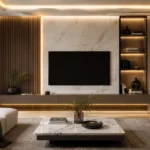
Luxury Modern Kitchen
Luxury kitchens prioritize minimal optical noise and high-impact design precision.
Recommended Art Styles:
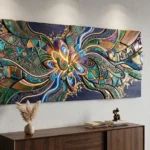
- Oversize abstract art
- Monochrome compositions
- Balanced minimalist panels
Design Objective:
Premium sophistication through restraint.
Core Rule:
“Maximum optical impact with minimal object density.”
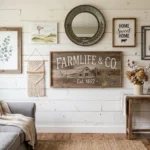
Rustic / Farmhouse Kitchen
Rustic kitchens emphasize emotional passion and nostalgic storytelling.
Recommended Art Styles:
- Botanical illustrations
- Vintage culinary sketches
- Earth-jewel compositions
Design Objective:
Create emotional grounding and natural comfort.
Kitchen Layout vs Art Strategy
| Kitchen Type | Art Style | Color Psychology | Design Goal |
| Small Kitchen | Minimal vertical | Light neutrals | Spatial expansion |
| Open Kitchen | Statement + gallery | Balanced tones | Functional zoning |
| Luxury Kitchen | Abstract + feeling | Monochrome/gold | Premium identity |
| Rustic Kitchen | Botanical/vintage | Warm earth tones | Emotional passion |
2026 European Kitchen Wall Art Trends
European design schools are shaping global kitchen aesthetics.
Biophilic Kitchen Art Trend
Biophilic design integrates natural elements into interiors.
Includes:
- Herb illustrations
- Botanical sketches
- Organic green abstractions
Psychological Benefit:
Reduces stress and increases cognitive relief.
Minimal Monochrome Aesthetics
Popular in Germany and Scandinavian interiors.
Includes:
- Black & white compositions
- Linear geometry
- Abstract simplicity
Textural Wall Art Systems
Adds dimensional bottom to flat kitchen surfaces.
Includes:
- Fabric-based prints
- Stone-Balanced visuals
- 3D canvas art
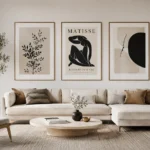
Structured Gallery Wall Systems
Not random decoration—mathematically aligned composition.
Includes:
- Grid-based layouts
- Equal spacing systems
- Frame consistency logic
Art Wall for Kitchen Placement Rules
Placement determines whether the design feels professional or chaotic.
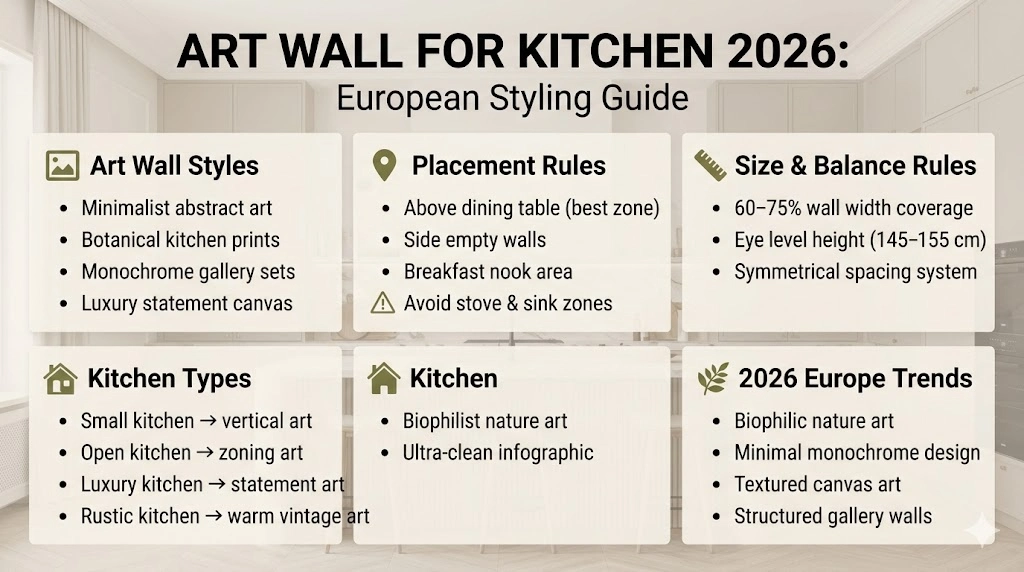
Optimal Placement Zones:
- Above dining table
- Empty lateral wall surfaces
- Breakfast nook zones
- Opposite cabinetry walls
Avoid Placement Zones:
- Above stove (heat exposure)
- Behind sink (moisture risk)
- Excessively high mounting
Golden Ratio Placement Rule:
- Artwork width = 60%–75% of wall width
- Center alignment height = 145–155 cm (eye level standard)
How to Build an Art Wall for Kitchen
Spatial Mapping
Identify unused optical surfaces.
Style Definition
Select one dominant style:
- Minimal
- Simple
- Luxury
- Modern
Color Synchronization
Match artwork with:
- Cabinet jewels
- Countertops
- Flooring feelings
Layout Structuring
Choose:
- Single focal piece
- Gallery composition
- Vertical stack system
Step 5: Installation Alignment
Ensure:
- Symmetry
- Equal spacing
- Optical equilibrium
Expert Styling Formula
Professional designers use a structured system:
“1 + 2 Composition Rule”
- 1 primary focal artwork
- 2 secondary supporting pieces
- Unified frame consistency
Result:
- Balanced composition
- Clean hierarchy
- Luxury optical output
Pros and Cons of Kitchen Wall Art
Advantages:
- Enhances spatial aesthetics instantly
- Adds emotional depth
- No renovation required
- Improves property appeal
- Works across all budgets
Disadvantages:
- Poor placement creates clutter
- Humidity sensitivity risk
- Requires design planning
- Overuse reduces impact
Best Materials for Kitchen Wall Art 2026
- Canvas prints (most versatile)
- Metal prints (modern luxury)
- Glass panels (high-end kitchens)
- Wooden frames (simple interiors)
- Textured composite panels (designer homes)
Common Mistakes to Avoid
- Overcrowding compact walls
- Mixing conflicting design languages
- Incorrect scale selection
- Poor alignment discipline
- Ignoring humidity exposure
European Influence on Kitchen Wall Art
Germany:
Functional precision and structured minimalism
France:
Elegant artistic refinement
Italy:
Warm emotional aesthetic storytelling
Scandinavia:
Light, minimal, nature-driven design
Quick Kitchen Wall Art Ideas
- Botanical herb wall composition
- Monochrome grid system
- Soft abstract canvas series
- Vintage culinary illustration set
- Symmetrical gallery arrangement
FAQs
Minimalist, botanical, and abstract art work best depending on kitchen style.
No, it is not recommended due to heat and grease exposure.
Ideally 60–75% of wall width for balance.
Neutral tones, greens, earth shades, and monochrome palettes.
Use vertical layouts, light colors, and minimal designs.
Conclusion
The art wall for kitchen concept has evolved into a central pillar of modern European interior design in 2026. It is no longer treated as decorative enhancement but as a strategic spatial design system that influences perception, emotion, and functionality.
When correctly executed, a kitchen art wall can:
- Transform spatial perception
- Improve emotional air
- Increase aesthetic value
- Strengthen interior coherence
Final Principle:
“True design is not about adding more elements, but about arranging them with intelligent intention and spatial peace.”