Introduction
A wall decor nursery room in modern European interior culture is no longer treated as simple visual decoration. It is now considered a developmental environment system that influences a baby’s emotional stability, sleep cycle, sensory perception, and early cognitive mapping.
Across countries like Germany, Sweden, Denmark, France, and the Netherlands, nursery design has evolved into a science-backed interior discipline. The focus is not on excessive decoration but on intentional environmental design.
In modern NLP (Neuro-Linguistic Programming) based interior thinking, a nursery is understood as:
- A sensory input system
- A subconscious emotional conditioning space
- A visual calmness generator
Babies do not interpret design logically; they respond through emotional and sensory absorption. Therefore, every wall element acts as a silent communicator.
European principle: “A nursery should regulate emotions before it entertains perception.”
European Philosophy Behind Wall Decor Nursery Room Design
Nursery architecture is built upon three dominant stylistic systems that shape modern baby interiors.
Scandinavian Minimalism
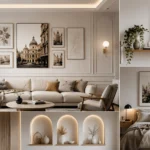
This is the most influential nursery design philosophy in Europe. It prioritizes visual silence and emotional neutrality.
Core characteristics:
- Reduced visual complexity
- Neutral chromatic systems
- Natural daylight optimization
- Functional simplicity over decorative overload
Wall implementation:
- One dominant feature wall
- Soft tonal palette: ivory, beige, light grey, muted sage
- Minimal illustrative art forms
Psychological outcome: Reduces cognitive overload and improves sleep induction behavior.
German Functional Nursery System
German nursery design is rooted in engineering logic and spatial efficiency.
Core principles:
- Function-first spatial structuring
- Safety-integrated design logic
- Modular adaptability for long-term usage
Wall integration:
- Built-in shelving as decorative structure
- Geometric alignment precision
- Storage as visual harmony
Goal: Create an organized, controlled, and hazard-free environment.
French Soft Luxury Nursery Aesthetic
French nursery interiors emphasize emotional softness blended with subtle elegance.
Key elements:
- Artistic expression with restraint
- Warm tactile materials
- Handcrafted visual details
- Gentle luxury impressions
Wall decor style:
- Watercolor illustrations
- Soft pastel framing
- Elegant symmetrical composition
Goal: Emotional warmth combined with aesthetic refinement.
Best Wall Decor Nursery Room Styles in Europe
Nature-Inspired Nursery Walls
Nature-themed nursery design is one of the strongest European trends.
Common visual elements:
- Forest landscapes
- Cloud formations
- Mountain silhouettes
- Botanical sketches
NLP psychological effect:
- Induces subconscious calmness
- Reduces overstimulation response
- Encourages sleep association patterns
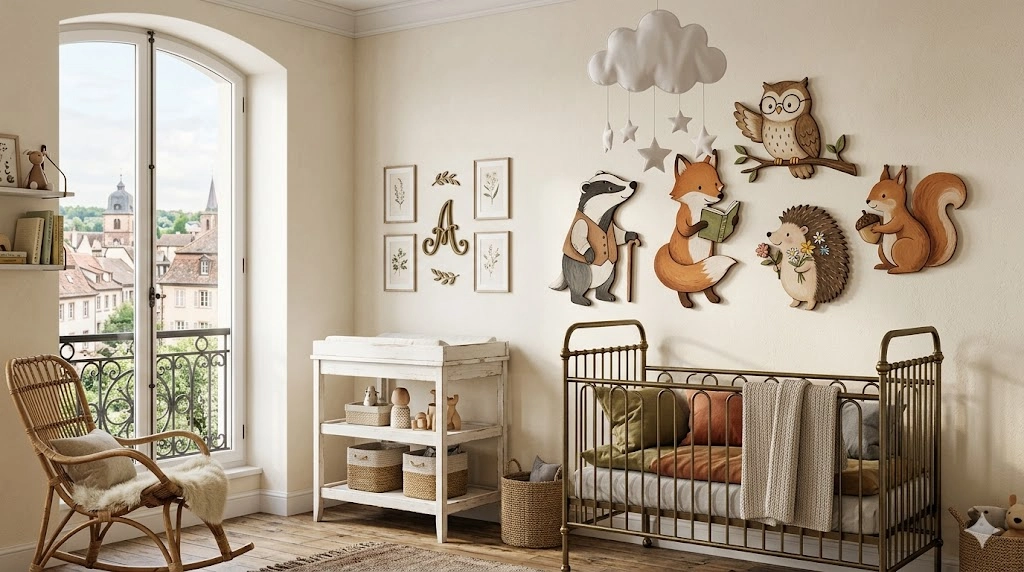
Animal-Themed Nursery Walls
Animal visuals are widely used for early recognition development.
Common motifs:
- Safari animals (elephant, lion, giraffe)
- Forest creatures (fox, deer, rabbit)
- Oceanic life (whale, turtle, fish)
Ideal placement:
- Crib background wall
- Reading zone
Minimalist Gallery Wall Concept
A gallery wall is used in modern European apartments to maintain structured visual storytelling.
Includes:
- Line art illustrations
- Alphabet typography
- Soft abstract shapes
Outcome:
- Controlled stimulation
- Visual order perception
Montessori Wall Design Approach
Montessori nursery walls are designed to support self-learning without overstimulation.
Key features:
- Real-world imagery
- Educational simplicity
- Low visual density
Principle: Learning occurs through calm exposure, not forced stimulation.
Nursery Wall Decor Materials in European Homes
Material selection is critical in nursery design because babies are highly sensitive to environmental textures.
Wooden Wall Panels
- Sustainable origin materials
- Warm natural aesthetics
- Scandinavian alignment
Textile Wall Hangings
- Macramé decor
- Acoustic softening
- Sensory comfort enhancement
Framed Minimal Art
- Monochrome or pastel illustrations
- Long-term visual stability
Peel-and-Stick Systems
- Rental-friendly solutions
- Safe temporary installation
Step-by-Step Wall Decor Nursery Room Design System
Step 1: Identify Focal Wall
Most effective walls:
- Behind crib
- Feeding chair background
- Entry-facing wall
Step 2: Choose ONE Design Identity
Avoid mixing multiple styles. Choose only one:
- Scandinavian minimalism
- Montessori learning system
- French aesthetic luxury
- Nature-based calm design
Step 3: Apply Visual Balance Rule
- 60% base tone (neutral foundation)
- 30% thematic decor
- 10% accent detail
Step 4: Safety Optimization
Avoid:
- Heavy frames above crib
- Glass materials
- Sharp-edge decor
- Overcrowded wall layouts
Step 5: Future-Proof Design Thinking
Nursery walls must evolve with child development stages.
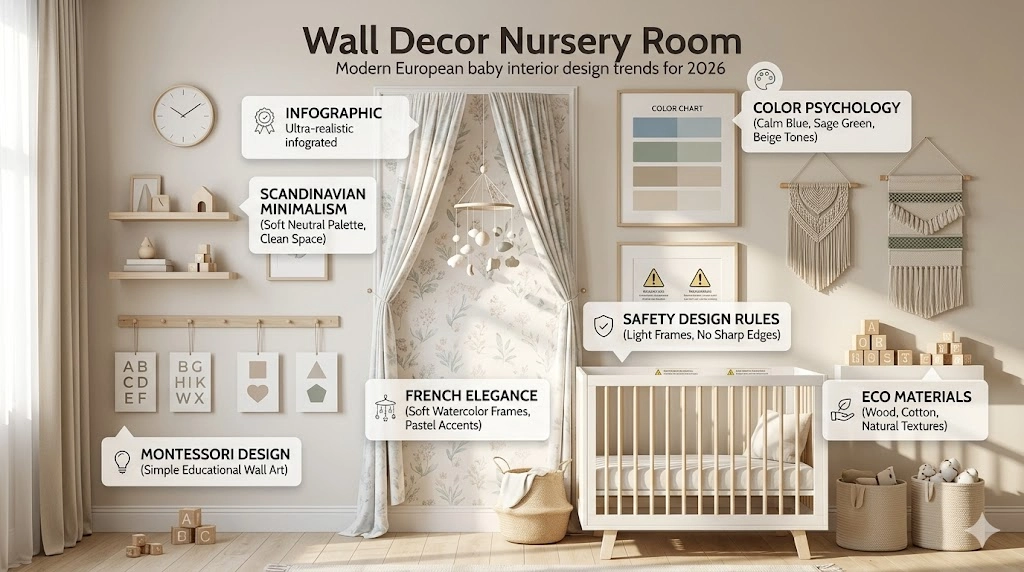
Color Psychology in European Nursery Wall Design
Soft Blue
- Emotional relaxation
- Sleep cycle stabilization
Sage Green
- Nervous system calming
- Natural harmony association
Beige & Cream
- Psychological safety
- Long-term neutrality
Dusty Pink
- Emotional softness
- Gentle nurturing atmosphere
European preference: Muted, desaturated, earthy tones dominate modern nursery palettes.
Common Mistakes in Nursery Wall Design
❌ Overdecorating all walls ❌ Mixing incompatible themes ❌ Using neon color systems ❌ Ignoring lighting interaction ❌ Lack of focal hierarchy
Core European rule: Less visual load = better emotional stability.
Nursery Wall Style Comparison
| Style | Complexity | Emotional Impact | Best Use |
| Scandinavian | Low | Calm | Modern homes |
| Montessori | Low | Focused | Learning environments |
| French Luxury | Medium | Warm elegance | Stylish interiors |
| Nature Theme | Medium | Relaxing | Sleep support |
| Animal Theme | Medium-High | Emotional bonding | Child engagement |
Pros and Cons
Advantages
- Enhances emotional development
- Supports sleep quality
- Improves cognitive stimulation balance
- Provides long-term aesthetic value
Limitations
- Requires careful planning
- Overdesign reduces effectiveness
- Safety compliance needed
- Trends evolve over time
Future Trends 2026 Europe
AI Personalized Nursery Art
Custom adaptive wall visuals based on developmental data
Sustainable Eco Materials
Organic paints, recycled wood, toxin-free textiles
Soft 3D Wall Surfaces
Light sensory texture integration
Biophilic Integration
Direct nature simulation in interiors
Interactive Learning Walls
Soft educational engagement systems
Expert Nursery Wall Framework
Step 1: Emotional Objective
Define desired emotional outcome (calm, safety, softness)
Step 2: Design Identity Selection
Commit to a single stylistic direction
Step 3: Hierarchical Wall Planning
Focal wall → secondary walls → accent elements
Step 4: Material Optimization
Use safe, sustainable materials only
Step 5: Growth Adaptability
Ensure design flexibility over time
FAQs
Minimalist, Montessori, and nature-based designs are most effective for emotional balance and cognitive comfort.
Soft tones such as sage green, beige, dusty pink, and light blue are preferred.
No. European design philosophy supports minimal focal wall strategies.
Yes, provided lightweight, secure, and non-glass materials are used.
A simplified educational visual system that avoids overstimulation.
Conclusion
The modern wall decor nursery room is an advanced fusion of psychology, architecture, and emotional intelligence.
European design systems emphasize:
- Minimalism
- Safety
- Emotional regulation
- Developmental harmony
The strongest nursery design is not the most decorative—it is the most emotionally intelligent and visually balanced environment.