Introduction
In 2026, interior design is moving toward intentional minimalism with emotional precision. One of the strongest visual systems leading this transformation in Europe is:
Black and white with color wall art
This is no longer a simple decoration idea. It is now a structured design language used in Scandinavian apartments, Parisian luxury homes, Milanese studios, and modern German architectural interiors.
It works because it combines two powerful visual forces:
- Monochrome structure (black & white)
- Controlled emotional color accents
Together, they create interiors that feel:
- Visually stable
- Emotionally expressive
- Architecturally balanced
- Professionally curated
But most online content fails because they treat this style as random decoration.
This guide fixes that.
You will learn a complete European design system that goes far beyond aesthetics and into:
- Visual psychology
- Color control theory
- Spatial composition systems
- Gallery wall engineering
- Room-based design logic
What Is Black and White With Color Wall Art?
Black and white with color wall art is a structured interior composition method where monochrome artwork forms the foundation, and selective colors are introduced as controlled focal points.
NLP-style definition:
It is a multi-layered visual contrast system combining grayscale imagery with intentional chromatic emphasis to direct attention, regulate emotional tone, and enhance spatial depth.
Simplified meaning:
You build a wall using black & white art, then strategically place limited color elements to guide the eye.
Core Principle:
“Color is not decoration. Color is direction.”
Why This Style Is Dominating European Interiors
Across Europe, this style is rapidly growing due to deep design shifts.
Minimalist Lifestyle Movement
Modern European homes prioritize:
- Reduced visual clutter
- Functional elegance
- Emotional calmness
- Architectural clarity
Black and white foundations support this perfectly because they remove distraction.
Emotional Design Balance Theory
Interior psychologists in Europe emphasize emotional regulation through the environment.
- Black = authority, grounding, depth
- White = clarity, openness, silence
- Color = emotional activation
This creates a balanced neuro-visual experience.
Multi-Room Adaptability
Unlike full-color wall systems, this approach adapts to:
- Bedrooms
- Offices
- Living rooms
- Hallways
- Studio apartments
It scales without losing coherence.
Psychological Framework Behind This Style
Understanding psychology is essential for mastery.
Visual Hierarchy Rule
Human vision follows this order:
- Color (first attention trigger)
- Contrast (structural recognition)
- Shape (detail processing)
So in a monochrome environment, even a small color element becomes a dominant focal anchor.
Emotional Coding of Black & White
- Black → power, sophistication, depth, grounding
- White → purity, silence, expansion, balance
Together they form visual neutrality with emotional stability.
Emotional Coding of Colors
| Color | Psychological Response |
| Red | energy, urgency, passion |
| Blue | trust, calm, intelligence |
| Green | restoration, nature, balance |
| Gold | luxury, warmth, prestige |
| Yellow | optimism, creativity |
European Color Accent Strategy
This is the most important part of the entire design method.
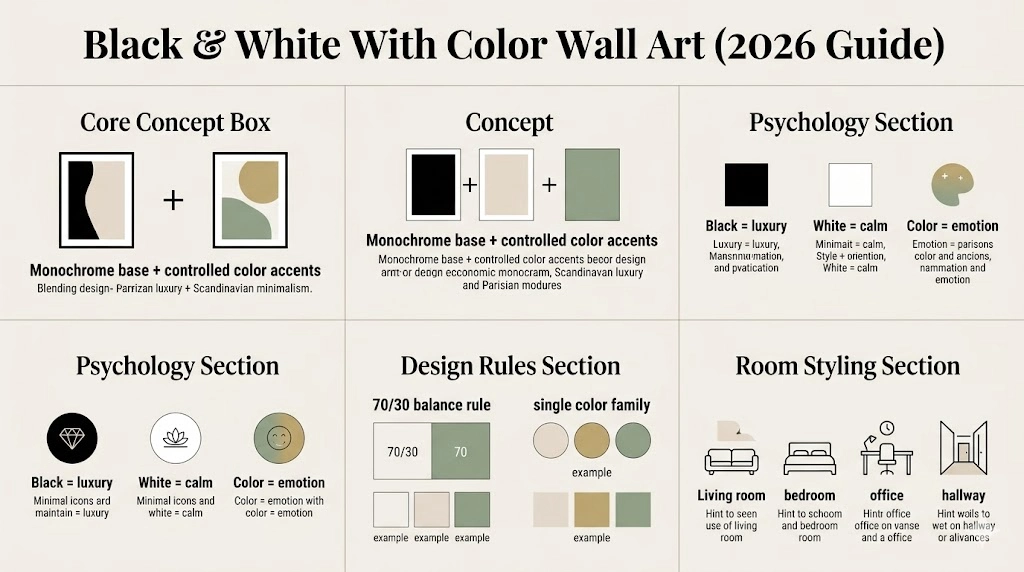
1: Color Family Selection System
Never randomly choose colors.
European rule system:
- Warm palette → Mediterranean & French interiors
- Cool palette → Scandinavian minimalism
- Earth palette → rustic modern European homes
Critical rule:
Use only ONE dominant color family per room.
Mixing families destroys visual coherence.
2: The 70/30 Structural Balance Rule
70% black and white base+30% color accents70\%\ \text{black and white base} + 30\%\ \text{color accents}70% black and white base+30% color accents
Meaning:
- 70% = monochrome foundation (structure, walls, art base)
- 30% = controlled color presence (emotion, focus, highlights)
If broken:
- Visual overload
- Loss of luxury perception
- Cognitive clutter
- Reduced aesthetic value
3: Color Placement Engineering
Color is not random. It follows spatial hierarchy.
Correct placement logic:
- Center artwork → strongest emotional color
- Side frames → supporting tones
- Lower zone → minimal accents
This creates a visual spotlight system.
Complete Design Blueprint
1: Establish Monochrome Foundation
Choose:
- Architectural photography
- Black ink abstract art
- Minimal portraits
- Urban street compositions
Goal:
Create emotional neutrality and spatial calmness.
2: Introduce Controlled Color Layer
Rules:
- Maximum 1–2 colors only
- Repeat colors across frames
- Avoid random distribution
3: Gallery Wall Engineering
| Wall Size | Recommended Layout |
| Small | 1–2 hero pieces |
| Medium | 3–5 structured frames |
| Large | grid or asymmetrical system |
4: Spacing Logic
- 5–10 cm spacing → modern European balance
- Equal spacing → minimalism
- Asymmetry → artistic expression
Room-by-Room European Styling System
Living Room
Design strategy:
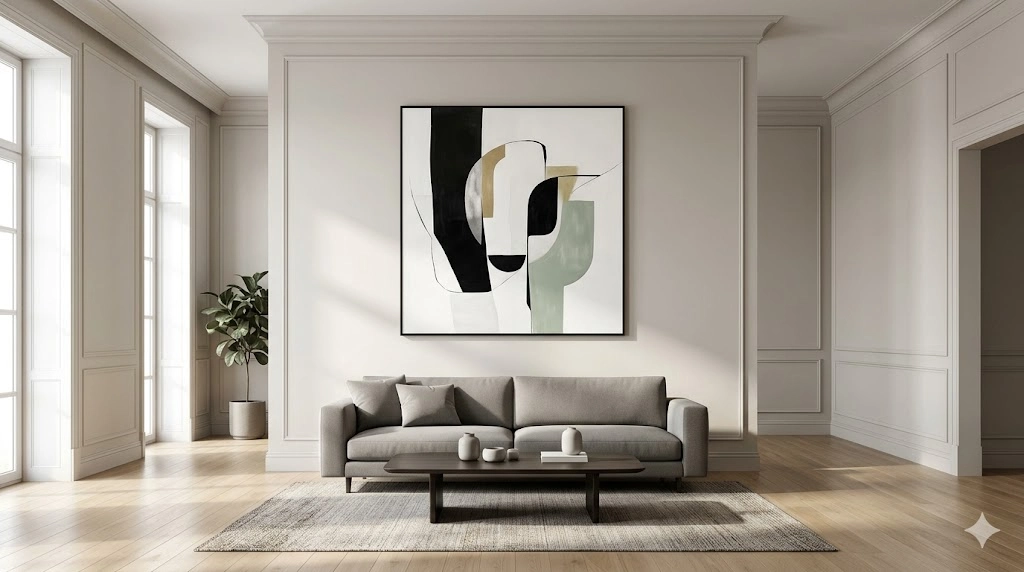
- Large monochrome centerpiece
- One bold accent color
- Neutral furniture palette
Goal:
Immediate visual authority + luxury impression
Bedroom
- Soft black & white imagery
- Muted tones (sage, blush, mist blue)
- Low contrast environment
Goal:
Relaxation and nervous system calm
Office
- Structured grid layout
- Minimal color interference
- Strong symmetry
Goal:
Focus, discipline, cognitive clarity
Hallway
- Thin monochrome frames
- Subtle color continuity
- Linear flow design
Goal:
Smooth psychological transition between rooms
European Design Influence System
Scandinavian Design Logic
- Soft minimalism
- Light dominance
- Natural textures
- Functional simplicity
French Interior Logic
- Elegant contrast
- Luxury restraint
- Gold accents
- Artistic framing
Italian Interior Logic
- Emotional color expression
- Artistic boldness
- Sculptural aesthetics
German Design Logic
- Precision structure
- Functional clarity
- Mathematical spacing systems
Advanced Style Comparison
| Style Type | Emotional Impact | Complexity | Use Case |
| Monochrome only | calm | easy | minimal homes |
| Full color walls | energetic | medium | creative spaces |
| Black + color system | balanced luxury | advanced | modern European interiors |
Common Mistakes
Most people fail because they:
- Overuse multiple colors
- Ignore focal hierarchy
- Break spatial proportions
- Mix warm + cool randomly
- Add too many frames
Result:
Loss of visual authority and luxury feel.
Expert-Level Designer Techniques
Professional European designers use these methods:
- Repeat one accent color across entire wall system
- Leave intentional negative space
- Use oversized anchor artwork
- Always define a “hero piece”
- Match wall art tones with furniture undertones
Deep NLP Design Interpretation Layer
From a cognitive design perspective, this system works because it optimizes:
- Attention distribution
- Emotional load balancing
- Visual memory anchoring
- Environmental coherence
It essentially converts a wall into a structured emotional interface.
FAQ
It combines monochrome structure with controlled color accents, producing a balanced emotional and visual system.
Muted gold, sage green, deep blue, and soft terracotta perform best in European interior systems.
No. It is recommended to use only 1–2 controlled colors to maintain visual harmony.
Yes, but use fewer frames, lighter tones, and stronger negative space.
Conclusion
Black and white with color wall art is not decoration.
It is a European interior design intelligence system built on:
- Visual psychology
- Controlled contrast
- Emotional engineering
- Spatial hierarchy
When applied correctly, it transforms ordinary walls into high-end architectural visual experiences.
The real secret of European design is not adding more color —
it is controlling color with precision.