Introduction
In the contemporary landscape of interior architecture and environmental psychology, Tree Wall Art Decals have evolved far beyond simple decorative accessories. They now function as expressive visual elements that influence emotional balance, spatial perception, and lifestyle identity within residential environments.
Across Europe—ranging from compact urban apartments in Germany, artistic residential spaces in France, to minimalist Scandinavian interiors—homeowners are increasingly integrating tree-themed wall decals as a strategic design intervention. This shift reflects a deeper cultural movement toward nature-connected living, where artificial environments are softened with organic visual cues.
In 2026, this design trend is accelerating due to multiple socio-aesthetic drivers:
- Rising demand for calm, emotionally balanced living environments
- Strong adoption of biophilic design principles (nature-integrated interiors)
- Cost-efficient alternatives to traditional wall renovation
- Rental-friendly, non-permanent decorative solutions
- Increasing awareness of mental wellness through environmental design
From an NLP (Natural Language Processing) perspective, the semantic clustering of terms such as calmness, relaxation, nature immersion, visual harmony, and spatial enhancement consistently aligns with user intent behind this décor category.
This comprehensive European design guide explores every critical dimension of tree wall art decals—including psychological impact, regional design variations, installation methodology, common errors, future innovations, and frequently asked questions.
What Are Tree Wall Art Decals?
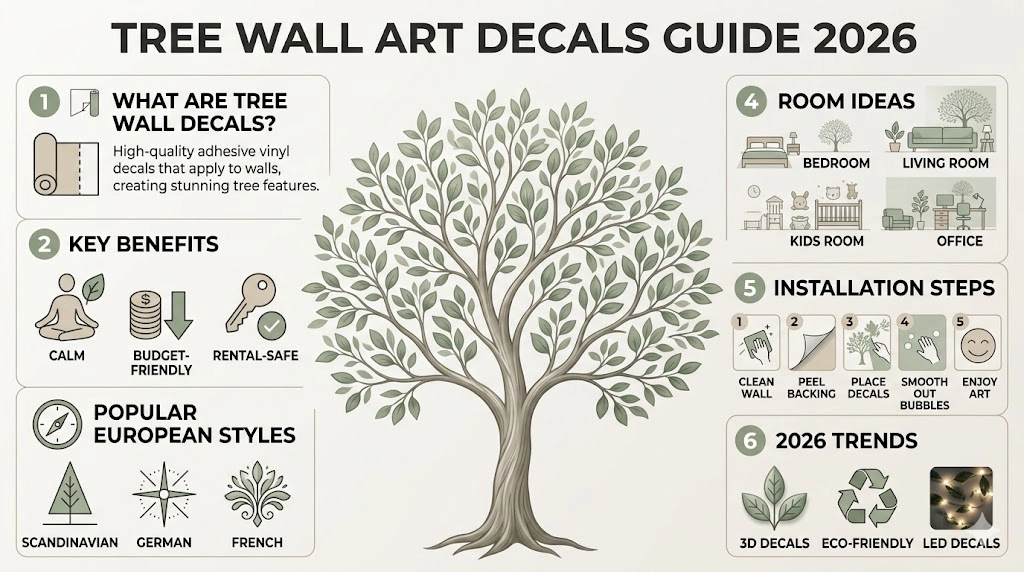
Tree wall art decals are adhesive-based decorative vinyl artworks designed in the form of trees, branches, leaves, forests, and botanical silhouettes. These elements are engineered for direct application onto interior wall surfaces without requiring permanent modifications or structural changes.
From a material science perspective, these decals are typically manufactured using high-grade PVC or eco-vinyl compounds, ensuring durability, flexibility, and surface compatibility.
Key Features
- Peel-and-stick installation system requiring no professional tools
- Non-invasive removal process that preserves wall integrity
- Wide spectrum of aesthetic variations (minimalist, abstract, realistic)
- Scalable dimensions adaptable to both small and large spaces
- Compatibility with modern interior surfaces such as plastered or painted walls
- Lightweight composition enabling easy repositioning in premium variants
Functional Placement Areas
Tree wall decals are highly versatile and can be integrated across multiple spatial contexts:
- Bedrooms (behind headboards for visual anchoring)
- Living rooms (feature wall focal enhancement)
- Children’s rooms (creative storytelling environments)
- Home offices (attention stabilization and cognitive support)
- Hallways and staircases (vertical spatial expansion effect)
The primary advantage lies in instant aesthetic transformation without structural renovation cost or long-term commitment.
Design Psychology Behind Tree Wall Art Decals
The widespread adoption of tree wall art decals is strongly rooted in environmental psychology, cognitive response theory, and biophilic design frameworks.
Biophilic Design Integration
Biophilia refers to the inherent human tendency to connect with nature. When natural visual patterns are introduced into built environments, measurable psychological responses occur.
Cognitive and Emotional Benefits:
- Reduction in perceived stress levels
- Enhancement of emotional stability and calmness
- Improved cognitive concentration and task performance
- Increased sensory comfort and environmental satisfaction
- Strengthened perception of spatial relaxation and safety
From an NLP semantic analysis perspective, these decals consistently activate associative mental models such as forest imagery, organic flow, natural balance, and visual tranquility.
Why Europe Strongly Adopts This Trend
European interior design philosophy is historically grounded in:
- Minimalist spatial efficiency
- Natural material integration
- Functional aesthetic balance
- Emotional subtlety in design language
This alignment makes tree wall decals a culturally coherent design solution across European households.
European Interior Styles Using Tree Wall Art Decals
Different European regions apply tree wall art decals through distinct stylistic interpretations.
Scandinavian Minimalism
Scandinavian interiors emphasize simplicity and spatial clarity.
- Neutral backgrounds (white, beige, soft grey)
- Black or muted tree silhouettes
- Clean geometric composition
Psychological output: serenity, airiness, mental clarity
German Functional Aesthetic
German design prioritizes structure and order.
- Symmetrical tree placements
- Monochrome tonal consistency
- Precise alignment and spacing
Psychological output: discipline, efficiency, balance
French Artistic Elegance
French interiors favor expressive storytelling.
- Decorative tree illustrations with artistic curves
- Gold, pastel, and soft tonal gradients
- Ornamented visual layering
Psychological output: luxury, creativity, emotional depth
UK Rental-Oriented Design
UK urban housing strongly integrates flexible décor solutions.
- Removable peel-and-stick formats
- Accent wall implementation
- Modular repositioning capability
Psychological output: adaptability, modern practicality
Room-by-Room Tree Wall Art Decals Ideas
Bedroom Applications
The bedroom is a primary zone for emotional restoration.
- Tree visuals positioned behind the bed create a natural headboard illusion
- Branch extensions simulate organic canopy coverage
- Soft visual flow enhances sleep-related relaxation cycles
Living Room Applications
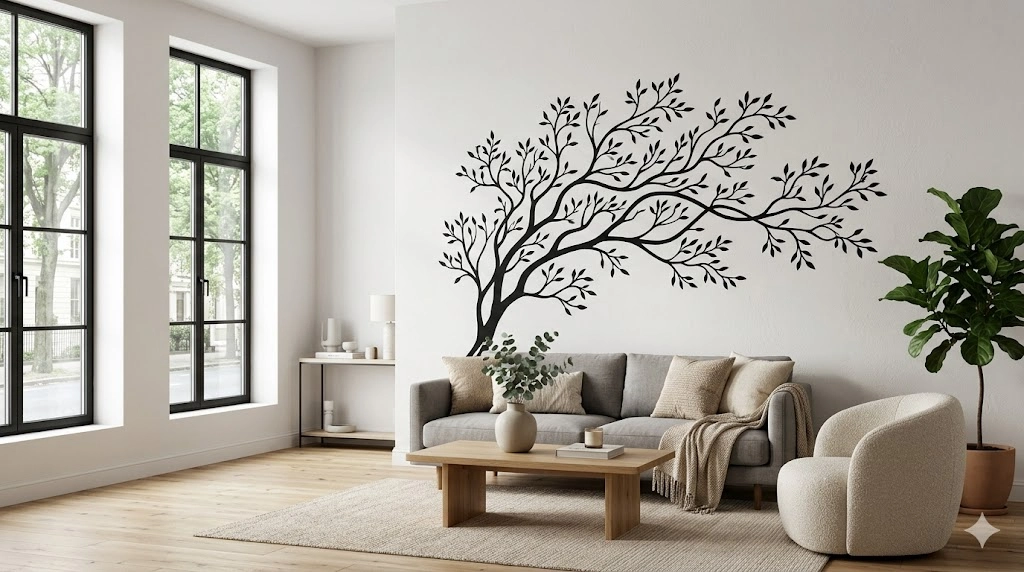
- Large-scale tree murals act as focal architectural elements
- Depth illusion enhances perceived room dimensions
- Creates a natural conversation centerpiece
Kids Room Applications
- Forest-inspired storytelling environments
- Integration with animal-themed visual elements
- Encourages imagination and cognitive development
Home Office Applications
- Minimal branch compositions reduce visual fatigue
- Supports sustained attention and productivity
- Improves screen-related cognitive balance
Hallway Applications
- Vertical tree expansion increases perceived ceiling height
- Enhances transitional spatial continuity
Step-by-Step Application Guide
Proper installation is essential for optimal durability and visual precision.
Installation Workflow
- Clean the wall surface thoroughly to eliminate dust and oil residues
- Measure spatial dimensions to ensure proportional alignment
- Mark guiding reference points for structural accuracy
- Carefully peel backing layer to avoid material distortion
- Apply from top to bottom to prevent trapped air pockets
- Smooth surface using flat tool for adhesion consistency
- Perform final inspection for alignment and finish quality
Optimization Tips
- Use only smooth, non-textured surfaces
- Avoid humid or damp wall environments
- Pre-plan composition layout before application
Common Mistakes & Fixes
Mistake 1: Incorrect Surface Selection
Fix: Always ensure clean, smooth, painted surfaces
Mistake 2: Misalignment During Installation
Fix: Use measurement tools and level indicators
Mistake 3: Low-Quality Material Selection
Fix: Choose premium vinyl-grade decals
Mistake 4: Oversized Design Misfit
Fix: Match decal scale with room proportions
Types of Tree Wall Art Decals Comparison
| Type | Style | Best Use | Visual Impact |
| Vinyl Flat | Minimalist | Bedrooms | Soft aesthetic |
| 3D Layered | Dimensional | Living Rooms | High visual depth |
| Watercolor | Artistic | French interiors | Elegant expression |
| Black Silhouette | Bold contrast | Scandinavian homes | Modern clarity |
| Forest Panels | Detailed ecosystem | Large walls | Immersive effect |
Pros and Cons
Advantages
- Fast installation without renovation
- Wall-safe removal system
- Affordable interior transformation
- Suitable for rental properties
- Wide aesthetic flexibility
Disadvantages
- Limited compatibility with textured walls
- Low-quality versions may fade over time
- Unsuitable for high-moisture environments
- Requires precision during application
2026 Future Trends in Tree Wall Art Decals
The evolution of tree wall art decals is transitioning toward technologically enhanced and environmentally conscious design systems.
Emerging Innovations
- 3D layered botanical wall ecosystems
- Eco-sustainable biodegradable materials
- AI-generated natural pattern design systems
- LED-integrated glowing tree installations
- Shadow-reactive dynamic visual effects
The Future paradigm shifts from static decoration to interactive environmental storytelling systems.
FAQs
Yes, high-quality decals are removable and safe for painted walls.
They work best on smooth surfaces.
Usually 3–7 years depending on quality.
Most are single-use, but premium types allow repositioning.
Yes, they are perfect for rented apartments.
Conclusion
Tree wall art decals represent a convergence of aesthetics, psychology, and functional interior design. They are not merely decorative objects but rather environmental enhancers that shape emotional experience within living spaces.
Across Europe, from Scandinavian simplicity to French artistic richness and German structural precision, these decals adapt seamlessly to diverse cultural design languages.
In 2026 and beyond, this movement reflects a deeper transformation in interior design philosophy—where homes are no longer static spaces, but emotionally intelligent environments that integrate nature, wellness, and visual harmony.