Introduction
Entryway wall decor has evolved far beyond its traditional role as a simple decorative afterthought. In 2026, especially within contemporary European interior architecture, the entryway is recognized as a high-impact psychological and aesthetic transition zone that sets the tone for the entire residential experience.
When a person steps into a home, the entryway becomes the first visual narrative, silently communicating the identity, taste, and emotional atmosphere of the space. Across design-forward cities such as Paris, Milan, Berlin, Amsterdam, and Copenhagen, homeowners are now prioritizing intentional spatial composition over excessive ornamentation.
Modern entryway wall decor delivers several transformative effects:
- It enhances perceived spatial volume
- It strengthens first-impression aesthetics
- It reduces visual noise and clutter
- It improves light distribution and reflection
- It immediately establishes interior mood and identity
Unlike outdated decorative approaches, modern European design philosophy operates under a refined principle:
“Minimal elements, maximum intentionality.”
This guide provides a comprehensive breakdown of entryway wall decor systems, materials, layouts, and design logic used in 2026 European interiors.
Why Entryway Wall Decor Is So Important in Modern Homes
The entryway functions as more than a passage—it is a psychological threshold interface between exterior and interior environments.
It marks the cognitive transition from:
- External environment → Private sanctuary
- Mental tension → Emotional comfort
- Visual chaos → Structured calmness
Functional Roles of Entryway Wall Decor
Modern entryway wall design contributes to:
- Establishing immediate visual identity
- Increasing spatial organization perception
- Amplifying room brightness and openness
- Enhancing architectural coherence
- Creating emotional grounding upon entry
In interior psychology, this transitional area is often referred to as the:
“Threshold Zone”
Designers treat it as a micro-architecture moment, not merely a decorative surface. It functions as a spatial introduction sequence that frames how the entire home will be perceived.
European Entryway Wall Design Philosophy 2026
Modern European interiors are grounded in clarity, restraint, material honesty, and spatial intelligence. Instead of overloading surfaces with decorative objects, designers prioritize structured simplicity and material authenticity.
Core Principles of European Entryway Design
1. Minimalism with Purpose
Every element must justify its existence through either function or emotional value.
2. Functional Aesthetic Integration
Decorative components are simultaneously functional—no purely ornamental clutter.
3. Natural Material Dominance
Key materials include:
- Solid wood
- Natural stone
- Mineral plaster
- Brushed metal
4. Vertical Spatial Optimization
Entryway walls are designed vertically to maximize narrow hallway efficiency.
5. Soft Luxury Expression
Luxury is expressed subtly through texture, proportion, and light—not excess decoration.
European Style Influences
- ???????? Scandinavian Design → Bright minimalism, warmth, simplicity
- ???????? French Modern Style → Soft elegance, symmetry, refinement
- ???????? Italian Contemporary Design → Artistic boldness, material richness
- ???????? German Minimalism → Precision, structure, efficiency
- ???????? Dutch Functional Style → Intelligent storage integration
These combined influences define modern European entryway aesthetics in 2026.
Mirror-Based Entryway Wall Design Systems
Mirrors are among the most powerful architectural tools in entryway composition. Their function extends beyond decoration into spatial transformation engineering.
Why Mirrors Matter
- Visually expand compact spaces
- Multiply natural and artificial light
- Reduce corridor compression effects
- Introduce instant elegance and clarity
- Enhance perceived depth and openness
Popular Mirror Typologies
- Full-height vertical mirrors (space extension effect)
- Circular minimal frame mirrors (soft modern aesthetic)
- Modular grid mirror systems (structured geometry)
- Organic asymmetrical sculptural mirrors (artistic expression)
Design Insight
In advanced European spatial psychology, mirrors are considered:
“Perceptual amplifiers of architecture rather than decorative objects.”
They actively reconfigure how space is cognitively interpreted.
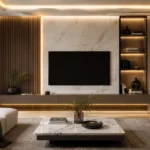
Wood Panel Entryway Wall Decor
Wood has become a dominant expressive material in modern entryway architecture due to its dual ability to introduce warmth and structural order simultaneously.
Popular Wood Wall Systems
- Vertical slatted wood panel systems
- Scandinavian light oak wall cladding
- Dark walnut luxury feature panels
- Hybrid wood-stone composite surfaces
Functional Benefits
- Enhances acoustic comfort
- Introduces natural warmth
- Adds architectural layering
- Improves tactile depth perception
Design Rationale
Wood transforms plain structural walls into intentional architectural surfaces, especially effective in compact urban apartments.
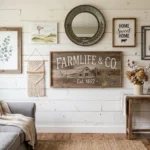
Gallery Wall Entryway Styling
Gallery walls remain relevant but have undergone a methodological transformation toward structured minimalism.
Outdated Gallery Wall Mistakes
- Excessive frame density
- Random spatial arrangement
- Mixed thematic inconsistency
- Visual overload without hierarchy
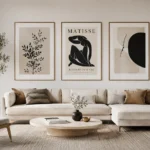
Contemporary European Approach
- Reduced frame quantity
- Precise spatial alignment
- Neutral tonal palettes
- Grid-based compositional order
Preferred Artistic Themes
- Monochrome photography
- Abstract European modern art
- Architectural conceptual prints
- Minimalist line compositions
Entryway Feature Wall Design
Feature walls act as spatial anchors that define the entryway’s visual identity.
Common Material Systems
- Textured mineral plaster finishes
- Natural stone cladding surfaces
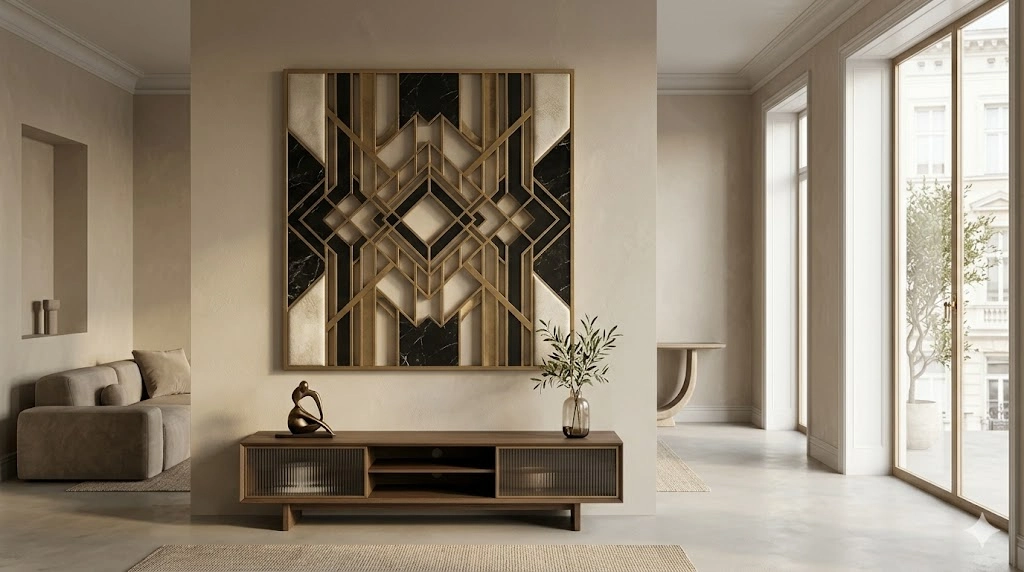
- Geometric wall molding structures
- Matte pigment accent coatings
Functional Importance
Feature walls introduce a visual pause point, allowing the brain to interpret spatial hierarchy and orientation upon entry.
Biophilic Entryway Wall Decor
Biophilic design integrates natural elements into interior architecture to improve emotional and cognitive wellbeing.
Components
- Vertical living plant walls
- Hanging botanical arrangements
- Raw stone texture integration
- Wood-green hybrid compositions
Psychological Benefits
- Reduces cognitive stress load
- Enhances emotional stability
- Improves perceived freshness
- Strengthens indoor-outdoor connection
Lighting as Entryway Wall Decor
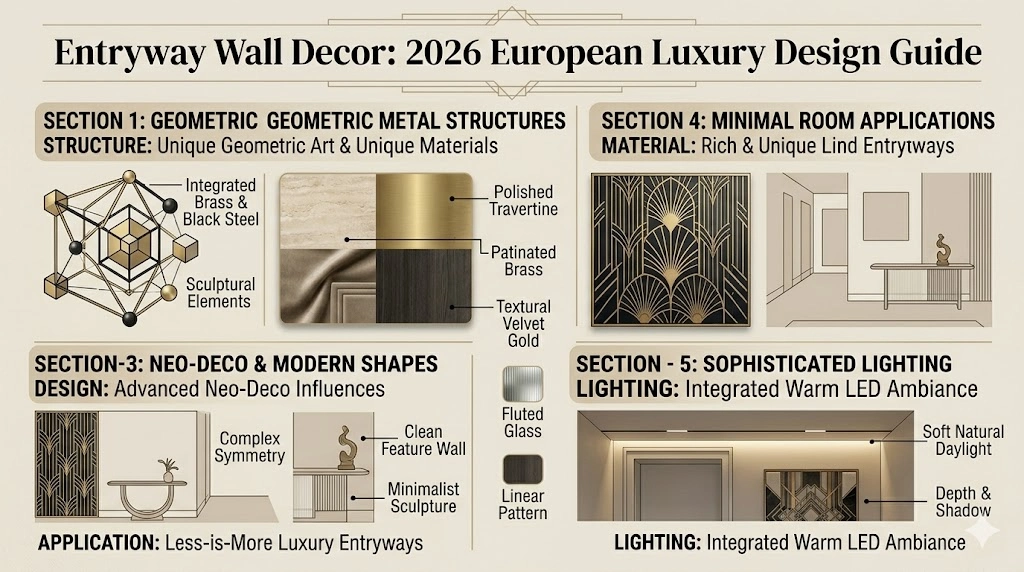
Lighting is no longer external to design—it is an integrated architectural material.
Modern Lighting Systems
- Wall-mounted sculptural sconces
- Concealed LED strip systems
- Indirect wall wash illumination
- Artistic ambient light installations
Design Principle
Lighting must not only illuminate surfaces—it must sculpt emotional perception and spatial depth.
Small Entryway Wall Solutions
Due to compact urban housing across Europe, entryway optimization is essential.
Efficient Space Strategies
- Vertical mirror expansion systems
- Floating modular shelves
- Slim profile wall hooks
- Narrow console integration units
Core Design Rule
Every installed element must simultaneously serve:
Functional utility + visual contribution
Luxury Entryway Wall Decor
Luxury in modern design is defined not by abundance but by refined restraint and material purity.
Premium Material Selection
- Polished marble accents
- Brushed brass detailing
- Deep walnut timber surfaces
- Matte natural stone panels
Luxury Design Principle
True luxury is achieved through:
Spatial calmness + material authenticity + visual clarity
Design Comparison Tables
European Style Comparison
| Style | Key Features | Best For | Effect |
| Minimalist | Neutral simplicity | Compact homes | Open clarity |
| Scandinavian | Light wood tones | Family spaces | Warm openness |
| Luxury Modern | Marble + brass | Villas | Elegant richness |
| Industrial | Concrete + metal | Lofts | Raw urban character |
| French Modern | Soft symmetry | Apartments | Refined elegance |
Small vs Large Entryway Strategy
| Element | Small Entryway | Large Entryway |
| Mirrors | Essential | Optional |
| Furniture | Minimal | Flexible |
| Lighting | Bright layering | Mood-based zoning |
| Decor | Highly selective | Moderately expressive |
Step-by-Step Entryway Wall Design System 2026
1: Spatial Analysis
Evaluate dimensions, light sources, and architectural constraints.
2: Design Direction Selection
Define stylistic direction: minimalist, luxury, Scandinavian, or hybrid European.
3: Functional Definition
Determine whether the wall is:
- Functional
- Decorative
- Hybrid system
4: Primary Feature Selection
Choose ONE dominant anchor element:
- Mirror
- Wood panel system
- Gallery composition
- Feature wall
5: Supporting Elements Integration
Add complementary components such as:
- Lighting
- Hooks
- Shelving systems
- Botanical accents
6: Visual Balance Optimization
Ensure proportion, alignment, and material harmony.
Common Mistakes in Entryway Wall Decor
Avoid the following design inefficiencies:
- Over-decorating the wall surface
- Mixing incompatible material languages
- Improper mirror scaling
- Insufficient lighting planning
- Lack of vertical alignment structure
Entryway Wall Decor Trends in Europe 2026
- Integrated built-in wall systems
- Dominance of organic natural materials
- Hidden architectural lighting solutions
- Ultra-minimal luxury aesthetics
- Smart storage wall integration
- Art-as-structure conceptual design
Pros & Cons
Advantages
- Enhances first impression quality
- Improves spatial organization
- Increases perceived room size
- Strengthens interior identity
Limitations
- Requires thoughtful planning
- Premium materials increase cost
- Poor execution leads to imbalance
FAQs
Mirrors, floating shelves, and vertical storage systems are the most effective solutions for compact entry spaces.
Use natural materials such as wood and stone combined with soft layered lighting for a refined aesthetic.
Neutral palettes such as beige, warm white, soft gray, and natural wood tones dominate modern interiors.
Yes, but they must follow structured minimal composition principles with controlled spacing.
Maintain equilibrium between functionality and visual simplicity.
Conclusion
Entryway wall decor in 2026 is no longer decorative excess—it is a systematic architectural discipline rooted in European design intelligence.
Modern interiors prioritize:
- Structural clarity
- Natural material expression
- Soft luxury aesthetics
- Functional spatial design
Whether small or large, every entryway should achieve one essential goal:
To create a calm, intentional, and emotionally coherent arrival experience.
A well-designed entryway wall is not just interior decoration—it is the identity gateway of the home.