Introduction
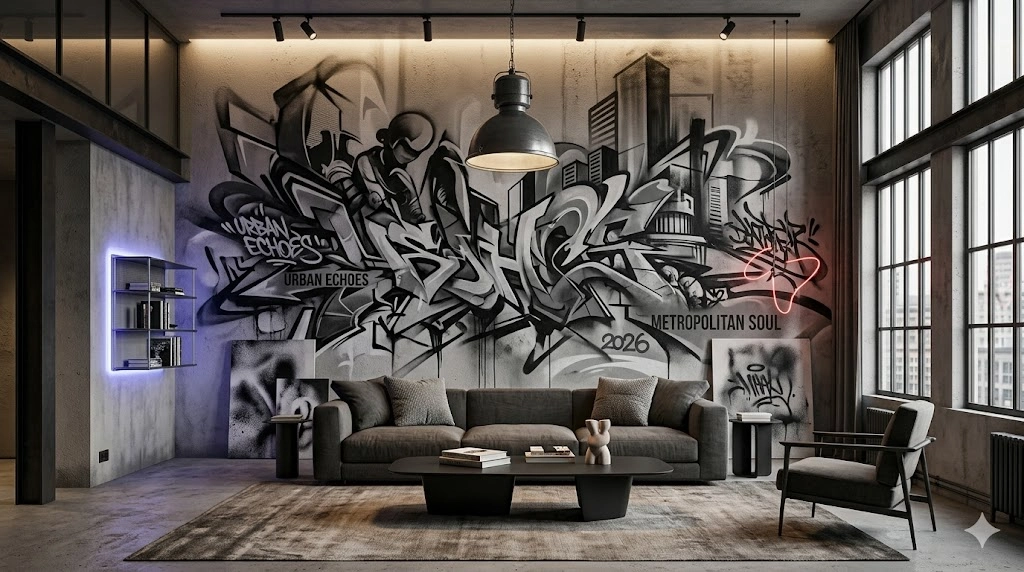
Graffiti wall art is no longer viewed as purely underground street expression. In 2026, it has transformed into one of the most influential visual concepts in contemporary European interior styling. From artistic Berlin loft apartments to elegant Milan penthouses, graffiti-inspired interiors now symbolize individuality, movement, texture, imagination, and architectural storytelling.
Modern interior environments are evolving rapidly. Homeowners no longer desire spaces that appear sterile, lifeless, or excessively polished. Instead, people across Europe increasingly prefer interiors that feel expressive, emotional, artistic, and unforgettable. This dramatic design shift explains why graffiti wall art is becoming dominant in modern residential and commercial spaces.
Unlike traditional decorative wall pieces, graffiti introduces:
- Bold visual movement
- Layered artistic texture
- Urban refinement
- Emotional intensity
- Creative atmosphere
- Architectural personality
Today’s premium interiors blend minimalist architecture with expressive artistic surfaces. Instead of treating wall décor as a secondary accessory, designers now integrate graffiti directly into the visual identity of the entire room.
In this complete pillar guide, you will discover:
- The psychology behind graffiti-inspired interiors
- Modern European urban luxury trends
- The best graffiti wall art styles in 2026
- Room-by-room design systems
- Graffiti wall positioning techniques
- Lighting and material strategies
- Luxury urban styling principles
- Common decorating mistakes to avoid
- Future trends shaping modern graffiti interiors
Whether you are designing a luxury apartment, gaming setup, modern office, creative café, industrial loft, or music studio, this guide will help you understand how graffiti wall art can function as a complete interior design language rather than simple ornamentation.
Why Graffiti Wall Art Is Dominating European Interiors in 2026
Modern European interiors are increasingly moving toward identity-driven design. Homeowners no longer want spaces that appear generic or copied from furniture catalogs. Instead, they seek environments that feel personal, imaginative, and emotionally engaging.
This transformation is one of the primary reasons graffiti wall art has become extraordinarily popular.
Cities such as Berlin, Milan, Amsterdam, and Paris are leading this urban luxury movement by blending industrial architecture with contemporary street-inspired aesthetics.
Modern graffiti interiors create spaces that feel:
- Dynamic
- Artistic
- Sophisticated
- Energetic
- Emotionally immersive
Instead of empty minimalism, designers now prioritize visual storytelling and experiential design.
The Shift From Decoration to Identity-Based Design
Traditional wall décor usually focuses only on appearance. Graffiti interiors focus on personality, individuality, and emotional identity.
Modern homeowners increasingly use graffiti-inspired interiors to express:
- Creativity
- Freedom
- Urban sophistication
- Contemporary lifestyle values
- Artistic uniqueness
Today, graffiti is frequently incorporated directly into architectural structures rather than added later as decorative accessories.
This creates environments that feel immersive, authentic, and visually memorable.
Why Urban Art Creates Emotional Energy
One of the strongest reasons graffiti wall art feels impactful is movement.
Graffiti naturally introduces:
- Sharp typography
- Spray-painted textures
- Layered pigment effects
- Abstract rhythm
- High-contrast visuals
These elements generate visual stimulation and emotional excitement.
That is why graffiti aesthetics work exceptionally well in:
- Creative workspaces
- Gaming rooms
- Urban cafés
- Modern lofts
- Music studios
- Start-up offices
The environment immediately feels more alive and expressive.
The Rise of Luxury Street Aesthetics
Luxury design in 2026 is no longer defined only by marble, gold detailing, or traditional symmetry.
Modern luxury embraces contrast and artistic individuality.
| Traditional Luxury | Urban Luxury Alternative |
| Perfect symmetry | Controlled artistic disorder |
| Neutral minimalism | Expressive visual movement |
| Decorative elegance | Architectural personality |
| Smooth surfaces | Texture-rich walls |
| Quiet interiors | Emotional storytelling |
This fusion creates what designers now describe as European urban luxury interiors.
What Is Graffiti Wall Art?
Graffiti wall art refers to artistic wall compositions inspired by urban culture, spray-paint aesthetics, abstract murals, street typography, and contemporary creative expression.
Modern graffiti interiors are far more sophisticated than traditional street tagging.
Today’s most influential styles include:
- Minimal monochrome murals
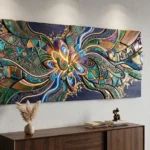
- Luxury abstract graffiti
- Industrial wall compositions
- Textured spray-paint finishes
- Contemporary typography artwork
- Mixed-media urban murals
Modern designers reinterpret graffiti as architectural texture instead of vandalism.
Traditional Graffiti vs Contemporary Interior Graffiti
| Traditional Graffiti | Contemporary Graffiti Interiors |
| Street-focused | Interior-focused |
| Raw rebellion | Refined artistic expression |
| Public walls | Residential & commercial interiors |
| High visual chaos | Controlled composition |
| Spray-paint dominant | Mixed materials and textures |
| Underground culture | Luxury urban aesthetics |
Modern interiors now use graffiti to establish atmosphere, identity, and emotional richness.
Street Art vs Graffiti Art
Many people confuse street art with graffiti art, yet they are distinct categories.
Graffiti Art
- Typography-focused
- Spray-paint aesthetics
- Urban lettering and tags
- Energy-driven compositions
Street Art
- Broader storytelling
- Illustrations and murals
- Political or cultural themes
- Figurative imagery
Modern luxury interiors frequently combine both approaches together.
Why Designers Use Graffiti as Architectural Texture
Today’s interiors strongly emphasize:
- Texture
- Layering
- Shadow interaction
- Spatial rhythm
- Visual hierarchy
Graffiti naturally introduces all these elements.
Instead of appearing as separate decorative objects, murals become integrated into the architecture itself.
This is one of the largest interior design trends of 2026.
The Psychology of Graffiti Wall Art in Interior Design
Interior psychology is becoming increasingly important in modern European homes.
Designers now recognize that walls dramatically influence the emotional atmosphere.
Because graffiti uses bold visual language, it creates a strong emotional impact inside a space.
Bold Typography & Visual Stimulation
Large-scale urban typography creates cognitive energy and immediately captures attention.
This works especially well in:
- Creative studios
- Gaming setups
- Youth-focused interiors
- Contemporary cafés
- Home offices
Typography naturally forms focal points within a room.
Color Contrast and Emotional Impact
Graffiti interiors often use dramatic color contrast such as:
- Black versus white
- Neon against matte neutrals
- Warm spray textures beside cool concrete
This contrast creates emotional tension, vibrancy, and excitement.
Emotional Effects of Common Graffiti Colors
| Color | Psychological Effect |
| Black | Sophistication and intensity |
| White | Clarity and openness |
| Red | Energy and movement |
| Blue | Creativity and calm balance |
| Neon accents | Youthful stimulation |
| Gray | Industrial modernity |
Movement, Energy, and Spatial Dynamics
Graffiti compositions feel alive because they rely on asymmetry and directional movement.
This creates:
- Dynamic spatial flow
- Architectural rhythm
- Layered storytelling
- Strong visual intensity
It can also make rooms feel larger and more immersive.
Why Graffiti Makes Spaces Feel More Creative
Creative environments benefit from visual unpredictability.
Modern workplace studies increasingly suggest that artistic stimulation may improve:
- Creative thinking
- Emotional engagement
- Environmental identity
- Motivation in artistic professions
That is why graffiti-inspired interiors are becoming increasingly popular in:
- Design studios
- Music rooms
- Gaming spaces
- Start-up offices
- Creative agencies
Top Graffiti Wall Art Styles in 2026
Graffiti interiors are evolving rapidly. The newest movements focus more on luxury restraint than chaotic overload.
Minimalist Graffiti
Minimalist graffiti combines:
- Neutral backdrops
- Matte black line work
- Sparse urban typography
- Clean architectural balance
This style works beautifully in Scandinavian and Nordic interiors.
Luxury Monochrome Graffiti
Monochrome graffiti uses:
- Black-and-white palettes
- Controlled contrast
- Sophisticated typography
- Architectural balance
It creates elegant metropolitan environments.
Neo-Industrial Graffiti
Popular in Berlin-inspired interiors, this style includes:
- Concrete textures
- Metal finishes
- Oversized monochrome murals
- Raw plaster walls
This creates authentic loft aesthetics.
Abstract Street Expressionism
This contemporary style combines:
- Abstract paint movement
- Spray textures
- Emotional composition
- Layered artistic depth
It works especially well in luxurious living rooms.
Pop-Art Graffiti Fusion
Pop-art graffiti introduces:
- Bright accent colors
- Graphic visuals
- Youthful atmosphere
- Creative contrast
This style is especially popular in gaming spaces and cafés.
Textured Graffiti Murals
Texture-driven murals are among the biggest 2026 design trends.
They combine:
- Concrete layering
- Embossed surfaces
- Mixed materials
- Shadow interaction
- Tactile depth
This makes walls feel immersive rather than flat.
European Graffiti Interior Design Trends
Europe is currently leading the transformation of luxury graffiti interiors.
Berlin Industrial Urbanism
Berlin interiors emphasize:
- Industrial minimalism
- Concrete textures
- Raw architectural surfaces
- Oversized monochrome murals
The result feels artistic, authentic, and expressive.
Milan Luxury Street Fusion
Milan combines:
- Luxury furniture
- Elegant palettes
- Statement graffiti walls
- Refined urban sophistication
This creates polished metropolitan interiors.
Scandinavian Graffiti Minimalism
Nordic interiors soften graffiti through:
- Neutral walls
- Minimal palettes
- Controlled contrast
- Clean visual harmony
This creates calm urban aesthetics.
Paris Art-Loft Styling
Paris lofts often combine:
- Contemporary murals
- Vintage architecture
- Creative lighting
- Artistic layering
The result feels cultured and emotionally expressive.
Amsterdam Creative Studio Aesthetic
Amsterdam interiors prioritize:
- Artistic freedom
- Open layouts
- Flexible spaces
- Youthful creativity
Graffiti becomes part of the room’s identity.
How to Use Graffiti Wall Art in Different Rooms
Different spaces require different emotional balance systems.
The key is understanding how graffiti influences the atmosphere.
Living Room Graffiti Styling
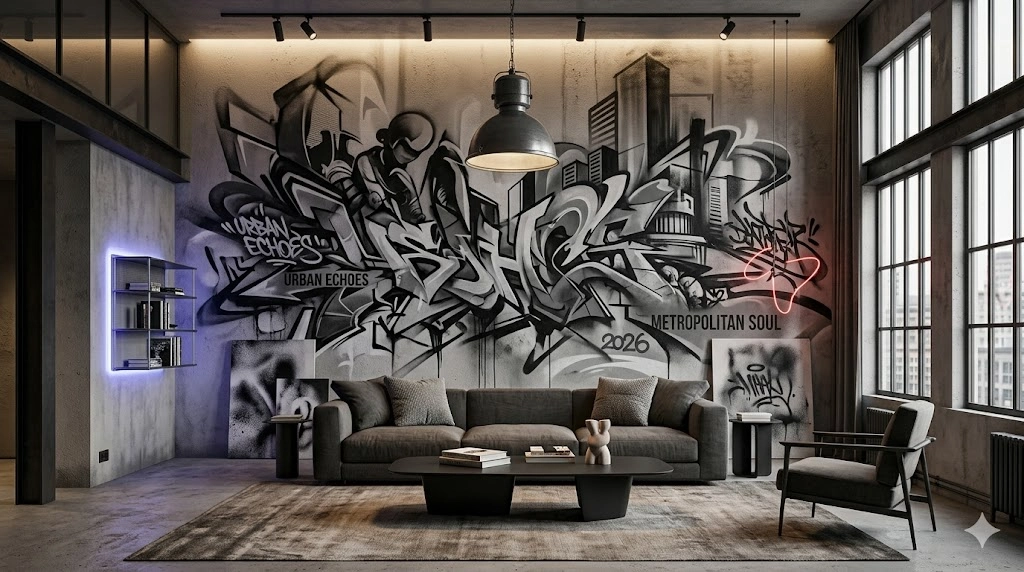
Living rooms work best with one oversized statement wall.
Popular ideas include:
- Monochrome murals behind sofas
- Matte black typography
- Concrete-texture feature walls
- Abstract urban compositions
Avoid placing graffiti on every wall.
Bedroom Graffiti Accent Walls
Bedrooms require softer emotional equilibrium.
Best approaches include:
- Minimal line work
- Muted urban palettes
- Neutral backgrounds
- Artistic typography
Avoid overly aggressive neon combinations.
Home Office Creative Energy Design
Graffiti can increase creative stimulation inside workspaces.
Ideal choices include:
- Inspirational typography
- Black-and-white murals
- Industrial textures
- Abstract urban visuals
This helps the workspace feel more dynamic.
Dining Area Statement Murals
Dining areas benefit from:
- Warm urban tones
- Artistic backdrops
- Concrete textures
- Soft directional lighting
This creates memorable social environments.
Graffiti Bathroom Concepts
Modern luxury bathrooms increasingly use:
- Waterproof murals
- Matte black urban visuals
- Concrete aesthetics
- Minimal typography
This creates a futuristic metropolitan atmosphere.
Gaming Room Graffiti Design
Gaming rooms naturally pair with graffiti aesthetics because both focus on:
- Motion
- Energy
- Visual intensity
- Immersive atmosphere
Neon accents and oversized graphics work exceptionally well here.
Graffiti Wall Art Placement Rules
Placement is one of the most overlooked elements of interior styling.
Even beautiful graffiti can fail if scaling and positioning are incorrect.
The 60–75% Width Rule
A graffiti artwork should generally occupy approximately 60–75% of the width of nearby furniture.
Examples include placement:
- Above sofas
- Behind beds
- Over dining consoles
This creates visual harmony and proportion.
Eye-Level Placement Strategy
The center of the mural should usually sit near eye level.
This improves:
- Viewing comfort
- Spatial balance
- Visual alignment
Oversized vs Gallery Layouts
| Oversized Murals | Gallery Layouts |
| Strong focal point | Flexible composition |
| Modern luxury feeling | Decorative storytelling |
| Cleaner hierarchy | More eclectic appearance |
| Best for minimal interiors | Best for layered rooms |
Oversized murals dominate 2026 luxury trends.
Lighting & Reflection Principles
Lighting dramatically transforms graffiti interiors.
Best practices include:
- Directional wall lighting
- Warm ambient balance
- Texture highlighting
- Reduced glare
Proper illumination increases depth and shadow movement.
Balancing Busy Walls with Minimal Furniture
When walls become visually expressive, furniture should remain restrained.
This prevents:
- Visual overcrowding
- Emotional exhaustion
- Chaotic composition
Minimal furniture creates stronger artistic contrast.
Best Colors for Graffiti Wall Art Interiors
Color systems define the emotional atmosphere of a room.
Black & White Urban Luxury
This remains the most timeless graffiti palette.
Benefits include:
- Sophisticated ambiance
- Elegant contrast
- Architectural clarity
Neon Accent Systems
Neon accents introduce:
- Futuristic aesthetics
- Creative stimulation
- Youthful energy
Use neon carefully to avoid visual overload.
Concrete Gray + Graffiti Contrast
Concrete gray backgrounds make graffiti feel:
- More premium
- More architectural
- Less aggressive
This combination dominates modern loft interiors.
Warm Earth Tones with Street Art
Warm neutrals soften graffiti intensity.
Excellent combinations include:
- Beige with black graffiti
- Clay tones with abstract murals
- Taupe with typography art
This creates emotional comfort and warmth.
Matte Neutral Backgrounds
Matte finishes help graffiti appear sophisticated rather than inexpensive.
Glossy walls often reduce artistic depth and texture visibility.
Graffiti Wall Materials & Texture Systems
Texture is one of the strongest design trends in 2026 interiors.
Concrete Texture Walls
Concrete creates authentic urban atmosphere.
Perfect for:
- Loft apartments
- Creative studios
- Industrial cafés
Plaster & Stucco Surfaces
These materials create:
- Soft shadow interaction
- Mediterranean warmth
- Tactile richness
They soften aggressive graffiti aesthetics.
Metallic Graffiti Accents
Metallic finishes introduce:
- Reflective depth
- Futuristic energy
- Luxury urban character
Mixed-Media Street Murals
Mixed-media murals combine:
- Paint
- Typography
- Panels
- Sculptural textures
- Artistic layering
This creates immersive wall systems.
Spray Texture & Shadow Interaction
Modern graffiti interiors emphasize:
- Layered paint depth
- Directional shadows
- Surface tactility
- Texture movement
These details elevate the luxury atmosphere.
How to Create a Luxury Graffiti Interior
Many graffiti interiors fail because they focus only on visual chaos.
Luxury urban interiors focus on balance and composition.
Avoiding Cheap Urban Looks
Avoid:
- Excessive colors
- Cheap repeated canvases
- Overcrowded walls
- Low-quality prints
Instead, prioritize one strong artistic centerpiece.
Choosing One Statement Wall
One oversized mural creates more sophistication than many competing artworks.
Statement walls improve:
- Visual hierarchy
- Emotional focus
- Architectural clarity
Combining Luxury Furniture with Street Art
The best interiors combine contrast.
Pair graffiti with:
- Minimal European furniture
- Matte finishes
- Neutral fabrics
- Architectural lighting
This creates balanced urban luxury.
Using Negative Space Correctly
Negative space allows the eyes to rest.
This creates:
- Premium balance
- Better visual focus
- Architectural sophistication
Empty space is just as important as the artwork itself.
Common Graffiti Wall Art Mistakes
Even expensive interiors can fail if composition is incorrect.
Overcrowding the Space
Too many visuals create emotional fatigue.
Always maintain breathing room.
Using Too Many Colors
Controlled palettes feel more luxurious than rainbow chaos.
Ignoring Wall Scale
Small artworks on massive walls often appear disconnected.
Oversized murals generally work better.
Poor Lighting Placement
Without proper lighting, graffiti loses depth and texture.
Cheap Canvas Overload
Repeating small inexpensive prints weakens the room’s identity.
Instead, focus on:
- One large mural
- Texture-rich art
- One strong focal composition
Graffiti Wall Art for Commercial Spaces
Commercial interiors increasingly use graffiti to establish brand identity.
Restaurants & Cafés
Graffiti creates memorable hospitality spaces.
Popular themes include:
- Urban typography
- Industrial textures
- Contemporary murals
- Local cultural storytelling
Luxury Fashion Stores
Retail environments use graffiti for:
- Brand identity
- Youth-focused luxury
- Creative atmosphere
Creative Offices
Modern offices use graffiti to:
- Inspire creativity
- Energize employees
- Strengthen company culture
Hotels & Hospitality Design
Boutique hotels increasingly integrate:
- Artistic corridors
- Large murals
- Urban-luxury themes
This creates social-media-friendly interiors.
Gym & Fitness Interiors
Graffiti works perfectly in fitness spaces because it reinforces:
- Motivation
- Energy
- Movement
- Urban intensity
2026 Graffiti Wall Art Trends
The future of graffiti interiors is becoming increasingly architectural and immersive.
Oversized Statement Murals
Large murals dominate because they create immersive visual experiences.
Texture-Driven Graffiti
Texture is becoming more important than color alone.
Designers now focus heavily on:
- Surface layering
- Tactile depth
- Shadow interaction
Muted Urban Color Palettes
Luxury graffiti is moving toward:
- Charcoal tones
- Warm neutrals
- Earth-inspired palettes
This creates more timeless interiors.
Sculptural Street Art
Three-dimensional graffiti installations are emerging in luxury hospitality design.
AI-Enhanced Graffiti Design
AI-assisted mural planning now helps designers:
- Simulate lighting
- Test color systems
- Visualize room integration
This is becoming a major European design trend.
Pros & Cons of Graffiti Wall Art
| Pros | Cons |
| Creates strong identity | Can overwhelm small rooms |
| Adds energy and creativity | Poor placement causes imbalance |
| Perfect for statement walls | Too many colors feel chaotic |
| Excellent for loft interiors | Cheap prints reduce sophistication |
| Works beautifully in modern spaces | Requires balanced furniture styling |
FAQs
Yes. Modern European luxury interiors increasingly combine minimalist architecture with expressive urban art to create individuality and emotional depth.
Neutral backgrounds such as gray, beige, matte black, and white usually work best because they balance strong urban visuals.
Yes. One statement wall is usually far more effective than multiple crowded artworks.
Living rooms, gaming rooms, loft apartments, creative offices, cafés, and studio interiors work especially well.
Focus on:
One focal mural
Controlled palettes
Minimal furniture
Texture-rich surfaces
Proper lighting placement
Avoid visual clutter.
Conclusion
Graffiti wall art has evolved far beyond underground street culture. In 2026, it has become one of the strongest forms of contemporary European interior expression.
From Berlin industrial lofts to Milan luxury apartments, graffiti-inspired interiors combine:
- Creativity
- Texture
- Architectural identity
- Emotional storytelling
- Modern sophistication
The secret to successful graffiti interiors is balance.
Luxury urban spaces use:
- Controlled palettes
- Oversized focal murals
- Texture-rich materials
- Strategic lighting
- Minimal furniture systems
Whether you prefer Scandinavian minimalism, industrial urbanism, or contemporary art-loft styling, graffiti wall art offers endless possibilities for creating interiors filled with personality and emotional energy.
For modern homeowners, designers, cafés, offices, gaming spaces, and hospitality environments, graffiti wall art is no longer just decoration.
It is becoming a complete architectural design language shaping the future of European interiors.