Dramatic Decorated Wall: Bold European Feature Wall Ideas, Styles & Design System
A dramatic decorated wall is no longer a simple interior styling choice. In 2026 European interior design, it functions as a visual language system, shaping perception, emotion, and spatial identity.
Across design capitals such as Paris, Berlin, Milan, Amsterdam, and Copenhagen, there is a noticeable shift in how interiors are structured. Instead of distributing attention evenly across multiple decorative elements, designers now prioritize one dominant focal surface—the feature wall.
This shift is rooted in both aesthetic minimalism and cognitive design psychology. In NLP (Neuro-Linguistic Programming) terms, humans process environments through anchoring, pattern recognition, and emotional tagging. A dramatic wall becomes the “anchor point” that defines the entire mental map of a room.
Rather than visual clutter, modern European interiors now emphasize:
- Emotional resonance
- Spatial hierarchy
- Textural depth perception
- Controlled lighting gradients
- Narrative-based design composition
A dramatic decorated wall operates like a semantic center of gravity inside a room—it pulls attention, stabilizes perception, and defines meaning.
This guide provides not just inspiration but a structured design system, allowing you to engineer walls that feel intentional, immersive, and architecturally powerful.
What Is a Dramatic Decorated Wall?
A dramatic decorated wall is a deliberately composed architectural surface designed to function as the primary visual and emotional focal point within a space.
From a design cognition perspective, it is a high-salience visual stimulus that overrides background perception.
It typically integrates:
- High contrast color encoding
- Layered surface textures
- Structured lighting gradients
- Large-scale compositional elements
- Architectural depth modulation
In NLP-based spatial perception, this wall acts as a dominant representational system trigger, meaning it influences how the brain “labels” the entire room.
Instead of being a passive background, it becomes the interpretive framework of the environment.
Core Elements of a Dramatic Wall
A successful dramatic wall operates through a combination of design variables:
1. Color Contrast Encoding
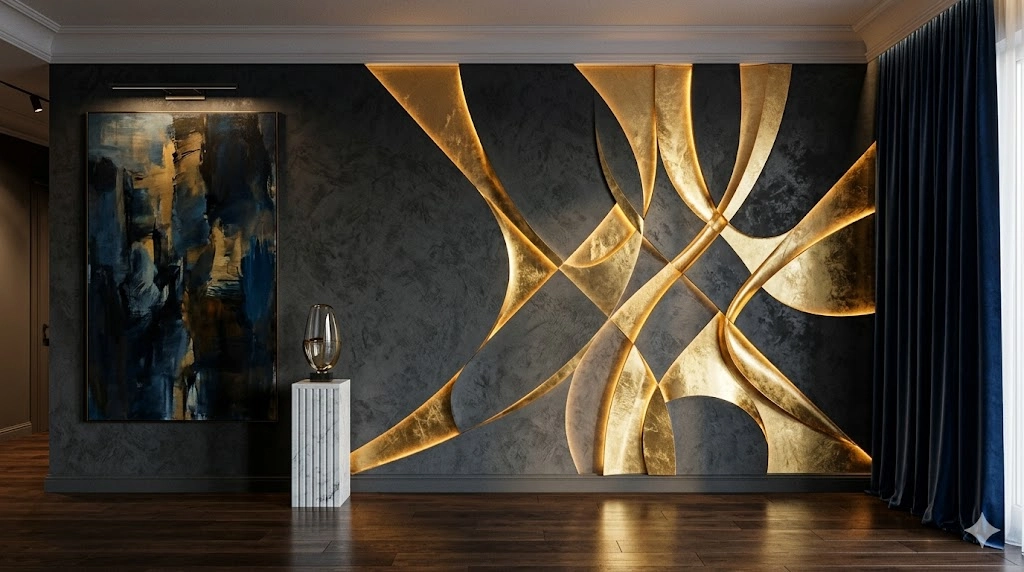
Color is not decorative—it is emotional programming. Deep tones such as charcoal, forest green, and navy generate perceived depth and stability.
2. Texture Layering System
Texture introduces micro-variation that the brain interprets as richness. Examples include:
- Wood grain diffusion
- Stone irregularity mapping
- Plaster organic surfaces
3. Lighting Gradient Control
Lighting defines spatial emotion. Without it, even complex surfaces lose dimensionality.
4. Scale Amplification
Large-scale elements override clutter perception and create visual dominance.
5. Compositional Hierarchy
Every element must support a single focal narrative.
Core principle: One wall = One identity signal
Design Psychology Behind Dramatic Decorated Walls
Understanding the psychological mechanics behind dramatic walls is essential for effective design execution.
1. Visual Focal Point Theory
Human cognition naturally seeks contrast-based anchors in visual environments. A dramatic wall exploits this mechanism by introducing a high-salience stimulus.
This creates:
- Immediate attention capture
- Reduced cognitive overload
- Structured spatial interpretation
- Intentional environmental reading
In NLP terms, this is known as anchoring response conditioning.
2. Emotional Encoding of Space
Colors and textures act as emotional encoding systems.
- Dark tones → perceived depth, luxury, calm authority
- Warm neutrals → safety, softness, relaxation
- Textures → tactile imagination activation
The brain does not “see” walls—it interprets emotional signals from surfaces.
3. Luxury Perception Construction
Luxury is not material—it is perceptual structure.
A well-designed dramatic wall increases perceived value of:
- Furniture
- Lighting
- Space dimensions
This is due to context amplification bias, where surroundings elevate object perception.
4. Memory Anchoring Effect
Spaces are remembered through distinctive visual markers.
A dramatic wall becomes a memory anchor node, meaning:
- It increases recall of the environment
- Strengthens emotional association
- Creates identity-based spatial memory
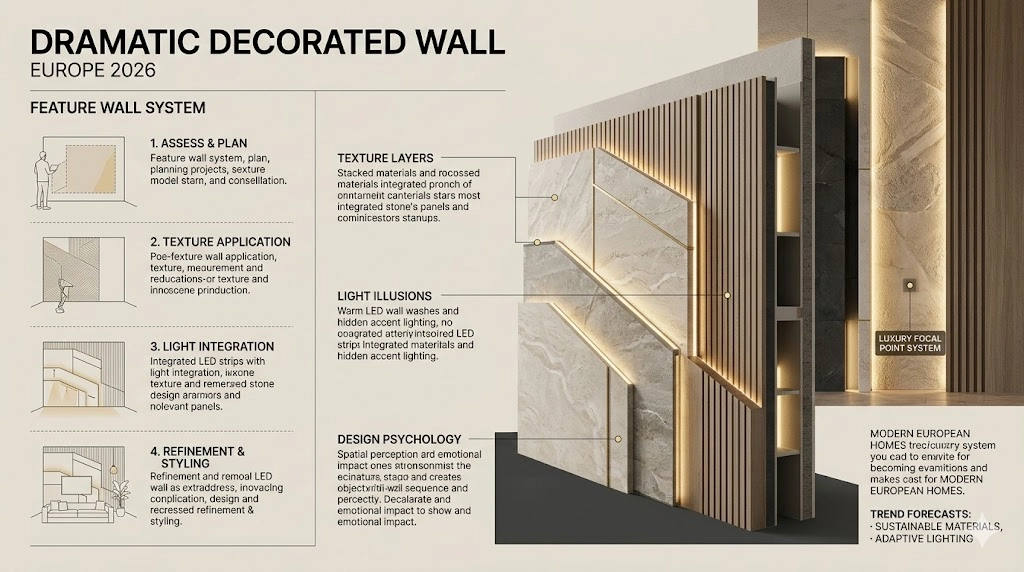
Dramatic Decorated Wall Design System
Instead of random decoration, modern European design follows a structured multi-layer system model.
The 4-Layer Design Architecture
| Layer | Function | Example |
| Color Layer | Emotional foundation | Navy, beige, charcoal |
| Texture Layer | Depth simulation | Wood, plaster, stone |
| Light Layer | Mood modulation | LED, cove lighting |
| Scale Layer | Visual dominance | Oversized art |
Step-by-Step System
1: Emotional Intent Definition
Begin by defining the emotional target:
- Calm
- Luxury
- Warmth
- Drama
- Minimal intensity
This becomes your design semantic root.
2: Base Color Selection
Color acts as the foundational psychological signal.
Popular European choices:
- Charcoal → modern authority
- Beige → soft neutrality
- Deep green → natural grounding
3: Texture Integration
Texture introduces perceptual depth noise, which prevents flat visual reading.
Common systems:
- Vertical wood slats
- Venetian plaster flow
- Stone surface mapping
4: Lighting Engineering
Lighting is the emotional amplifier layer.
Techniques:
- Wall washing (uniform diffusion)
- Hidden LED strip gradients
- Focused spotlighting
- Cove lighting depth illusion
5: Focal Point Reduction Strategy
Minimalism principle applies:
- One artwork OR
- One mirror OR
- One structural panel system
Avoid multi-object competition.
Room-by-Room Dramatic Decorated Wall Strategy
Each room requires a different emotional function mapping.
Living Room: Primary Identity Generator
The living room acts as the dominant narrative zone.
Recommended systems:
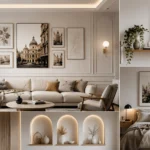
- Textured TV wall composition
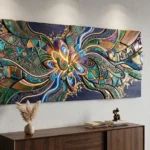
- Oversized abstract artwork
- Stone or wood feature panels
European stylistic variations:
- Scandinavian → soft contrast + wood integration
- German → symmetrical structural clarity
- French → elegant minimal drama layering
Objective: instant identity formation
Bedroom: Emotional Stabilization Zone
Bedroom walls must reduce stimulation while maintaining richness.
Effective systems:
- Upholstered headboard walls
- Soft fabric paneling
- Matte tonal gradients
Color psychology:
- Dusty rose → emotional softness
- Beige → neutrality balance
- Navy → controlled depth
Objective: emotional stabilization
Hallway: Narrative Transition Space
Hallways function as perceptual transition corridors.
Design strategies:
- Vertical rhythm wood panels
- Mirror repetition sequences
- Linear LED guidance systems
Objective: directional flow control
Dining Room: Emotional Intimacy Generator
Dining spaces require warmth and social comfort.
Recommended setups:
- Dark matte backgrounds
- Golden warm lighting layers
- Textured plaster finishes
Objective: sensory intimacy enhancement
Best Materials for Dramatic Decorated Walls
Material selection defines perceived architectural intelligence.
High-Impact Materials
- Fluted wood systems
- Venetian plaster
- Concrete micro-texture
- Metal inlay accents
- Fabric acoustic panels
- Natural stone layering
Lighting: The Core Emotional Driver
Without lighting, spatial depth collapses.
Lighting System Types:
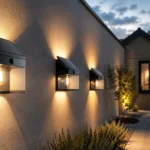
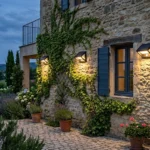
- Wall wash diffusion systems
- Hidden LED contouring
- Spotlight framing
- Architectural cove lighting
Lighting acts as the emotional modulation engine
Art & Composition Strategy
Avoid randomness. Use structured visual grammar.
Best frameworks:
- Single oversized artwork dominance
- Triptych balanced narrative
- Asymmetrical controlled imbalance
- Negative space breathing zones
Principle: fewer elements = stronger meaning
Comparison: Types of Dramatic Decorated Walls
| Type | Style | Best Use | Impact |
| Color Block | Minimal | Small rooms | Medium |
| Textured Wall | Luxury | Living rooms | High |
| Art Statement | Modern | Creative zones | High |
| Lighting Wall | Contemporary | Bedrooms | Very High |
| Mixed Material | Premium | Villas | Extreme |
Pros & Cons
Advantages
- Strong spatial identity creation
- Elevated perceived luxury
- Works across room sizes
- Enhances emotional depth
- High customization flexibility
Limitations
- Requires planning precision
- Lighting dependency is critical
- Overdesign risk exists
- Premium materials can be costly
European Interior Design Trends
Current European design evolution includes:
- Nordic minimal contrast systems
- Parisian texture elegance layering
- Italian stone-based luxury narratives
- German geometric structure focus
- Dutch asymmetrical experimentation
Core trend: minimal objects, maximal wall identity
Common Mistakes to Avoid
- Over-decorating multiple walls
- Mixing unrelated material languages
- Ignoring lighting hierarchy
- Using undersized artwork on large surfaces
- Random color mixing without structure
Expert Design Formula
The universal construction formula:
Emotion (Color) + Depth (Texture) + Atmosphere (Light) + Balance (Scale)
This represents the complete semantic architecture of dramatic wall design.
FAQs
A wall becomes dramatic when it uses contrast, feeling, lighting, and scale to create a strong focal point.
Yes. Small European flats often use dramatic walls to create bottom illusion and zone expansion.
Deep neutrals like charcoal, navy, and warm beige work best for modern European interiors.
Yes. Without lighting, a dramatic wall loses bottom and emotional impact.
Wood panels and matte paint finishes are the easiest starting point.
Conclusion
A dramatic decorated wall is not simply an aesthetic upgrade—it is a structured environmental design system.
It influences:
- Spatial perception
- Emotional response
- Luxury interpretation
- Memory formation
Modern European interiors are moving away from decorative clutter and toward singular identity-driven architecture, where one wall defines the entire experience of a room.