Introduction
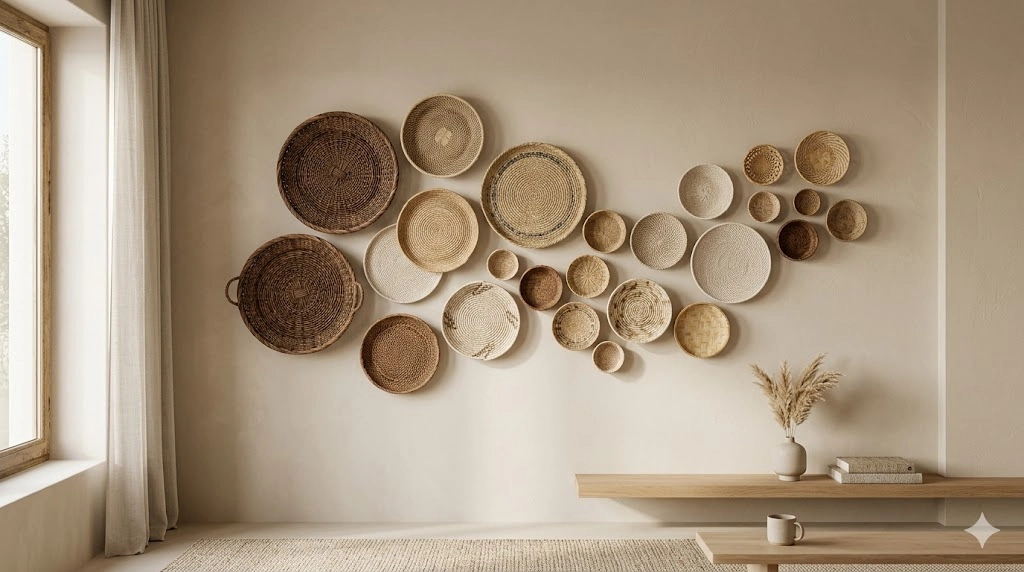
Wall basket decor has evolved far beyond simple wall ornamentation or bohemian styling trends. In 2026, it was recognized across European interior architecture as a structured visual composition system, used in residential interiors, boutique hotels, creative studios, and luxury minimalist spaces.
From the calm, light-filled Scandinavian interiors of Sweden to the warm, earthy Mediterranean homes of Italy and Spain, designers are no longer treating woven baskets as casual decorations. Instead, they are integrating them into intentional spatial design frameworks that control texture, rhythm, depth, and emotional perception.
What makes this design movement powerful is not complexity—but simplicity combined with structure.
Most wall decorations today are:
- Flat (two-dimensional)
- Emotionally neutral
- Mass-produced and visually repetitive
In contrast, wall basket decor introduces:
- Organic irregularity
- Three-dimensional shadow play
- Natural fiber textures
- Emotional warmth and tactile richness
But the most important principle is this:
Wall basket decor is not decoration—it is a spatial composition system based on balance, rhythm, and material psychology.
This article will guide you through the complete European framework used by designers to transform empty walls into intentional, emotionally intelligent design statements.
You will learn:
- How professionals structure basket arrangements
- Placement psychology used in modern interiors
- Material harmonization rules
- Room-specific styling logic
- Mistakes that destroy visual quality
- Step-by-step execution system
What Is Wall Basket Decor in Modern Interior Design Theory?
Wall basket decor refers to the deliberate placement of woven objects—such as rattan baskets, bamboo trays, seagrass discs, and fiber-crafted elements—on vertical wall surfaces to construct visual rhythm, depth layering, and aesthetic storytelling.
However, in European design methodology, its meaning is far deeper.
It functions as a multi-layered sensory design tool, fulfilling both visual and emotional roles.
Core Functional Roles:
Wall basket decor is used to:
- Introduce natural texture layering systems
- Soften rigid architectural geometry (walls, concrete, plaster)
- Create visual movement patterns across flat surfaces
- Inject emotional warmth into minimal interiors
- Establish biophilic (nature-connected) design presence
Unlike framed artwork or posters, basket decor provides:
- Physical depth (3D projection from wall)
- Organic asymmetry (non-perfect forms)
- Handmade authenticity (craft-based identity)
- Natural fiber variation (visual complexity without chaos)
Designers often describe it as:
“A soft architectural language that humanizes interior walls.”
The European Wall Basket Design System
European interior designers rarely place baskets randomly. Instead, they follow a structured compositional logic system based on three core principles: rhythm, density, and material harmony.
Rhythm Rule
In advanced interior composition, perfect symmetry is often avoided because it creates visual rigidity and emotional stiffness.
Instead, designers apply controlled asymmetry, where balance is achieved through variation—not repetition.
Key Principles:
- Combine multiple basket sizes intentionally
- Avoid grid-based or uniform layouts
- Create directional visual flow across the wall
- Allow natural eye movement patterns
Psychological effect:
The wall feels alive, organic, and dynamically structured instead of static.
Density Rule
One of the most critical European design concepts is spatial breathing.
Walls must not feel overloaded or visually compressed.
Ideal composition ratio:
Basket Coverage=60%Wall Breathing Space=40%\text{Basket Coverage} = 60\% \quad \text{Wall Breathing Space} = 40\%Basket Coverage=60%Wall Breathing Space=40%
Interpretation:
- 60% visual activity (baskets)
- 40% empty negative space
Why this works:
- Prevents sensory overload
- Improves focal clarity
- Enhances premium aesthetic perception
Material Harmony Rule
Material overuse creates visual noise. European designers strictly limit material diversity to maintain coherence.
Recommended combinations:
- Scandinavian minimalism → light rattan + soft beige seagrass
- Mediterranean warmth → bamboo + jute fibers
- Modern contrast interiors → black metal + woven natural fiber
Rule:
Never exceed 2–3 material categories per wall system
Professional Wall Basket Composition System
Below is the structural breakdown used in professional interior styling:
| Design Element | Rule | Purpose |
| Basket Size Mix | Small, Medium, Large | Depth perception |
| Placement Style | Asymmetrical flow | Natural visual movement |
| Spacing | 10–25 cm gaps | Rhythm control |
| Color Palette | Neutral earth tones | Emotional calmness |
| Wall Coverage | Max 60% | Prevent clutter |
| Focal Point | One anchor element | Visual hierarchy |
Room-by-Room Wall Basket Decor Strategy
Different rooms require different psychological design strategies.
Living Room: Emotional Focal System
The living room is the central emotional hub of any home, making it the most important zone for wall basket composition.
Design Approach:
- Use a large anchor basket or central cluster
- Apply asymmetrical composition
- Use warm neutral tones
- Maintain balanced spacing
Regional European Variations:
- Sweden → minimal composition, airy spacing
- France → artistic layered clustering
- Italy → dense, warm textured arrangements
Goal:
Create emotional depth and visual storytelling.
Hallway: Movement-Based Design Logic
Hallways are transitional spaces designed for motion, not long visual engagement.
Key Rules:
- Prefer vertical stacking arrangements
- Use smaller basket sizes
- Keep palette light and neutral
Function:
- Guides movement direction
- Creates welcoming transition energy
- Eliminates visual emptiness
Bedroom: Calm Psychological Environment
Bedrooms require emotional stability and visual softness.
Design System:
- Soft-toned basket selection only
- Minimal grouping (low density)
- Placement above bed or side wall
Psychological Outcome:
- Reduced cognitive load
- Improved relaxation response
- Enhanced emotional comfort signals
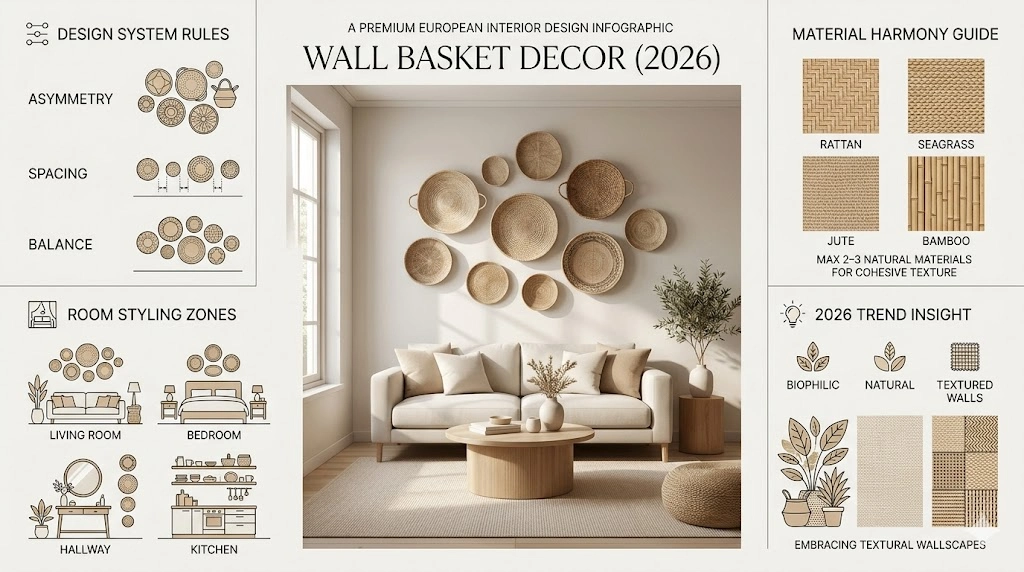
Kitchen: Functional Aesthetic Integration
Kitchen basket decor blends utility with aesthetic softness.
Strategy:
- Mix woven and structured materials
- Maintain minimal composition
- Avoid overcrowding surfaces
Result:
A balanced fusion of practicality and natural warmth.
Common Wall Basket Decor Mistakes
Even expensive materials fail when spatial logic is ignored.
1: Overcrowding
Too many baskets destroy focal clarity and create chaotic visual density.
2: Incorrect Scale Usage
Small baskets on large walls appear visually weak and disconnected.
3: Single Material Dependence
Lack of material diversity results in flat, lifeless composition.
4: Grid Alignment
Rigid symmetry removes organic flow and natural movement.
5: Missing Focal Anchor
Without a dominant element, the wall feels directionless.
Psychological Impact of Wall Basket Decor
Wall basket decor is not purely aesthetic—it directly influences human emotional perception within a space.
Emotional Effects:
- Reduces visual stress levels
- Enhances warmth perception
- Improves spatial comfort feeling
- Introduces natural living atmosphere
- Softens harsh architectural geometry
This aligns with biophilic design psychology, a major European interior trend focusing on nature-connected living environments.
Why Wall Basket Decor Is Growing in Europe
Europe is shifting toward emotionally intelligent interior design systems.
Key Trends:
- Natural materials replacing synthetic finishes
- Handmade textures replacing machine-perfect surfaces
- Neutral palettes replacing aggressive color schemes
- Emotional design replacing purely visual aesthetics
Leading Countries:
- Sweden ????????
- Denmark ????????
- France ????????
- Italy ????????
Wall baskets fit perfectly because they represent:
- Authentic imperfection
- Cultural craftsmanship
- Organic visual layering
The Perfect Wall Basket Formula
Designers often follow a simplified structural rule:
The 3–2–40 System:
- 3 basket sizes (small, medium, large)
- 2 material types maximum
- 40% negative wall space
Plus:
- Asymmetrical layout structure
- Controlled spacing rhythm
This is widely used in European residential design projects.
Wall Basket Decor vs Traditional Wall Art
| Feature | Wall Basket Decor | Traditional Wall Art |
| Texture | 3D organic depth | Flat surface |
| Emotional Effect | Warm & natural | Neutral |
| Visual Depth | High | Low |
| Flexibility | High | Medium |
| Trend Relevance (2026) | Rapidly growing | Stable |
Pros and Cons
Advantages:
- Adds natural warmth instantly
- Works across multiple interior styles
- Highly customizable compositions
- Cost-effective design impact
- Strong alignment with European trends
Limitations:
- Requires spatial planning
- Can become visually messy if overused
- Limited color diversity
- Not suitable for ultra-sterile minimalism
Step-by-Step Wall Basket Styling System
1: Select Wall Surface
Choose a visually underutilized or blank wall.
2: Define Focal Point
Decide the primary visual anchor.
3: Select Basket Sizes
Use at least three size variations.
4: Choose Materials
Limit to 2–3 natural textures.
5: Floor Composition Layout
Test arrangement before installation.
6: Install with Spacing Logic
Maintain 10–25 cm gaps.
7: Final Balance Evaluation
Ensure rhythm, flow, and proportion harmony.
FAQs
It is used to introduce texture, warmth, and structured artistic composition into interior walls.
Yes, it is rapidly growing in European natural interior design systems.
Living rooms, bedrooms, hallways, and kitchens are ideal zones.
Yes, when applied with minimal composition logic and controlled material usage.
Overcrowding and ignoring spatial rhythm balance.
Conclusion
Wall basket decor has evolved into a sophisticated European interior design system built on psychological perception, material intelligence, and spatial balance.
When applied correctly, it transforms empty walls into:
- Emotionally warm focal zones
- Textural architectural compositions
- High-end interior design statements
The fundamental principle is not abundance—but structured restraint, rhythm control, and material harmony.
In modern European interiors, the most powerful walls are not the most decorated—they are the most intelligently composed.