Introduction
Gold framed wall art has evolved far beyond simple wall decoration. In the 2026 European interior design landscape, it has transformed into a structured visual system that architects, stylists, and luxury decorators use to construct emotionally intelligent spaces.
Across major European design hubs such as Frankfurt, Paris, Milan, Amsterdam, and Zurich, gold framed wall art is now a foundational element in spatial storytelling. It is no longer treated as an accessory but as a core design language that defines mood, hierarchy, and visual rhythm inside interiors.
In earlier decades, gold frames were often associated with excessive ornamentation, traditional palaces, or classical luxury interiors. However, the modern interpretation is significantly different. Today’s gold framing philosophy is built around restraint, balance, tonal harmony, and psychological warmth.
Instead of heavy, dramatic, and overly decorative frames, designers now prefer soft metallic finishes, subtle textures, and minimal structural outlines. This creates a refined balance between modern minimalism and emotional richness.
This comprehensive guide will help you understand gold framed wall art as a complete design system rather than a simple décor idea. You will learn:
- The psychological principles behind gold tones in interiors
- How European designers structure wall compositions
- Gallery wall frameworks used in luxury apartments
- Placement ratios and spatial alignment formulas
- Material styles and finish variations
- Room-specific styling strategies
Think of this not as decoration advice, but as a professional-level interior architecture framework.
Why Gold Framed Wall Art Is Dominating 2026 Interiors
Emotional Warmth and Psychological Balance
One of the strongest reasons for the rising dominance of gold framed wall art is its deep emotional resonance. In interior psychology, color temperature plays a critical role in shaping human perception of space.
Gold tones introduce:
- Emotional comfort and psychological ease
- Visual softness in otherwise sterile minimalist rooms
- A feeling of understated richness without overwhelming the senses
Modern European interiors often lean toward minimal structures, neutral palettes, and clean architectural lines. While visually appealing, these environments can sometimes feel emotionally detached. Gold framed wall art resolves this imbalance by introducing warmth and emotional grounding.
Dynamic Light Interaction and Reflective Depth
Unlike matte black or neutral aluminum frames, gold surfaces interact dynamically with light sources throughout the day.
- Morning sunlight creates a soft luminous glow
- Afternoon light enhances warm reflective undertones
- Artificial lighting produces elegant metallic diffusion
This constant transformation gives gold framed wall art a living presence within the room. It is not static; it evolves with time and lighting conditions, adding depth to spatial perception.
Visual Anchoring and Spatial Organization
Interior designers frequently use gold framed wall art as a visual anchoring mechanism. It acts as a focal stabilizer that organizes visual chaos within a room.
Key functions include:
- Structuring empty wall spaces
- Establishing visual hierarchy
- Guiding the eye movement naturally
- Balancing furniture proportions
The European Philosophy Behind Gold Framed Wall Art
Warm Minimalism vs Cold Minimalism
Traditional minimalism often emphasizes emptiness, stark white surfaces, and geometric simplicity. While visually clean, it can sometimes feel emotionally void.
European design philosophy introduced a refined alternative: warm minimalism.
This approach incorporates:
- Soft beige, sand, and ivory wall tones instead of harsh white
- Organic textures such as linen, oak, and stone
- Subtle metallic accents like brushed gold instead of chrome or steel
Gold framed wall art plays a crucial role in softening spatial rigidity while preserving minimalist clarity.
Controlled Luxury Principle
European luxury design does not rely on excess or visual overload. Instead, it focuses on intentional restraint.
Core principles include:
- Strategic placement of fewer but higher-impact elements
- Emphasis on proportion and spatial balance
- Avoidance of visual clutter or over-decoration
Gold frames are used sparingly, often as accent focal points rather than continuous repetition.
Architectural Harmony and Structural Enhancement
Many European interiors are shaped by architectural heritage such as high ceilings, ornate moldings, and symmetrical room geometry.
Gold framed wall art enhances these features by:
- Complementing structural symmetry
- Highlighting architectural depth
- Reinforcing spatial proportion
Types of Gold Framed Wall Art Styles 2026
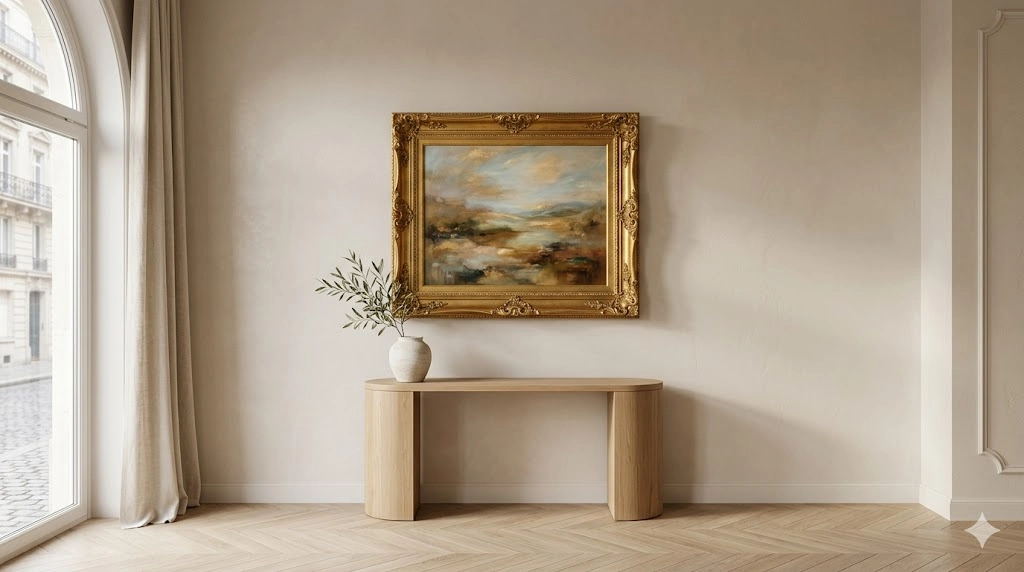
Brushed Gold Frames
- Matte metallic finish
- Soft, diffused reflection
- Ideal for contemporary minimalist interiors
Champagne Gold Frames
- Neutral warm metallic tone
- Highly versatile across interior styles
- Most widely used in modern European homesH3: 3. Antique Gold Frames
- Slightly aged, textured appearance
- Strong classical European aesthetic
- Suitable for heritage or vintage-inspired interiors
Slim Gold Frames
- Ultra-thin structural design
- Strong modern architectural feel
- Popular in Scandinavian-inspired interiors
How to Style Gold Framed Wall Art Like a Designer
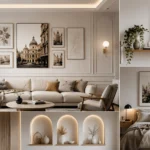
Above Sofa Rule (60–75% System)
Professional designers use proportional alignment systems to maintain visual harmony.
Rule:
- Artwork width should cover 60–75% of sofa width
- Maintain centered alignment
- Keep 15–25 cm vertical spacing above furniture
Eye-Level Placement Rule
The ideal viewing height ensures ergonomic visual comfort.
Standard measurement:
- Center point of artwork: 145–155 cm from floor level
Symmetry vs Asymmetry
| Style | Application | Effect |
| Symmetry | Formal interiors | Stability and calmness |
| Asymmetry | Contemporary spaces | Creativity and dynamism |
| Grid | Workspaces | Order and structure |
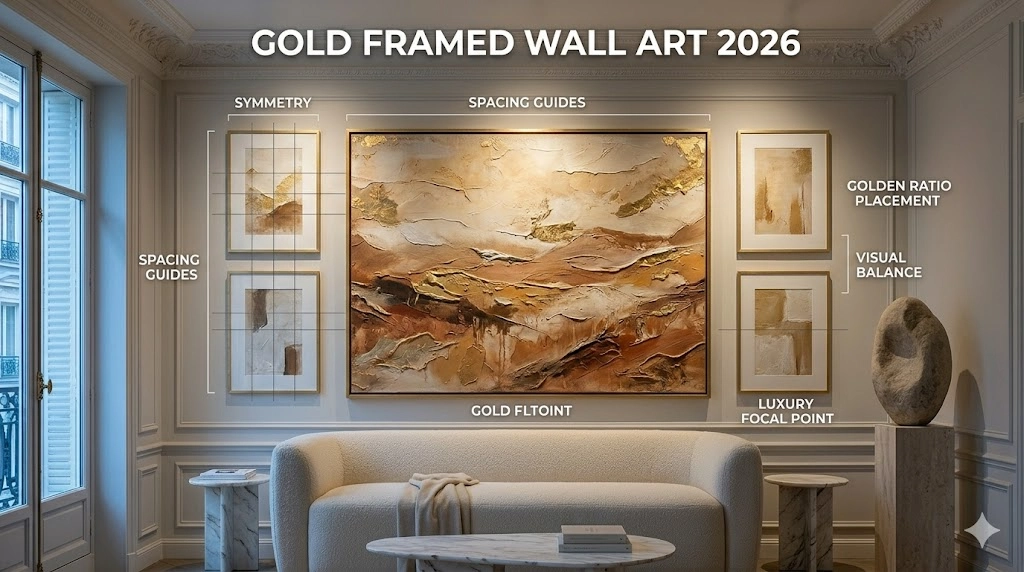
Gold Framed Gallery Wall System
Grid Layout System
- Equal spacing (2–6 cm)
- Uniform frame sizing
- Clean architectural alignment
Salon Style Layout
- Mixed frame sizes
- Organic visual composition
- Central anchor artwork
Frame Hierarchy Rule
- 1 dominant large piece
- 2–3 medium supporting pieces
- 1–2 small accent elements
Spacing Guidelines
- Tight luxury spacing: 2–3 cm
- Balanced spacing: 4–6 cm
- Airy modern spacing: 7–10 cm
Color Psychology of Gold in Interior Design
Gold operates as a psychological signal rather than just a visual tone.
Emotional associations:
- Warmth and comfort
- Prestige and refinement
- Emotional calmness with luxury undertones
Best Pairing Combinations:
- Beige + Gold → Soft luxury expression
- Black + Gold → High contrast elegance
- Navy + Gold → Deep royal sophistication
- Green + Gold → Natural luxury balance
Room-by-Room Styling Guide
Living Room
Serves as the central visual anchor space. Large gold framed artworks create focal stability.
Bedroom
Soft brushed gold enhances emotional calmness and relaxation.
Hallways
Gallery-style arrangements improve spatial flow and continuity.
Dining Area
Enhances warm ambient lighting and social comfort.
Common Mistakes to Avoid
- Excessive use of shiny gold finishes
- Incorrect scaling of frame sizes
- Mixing inconsistent gold tones
- Lack of structured spacing
- Poor lighting integration
Future Trend 2026+: Gold as a Neutral Tone
Gold is increasingly being recognized as a neutral design language in European interiors.
Future directions include:
- Sustainable luxury material innovation
- Digital artwork integration within gold frames
- Architectural gold detailing in structural elements
Pros and Cons
Advantages:
- Immediate luxury enhancement
- Versatile design adaptability
- Strong emotional impact
- Effective focal creation
Disadvantages:
- Easy to overuse without restraint
- Requires proper lighting balance
- Low-quality frames reduce aesthetic value
Comparison Table of Gold Frame Types
| Type | Style | Best Use | Popularity |
| Brushed Gold | Minimal | Modern homes | High |
| Champagne Gold | Neutral | Luxury apartments | Very High |
| Antique Gold | Classic | Heritage interiors | Medium |
| Slim Gold | Modern | Urban apartments | Very High |
FAQs
Yes, it continues evolving as a modern European luxury design system.
Neutral tones such as beige, cream, and white provide the strongest harmony.
Yes, especially brushed and slim gold frame styles.
Typically 60–75% of the width of the furniture below it.
Conclusion
Gold framed wall art is more than decoration—it’s a refined design system that brings warmth, structure, and luxury into modern interiors. When used with balance, spacing, and thoughtful composition, it transforms plain walls into elegant focal points inspired by timeless European aesthetics.