Introduction
3D wall art decor is no longer a simple aesthetic enhancement or decorative afterthought. In 2026, it has evolved into a fully structured interior design methodology that actively shapes atmosphere, perception, and emotional experience inside living spaces.
In straightforward terms:
- Walls are no longer passive surfaces
- Walls have become interactive design structures
- Walls now define identity, mood, and architectural depth
Across Europe—especially in Germany, Italy, France, and Scandinavian countries—interior designers are increasingly abandoning flat, uninspiring wall finishes. Instead, they are adopting layered, sculptural, and tactile 3D wall systems that introduce dimensionality, ambiance, and emotional resonance.
This transformation is not accidental. It is driven by three dominant architectural and psychological shifts:
- Residential spaces are becoming emotionally intelligent environments
- Modern consumers desire both minimalism and luxury simultaneously
- Lighting and surface texture now outweigh color in importance
In contemporary 2026 interior philosophy, a fundamental principle dominates:
A wall is no longer a background element—it is an experiential surface.
This comprehensive guide explores the complete ecosystem of 3D wall art decor, including design frameworks, psychological principles, material science, European stylistic influences, spatial planning strategies, emerging trends, common design errors, and future innovations.
Understanding the 3D Wall Art Decor System
Most online content focuses only on visual inspiration or decorative examples. However, professional interior design treats 3D wall art decor as a structured system rather than random decoration.
What Is a 3D Wall Art Decor System?
A 3D wall art decor system is a deliberate and coordinated architectural composition involving multiple interconnected design variables:
- Surface texture engineering
- Controlled lighting interaction
- Functional room alignment
- Material selection strategy
- Depth perception calibration
- Visual equilibrium and balance
Instead of simply placing artwork on a wall, designers construct a complete spatial narrative using wall geometry and material behavior.
For instance, a modern living room wall is designed through:
- Textural layering (plaster, wood, or composite surfaces)
- Strategic illumination angles (warm ambient or directional lighting)
- Defined focal hierarchy (television unit, sculpture, or centerpiece wall)
- Color harmony coordination (neutral, earthy, or monochromatic palette)
This systematic approach explains why European interiors appear premium, even when furniture remains minimal.
Core Principles of European 3D Wall Design
European interior architecture is governed by a refined set of design principles that emphasize restraint, material intelligence, and spatial clarity:
1. Minimalism with Warmth
Spaces remain clean and uncluttered, yet emotionally inviting and visually comfortable.
2. Material Naturalism
Organic materials such as wood, stone, plaster, and metal are balanced to create authenticity and tactile richness.
3. Integrated Lighting Design
Light is not an external accessory; it is embedded into the architectural structure of the wall.
4. Functional Aesthetic Philosophy
Every design decision serves both visual and practical purposes simultaneously.
5. Spatial Equilibrium
No surface appears excessively dense or visually empty; balance is always maintained.
Psychology Behind 3D Wall Art Decor
Understanding why 3D wall systems are so powerful requires examining human cognitive and emotional response mechanisms.
Depth Perception Mechanism
Human perception is naturally drawn to layered environments and dimensional structures. 3D wall designs exploit this neurological preference by creating:
- Optical depth expansion
- Visual motion simulation
- Cognitive engagement stimulation
- Architectural richness perception
As a result, even compact interiors appear more spacious and architecturally sophisticated.
Emotional Response to Texture
Different surface textures directly influence psychological and emotional states:
| Texture Type | Emotional Response | Ideal Application |
| Smooth plaster | Calm, soothing, balanced | Bedrooms |
| Angular geometric forms | Focused, structured thinking | Offices |
| Organic curved surfaces | Relaxation and natural comfort | Living rooms |
| Metallic finishes | Energy, strength, luxury perception | Modern apartments |
Texture functions as an emotional language within interior environments.
Light-Texture Interaction Psychology
Lighting plays a transformative role in 3D wall perception. A textured wall behaves dynamically under changing light conditions:
- Morning illumination produces soft gradient effects
- Afternoon lighting enhances shadow definition and contrast
- Evening lighting creates dramatic, luxurious ambiance
This dynamic behavior produces what designers call a “living surface effect,” where the wall appears constantly evolving.
European Influence on 3D Wall Art Decor
Europe remains the global epicenter of architectural innovation in interior design. Each region contributes a distinct stylistic philosophy.
Scandinavian Interior Philosophy
Countries: Sweden, Norway, Denmark
Key characteristics:
- Light-toned wooden materials
- Neutral and soft color palettes
- Simple geometric wall patterns
- Strong reliance on natural daylight
Objective: Create calm, functional, and emotionally balanced environments.
German Architectural Precision Design
Germany emphasizes:
- Structurally engineered wall panels
- Industrial-grade material usage
- Strict geometric alignment
- Functional spatial optimization
Objective: Achieve efficiency, order, and architectural clarity.
Italian Luxury Aesthetic Design
Italy represents expressive luxury in interior architecture:
- Sculptural wall compositions
- Bold dimensional textures
- Artistic layering techniques
- Gallery-inspired visual storytelling
Objective: Evoke emotional luxury and artistic depth.
French Interior Elegance Style
French interiors prioritize refined subtlety:
- Soft curved surface geometry
- Muted and neutral tones
- Delicate layered textures
- Romantic spatial atmosphere
Objective: Timeless elegance and understated sophistication.
Types of 3D Wall Art Decor Systems 2026
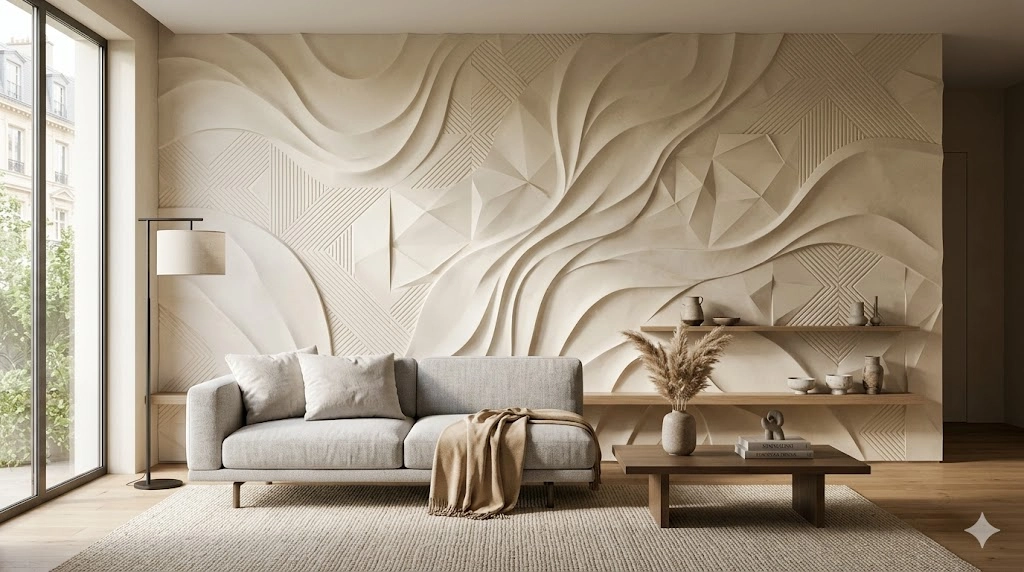
Sculptural Plaster Wall Systems
- Handcrafted organic forms
- Flowing wave-like structures
- Soft shadow diffusion
Best suited for luxury living environments.
Wooden Geometric Wall Panels
- Nordic-inspired minimal patterns
- Sustainable material usage
- Repetitive structural rhythm
Ideal for bedrooms and home offices.
Metallic Artistic Wall Installations
- Industrial luxury aesthetics
- Reflective metallic surfaces
- High visual impact structures
Best for modern urban apartments.
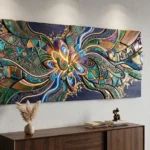
Resin-Based Artistic Wall Designs
- Gloss-enhanced surfaces
- Fluid abstract compositions
- Custom color adaptability
Suitable for creative and design studios.
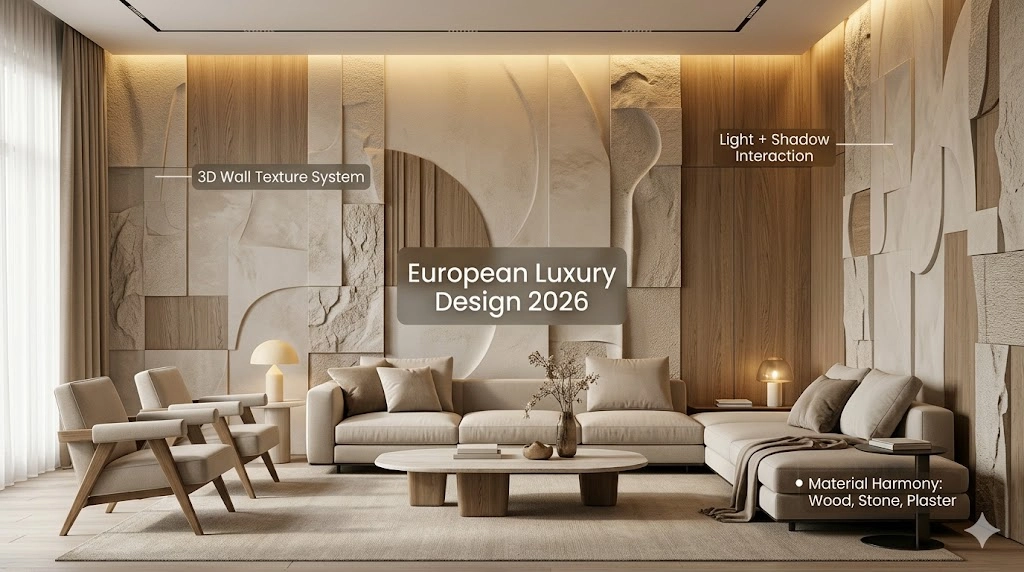
Hybrid Material Wall Systems
Combination of:
- Wood + plaster
- Metal + stone
- Resin + composite textures
Best for high-end villas and luxury residences.
Room-by-Room 3D Wall Art Strategy
Living Room Strategy
The living room is the primary visual focal zone.
Guidelines:
- One dominant feature wall only
- Minimal furniture clutter
- Warm ambient lighting integration
Goal: Achieve strong visual luxury without overstimulation.
Bedroom Strategy
Bedrooms are designed for psychological recovery.
Guidelines:
- Soft, low-intensity textures
- Neutral calming color palette
- Avoid sharp geometric contrast
Goal: Encourage relaxation and emotional restoration.
Office / Study Strategy
Workspaces require cognitive clarity.
Guidelines:
- Structured geometric patterns
- Wood-based panel systems
- Symmetrical alignment
Goal: Improve concentration and productivity.
Hallway Strategy
Hallways serve as transitional environments.
Guidelines:
- Vertical pattern emphasis
- Directional lighting flow
- Optical expansion techniques
Goal: Create perception of extended space.
Material Trends in 3D Wall Art Decor
Modern European interiors strongly prioritize sustainability and longevity.
Key materials include:
- Natural timber composites
- Gypsum-based plaster systems
- Metallic hybrid materials
- Resin-infused artistic blends
- Natural stone applications
Direction: Eco-conscious luxury with long-term durability.
Comparison of 3D Wall Art Types
| Type | Design Style | Strength | Ideal Space |
| Plaster Sculptures | Organic luxury | Soft elegance | Living rooms |
| Wooden Panels | Scandinavian minimalism | Warm structure | Bedrooms |
| Metal Walls | Industrial modernism | Bold impact | Apartments |
| Resin Surfaces | Abstract artistic | Visual depth | Studios |
| Hybrid Systems | Architectural luxury | High-end finish | Villas |
Advantages and Limitations
Advantages
- Enhances spatial depth perception
- Elevates luxury perception significantly
- Improves lighting interaction dynamics
- Suitable for multiple interior styles
- Strengthens emotional engagement
Limitations
- Requires precise lighting design
- Higher installation cost
- Needs professional craftsmanship
- Unsuitable for heavily cluttered interiors
Future Trends of 3D Wall Art Decor
Intelligent Adaptive Wall Systems
Future walls will integrate:
- AI-generated surface patterns
- Motion-responsive lighting systems
- Interactive material behavior
Modular Wall Architecture
- Replaceable wall components
- Seasonal design transformation
- Flexible customization systems
Biophilic 3D Design Evolution
Nature-inspired design includes:
- Organic leaf structures
- Flowing natural contours
- Growth-pattern aesthetics
This trend is particularly dominant in Scandinavian design evolution.
Common Mistakes in 3D Wall Design
Avoid these critical errors:
- Overloading a single wall with multiple textures
- Incorrect lighting direction placement
- Excessive material mixing without harmony
- Ignoring proportional room scaling
- Lack of compositional balance
Core rule: Minimal but meaningful design always prevails.
Expert European Styling Guidelines
- Design according to functional room purpose
- Maintain a single dominant texture per space
- Combine lighting and shadow intentionally
- Preserve symmetrical harmony
- Avoid decorative excess
Fundamental principle:
Simplicity equals luxury in modern European interiors.
FAQs
3D wall art decor refers to a modern interior design technique that uses textured, layered, and sculptural wall surfaces to create depth and visual complexity.
Yes. When applied with light tones and vertical pattern orientation, it enhances spatial perception and makes rooms appear larger.
Wood, gypsum, and plaster are widely preferred due to durability, versatility, and European design compatibility.
Yes. It remains one of the strongest and most influential interior design trends across Europe and global luxury interiors.
Conclusion
3D wall art decor has transitioned from a decorative concept into a complete architectural language shaping modern interiors.
In 2026, walls define:
- Emotional atmosphere
- Luxury perception
- Spatial expansion
- Lifestyle identity
From German precision engineering to Italian artistic expression and Scandinavian minimalism, Europe continues to lead this global transformation.
Final design principle:
Modern interiors are no longer built around furniture—they are constructed around walls.