Introduction
In 2026, Jesus wall art has evolved far beyond traditional religious decoration. It is no longer limited to spiritual imagery or ornamental display. Instead, it has become an integral component of European luxury interior design systems, where emotional intelligence, environmental psychology, and spatial storytelling merge into a unified aesthetic language.
Modern interiors across Europe are increasingly designed not only for visual appeal but also for cognitive comfort, emotional regulation, and subconscious harmony. Homes are no longer static spaces—they are experiential environments that influence mood, behavior, and mental clarity.
Today’s homeowners prioritize:
- Emotional calmness and psychological ease
- Visual balance and spatial harmony
- Identity expression through curated interiors
- Subconscious spiritual grounding
- Luxury minimalism with meaning-driven aesthetics
Within this transformation, Jesus wall art functions as an emotional anchor point—an intentional focal element that stabilizes the atmosphere of a room.
From contemporary apartments in Germany to refined villas in Italy and minimalist Scandinavian interiors, sacred wall art is being reinterpreted as a design language rather than a purely religious artifact. It integrates spirituality with architecture, emotion with geometry, and symbolism with modern aesthetics.
This guide presents a complete NLP-informed interior design framework for Jesus wall art in 2026, covering placement science, emotional psychology, color semantics, stylistic taxonomy, and European luxury design systems.
The Evolution of Jesus Wall Art in 2026
From Traditional Religious Imagery to Modern Design Language
Historically, Jesus wall art was characterized by:
- Classical oil paintings with heavy visual detailing
- Ornate wooden or gilded frames
- Church-inspired visual narratives
- Literal biblical storytelling scenes
- Dense symbolic compositions
However, in the 2026 interior landscape, this visual language has undergone a significant transformation.
Modern interpretations now emphasize:
- Minimalist sacred representations
- Emotionally abstract visual structures
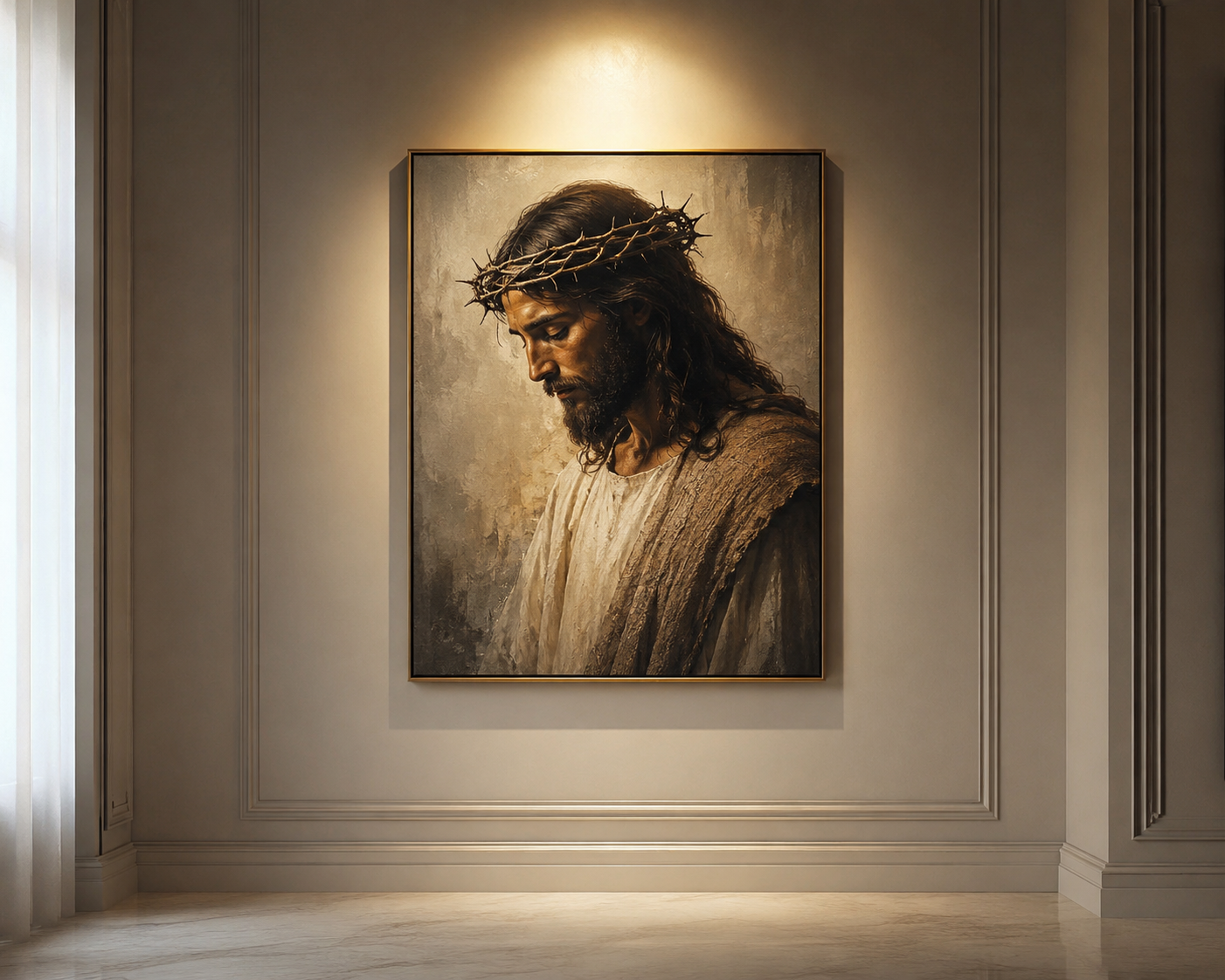
- Soft lighting integration within artwork
- Gallery-style framing systems
- Reduced visual noise with enhanced symbolic clarity
The shift is not merely aesthetic—it is cognitive. Modern design removes excess visual load to improve mental processing fluency, which increases subconscious comfort and emotional resonance.
Core Transformation Insight (NLP Perspective)
Traditional design focused on visual narration.
Modern design focuses on emotional suggestion and subconscious interpretation.
Why Europe Is Leading This Transformation
European interior design has become the global reference point for sacred minimalism due to its layered cultural design intelligence:
- Scandinavian design emphasizes cognitive simplicity and visual silence
- French interiors prioritize emotional elegance and spatial refinement
- Italian design integrates artistic heritage with contemporary reinterpretation
- German design introduces structured functionality and spatial precision
- Dutch design contributes abstract emotional expression and conceptual art logic
Together, these influences form a unified system:
“Sacred Minimal Luxury Interior Intelligence”
This system merges emotional psychology with architectural discipline.
Psychological Impact of Jesus Wall Art
Emotional Regulation and Mental Stability
Jesus wall art functions as a subconscious stabilizer in interior environments. From a neuro-design perspective, it contributes to:
- Reduced cognitive overload
- Enhanced emotional grounding
- Increased perception of safety
- Improved environmental coherence
- Stabilized mood patterns
When placed correctly, such artwork acts as a visual anchor that reduces internal mental noise and encourages psychological equilibrium.
Identity Encoding and Symbolic Self-Expression
Modern homes operate as identity ecosystems. Every design choice communicates subconscious self-representation.
Jesus wall art expresses:
- Spiritual belief systems
- Emotional value structures
- Inner philosophical orientation
- Cultural alignment
- Personal meaning frameworks
This transforms interior spaces into narrative environments—where walls do not merely decorate but communicate identity.
Focal Point Psychology and Visual Anchoring
Every well-designed room requires a dominant visual anchor. This is a foundational principle in spatial cognition.
Jesus wall art often becomes:
- The primary attention trigger upon entry
- The emotional center of spatial experience
- The stabilizing visual reference point
- The subconscious hierarchy leader of the room
From an NLP standpoint, the brain prioritizes structured focal elements to reduce uncertainty and increase environmental predictability.
European Interior Design System for Jesus Wall Art
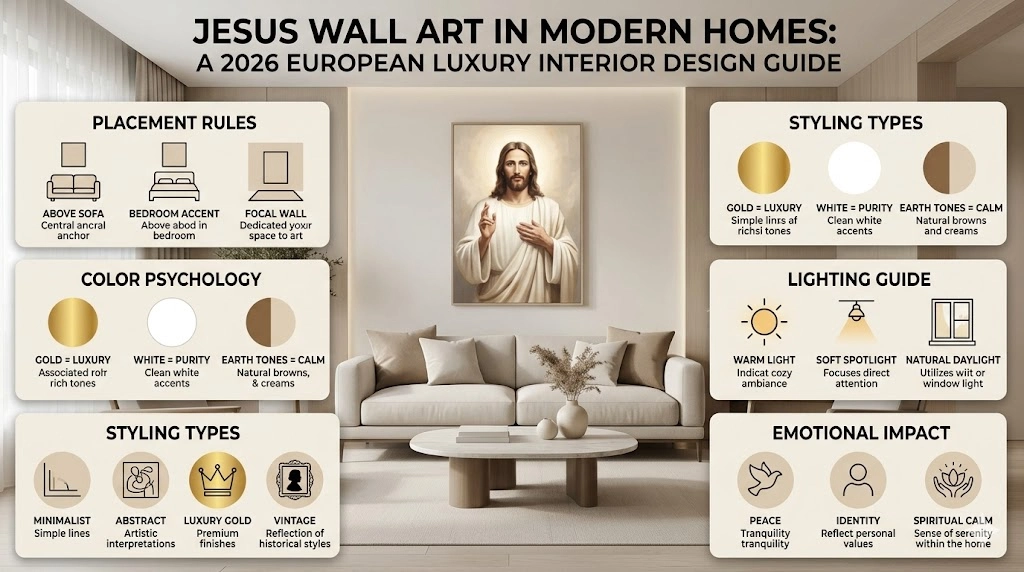
Focal Wall Rule
Jesus wall art should always be placed on a primary structural wall that naturally commands attention.
Optimal placements include:
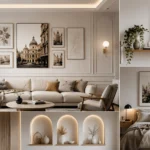
- Above the sofa in living rooms
- Above the headboard in bedrooms
- Main architectural wall in open spaces
- Terminal wall in corridors or hallways
Cognitive Rule:
The artwork must enter visual awareness within 3–5 seconds of room entry.
60–30–10 Spatial Composition System
A professionally balanced interior follows a structured distribution model:
- 60% negative space (visual breathing room)
- 30% functional furniture presence
- 10% emotional focal artwork (Jesus wall art)
This ratio prevents sensory overload while maintaining aesthetic clarity and emotional focus.
Height Optimization Rule
Correct vertical placement significantly influences emotional perception:
- Ideal eye-level center: 145–155 cm
- Above sofa spacing: 15–25 cm
- Large-scale frames: slightly elevated for luxury perception
Incorrect alignment disrupts visual harmony and reduces emotional impact.
Lighting Intelligence System
Lighting is not auxiliary—it is transformational.
Recommended lighting strategies:
- Warm white ambient illumination
- Directional soft spotlights
- Natural daylight synchronization
- Wall grazing illumination for texture enhancement
Avoid:
- Harsh cool LED lighting
- Overexposure and glare
- Flat, shadowless illumination
Lighting defines emotional intensity.
Styles of Jesus Wall Art
Minimalist Sacred Expression
Characteristics:
- Neutral chromatic palette
- Reduced visual complexity
- Soft geometric abstraction
- Clean spatial integration
Ideal for Scandinavian and modern minimalist interiors.
Luxury Gold Sacred Aesthetics
Characteristics:
- Metallic gold detailing
- High contrast backgrounds
- Refined ornamental balance
- Elegant visual hierarchy
Ideal for luxury villas and high-end interiors.
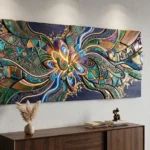
Abstract Emotional Interpretation
Characteristics:
- Non-literal visual representation
- Light-based symbolic expression
- Fluid conceptual composition
Ideal for Contemporary and artistic environments.
Nature-Inspired Sacred Design
Characteristics:
- Organic botanical elements
- Earth-toned color systems
- Soft environmental integration
Ideal for wellness-focused interiors.
Vintage European Sacred Heritage Style
Characteristics:
- Renaissance-inspired detailing
- Classical artistic composition
- Historical depth and texture
Ideal for traditional European architecture.
Room-by-Room Placement Strategy
Living Room
- Large-scale central artwork placement
- Positioned above main seating structure
- Balanced lighting distribution
Purpose: Establish emotional identity of the entire home.
Bedroom
- Soft-toned visual compositions
- Above bed or adjacent wall placement
- Minimal visual disruption
Purpose: Promote relaxation and subconscious calm.
Hallway
- Sequential vertical arrangement
- Narrative visual flow system
- Movement-guided experience design
Purpose: Create transitional emotional continuity.
Meditation Space
- Single artwork focus principle
- No visual clutter allowed
- Minimal environmental interference
Purpose: Enhance introspection and mental silence.
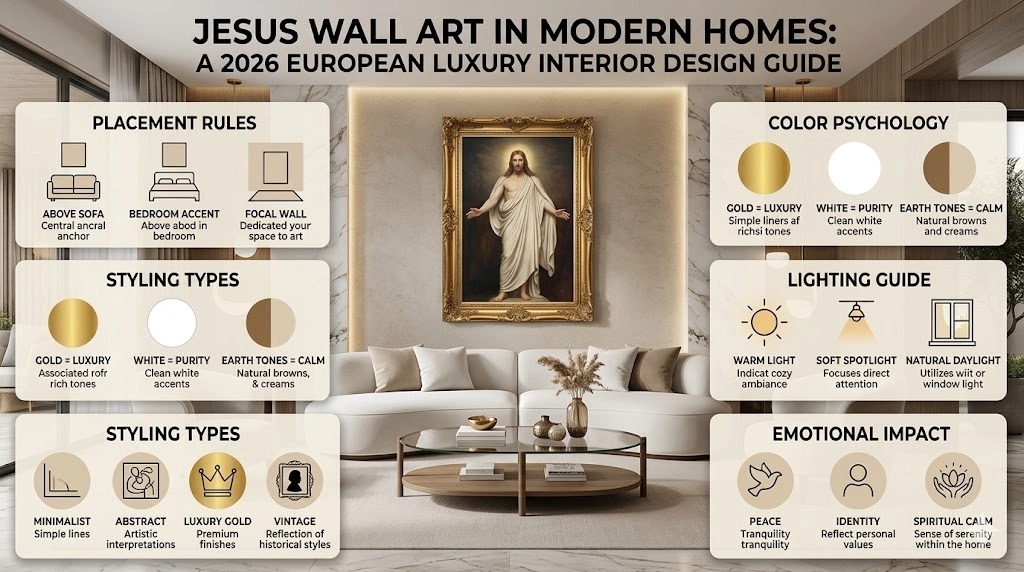
Color Psychology in Jesus Wall Art
2026 Trending Color Systems
- Beige and ivory → emotional neutrality and calmness
- Gold and black → luxury symbolism and sacred depth
- Olive green → nature connection and balance
- Grey and white → modern cognitive clarity
Emotional Color Semantics
| Color | Emotional Meaning |
| Gold | Sacred luxury, elevation |
| White | Purity, clarity |
| Earth tones | Stability, grounding |
| Black | Depth, introspection |
Colors directly influence subconscious emotional mapping.
Style vs Emotional Impact Framework
| Style | Emotional Effect | Ideal Environment | Psychological Outcome |
| Minimalist | Soft neutrality | Small apartments | Calm cognition |
| Luxury Gold | Strong presence | Formal spaces | Prestige perception |
| Abstract | Deep engagement | Artistic interiors | Emotional stimulation |
| Nature | Organic balance | Bedrooms | Relaxation response |
| Vintage | Rich storytelling | Classic homes | Historical continuity |
Pros and Cons
Advantages
- Enhances emotional atmosphere
- Strengthens identity-based interiors
- Compatible with modern and classical systems
- Functions as a focal design anchor
- Supports psychological calmness
Limitations
- Improper placement reduces effectiveness
- Overuse creates visual heaviness
- Requires controlled lighting balance
- Style mismatch may disrupt harmony
Common Mistakes in Sacred Wall Design
- Excessive artwork density on one wall
- Ignoring proportional scaling rules
- Incorrect lighting temperature selection
- Improper height positioning
- Mixing incompatible design languages
Future Trend: Abstract Sacred Minimalism 2026+
The evolution of Jesus wall art is moving toward:
- Increased abstraction over literal depiction
- Emotional intelligence-based design
- Architectural integration of sacred elements
- Gallery-inspired presentation systems
- Ultra-minimal framing techniques
Future interiors will treat sacred art as part of architectural identity rather than decorative addition.
FAQs
Yes. In 2026, it will be increasingly integrated into European luxury and minimalist interior systems, especially in emotionally conscious design environments.
It is most effective in living rooms, bedrooms, hallways, and meditation spaces where emotional influence and visual anchoring are desired.
Minimalist and abstract interpretations are most aligned with contemporary European interior design principles.
Yes. Color selection directly influences emotional perception, subconscious response, and environmental mood regulation.
Absolutely. It is widely used in European luxury design systems as a symbolic and emotional focal element.
Conclusion
Jesus wall art in 2026 has evolved into a refined element of European luxury interior design, moving beyond decoration into emotional and psychological space shaping. When thoughtfully placed and styled, it works as a focal anchor that brings calmness, identity, and meaning into modern homes.
With the right balance of placement, lighting, color psychology, and design style, sacred artwork becomes part of a cohesive interior system—supporting both aesthetic elegance and emotional well-being.