Gold Decor for Walls | Luxury Design System, Psychology & European Styling Trends
In 2026, the concept of gold decor for walls has evolved far beyond decorative styling. It is now interpreted as a semantic design system within modern interior architecture—especially across European residential and commercial spaces.
From high-end apartments in Frankfurt and Paris to minimalist Scandinavian villas, gold is being applied not as excessive ornamentation but as a controlled visual accent within structured design frameworks.
Core Shift in 2026 Design Thinking
The major transformation in interior design philosophy can be summarized as:
- Old approach: “Use gold to show luxury”
- New approach: “Use gold to communicate refined emotional intelligence in space”
This aligns with modern NLP-inspired design thinking, where every visual element is treated as a signal that influences perception, emotion, and cognitive response.
Modern Design Principle
“Luxury is not material abundance—it is perceptual precision.”
Gold is now treated as a micro-accent system, not a dominant surface treatment. It interacts with:
- Light reflection behavior
- Emotional warmth triggers
- Spatial hierarchy mapping
- Attention flow direction
What You Will Learn in This Guide
This complete pillar article explains:
- Semantic meaning of gold decor in interiors
- Psychological and neurological response patterns
- European design systems (2026 updated models)
- Professional step-by-step wall styling framework
- Room-specific implementation strategy
- Trend forecasting and material evolution
- Mistakes that reduce perceived luxury value
What Is Gold Decor for Walls?
From an NLP (Natural Language Processing) perspective, gold decor for walls can be defined as a visual token system used to enhance environmental perception of luxury, warmth, and spatial depth.
In practical interior design terms, it refers to:
The strategic application of gold-toned materials, textures, or visual accents on vertical wall surfaces to create aesthetic hierarchy and emotional resonance.
Key Functional Roles
Gold wall decor performs multiple roles simultaneously:
- Attention anchoring (visual focalization)
- Light diffusion enhancement
- Emotional value signaling (luxury association)
- Spatial identity reinforcement
- Aesthetic balancing element
Categories of Gold Wall Decor (Modern Classification)
Instead of traditional decorative listing, 2026 design systems classify gold decor into structured types:
1. Gold Wall Art Systems
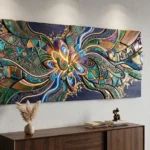
Abstract or geometric visual compositions with metallic gold integration.
2. Reflective Gold Mirror Frameworks
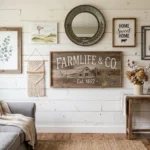
Gold-framed mirrors that manipulate spatial perception and light amplification.
3. Architectural Metal Installations
3D sculptural wall structures with gold finishes.
4. Gold Panel Geometry Systems
Structured wall segmentation using gold accents or inlays.
5. Metallic Wallpaper Layering
Subtle gold-infused surface textures for ambient luxury.
6. Minimal Line Art Encoding
Thin gold strokes used as visual syntax in modern interiors.
Core Insight
Gold decor is not a style—it is a design language system that communicates status, harmony, and visual intelligence.
Psychology Behind Gold Decor for Walls
In Environmental psychology, gold is classified as a high-impact perceptual stimulus. It influences both conscious and subconscious interpretation of space.
Cognitive Response Mechanisms
Gold triggers multiple neural associations:
1. Luxury Encoding Effect
The brain maps gold to high-value environments due to cultural conditioning.
2. Warmth Perception Activation
Gold wavelengths psychologically increase the perceived temperature of a room.
3. Attention Bias Mechanism
The human visual cortex prioritizes reflective and metallic surfaces.
4. Luminosity Amplification Perception
Gold enhances perceived brightness through reflective interaction with light sources.
European Design Psychology
Modern European interiors follow a minimalist cognitive-load reduction model.
Core Rule:
“Reduce visual noise, increase emotional clarity.”
Thus, gold is:
- Limited in quantity
- Positioned strategically
- Balanced with neutral environments
NLP Interpretation
Gold acts as a semantic highlight token, similar to bold keywords in text—it guides perception without overwhelming the system.
Gold Decor for Walls Design System
Professional interior designers do not decorate randomly. They use structured design logic systems, similar to algorithmic workflows.
Gold Design System Framework
| Principle | Meaning | Application |
| 10% Rule | Minimal gold presence | Use sparingly |
| Focal Node Rule | One visual anchor | One wall focus |
| Light Mapping | Reflective positioning | Near light sources |
| Material Contrast | Neutral dominance | Balance textures |
| Visual Load Control | Avoid saturation | Reduce overuse |
Step-by-Step System
1: Identify Focal Node Wall
Select a wall with natural attention gravity:
- Living room main wall
- Bedroom headboard wall
- Dining feature wall
2: Apply Gold as Secondary Layer
Gold must function as a supporting visual modifier, not primary surface.
Examples:
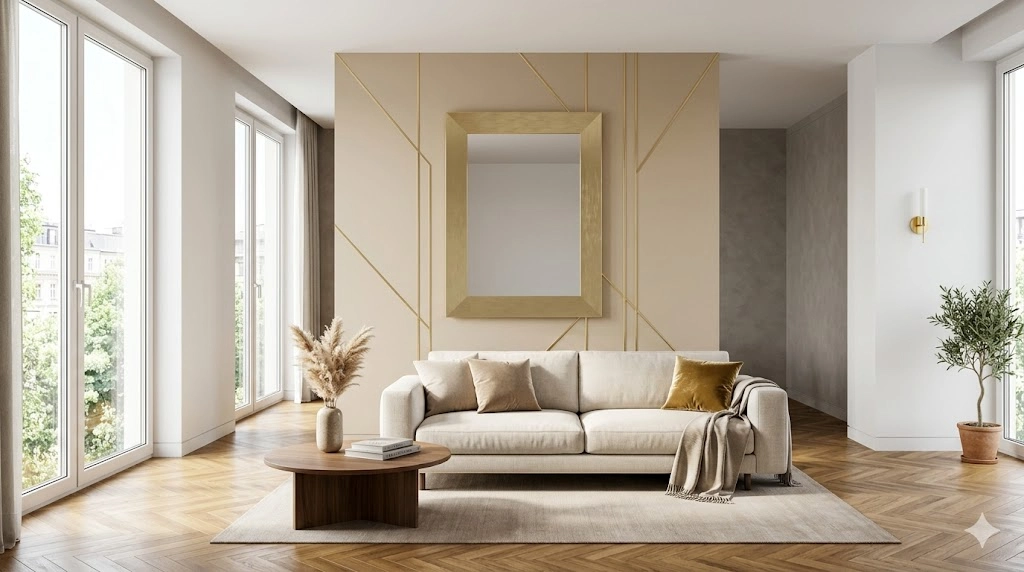
- Thin gold frames
- Micro geometric accents
- Minimal metallic inserts
3: Establish Neutral Base Palette
Gold requires low-noise backgrounds:
- Warm white
- Beige tones
- Soft grey
- Stone textures
4: Control Light Algorithm
Lighting determines gold performance:
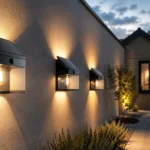
- Warm LED systems
- Indirect wall washing
- Ambient diffusion lighting
Avoid:
- High-intensity cold light
- Sharp directional glare
5: Evaluate Visual Balance
Ask:
Does gold guide attention or dominate perception?
If dominance occurs → reduce intensity
If guidance occurs → optimal design achieved
Types of Gold Decor for Walls
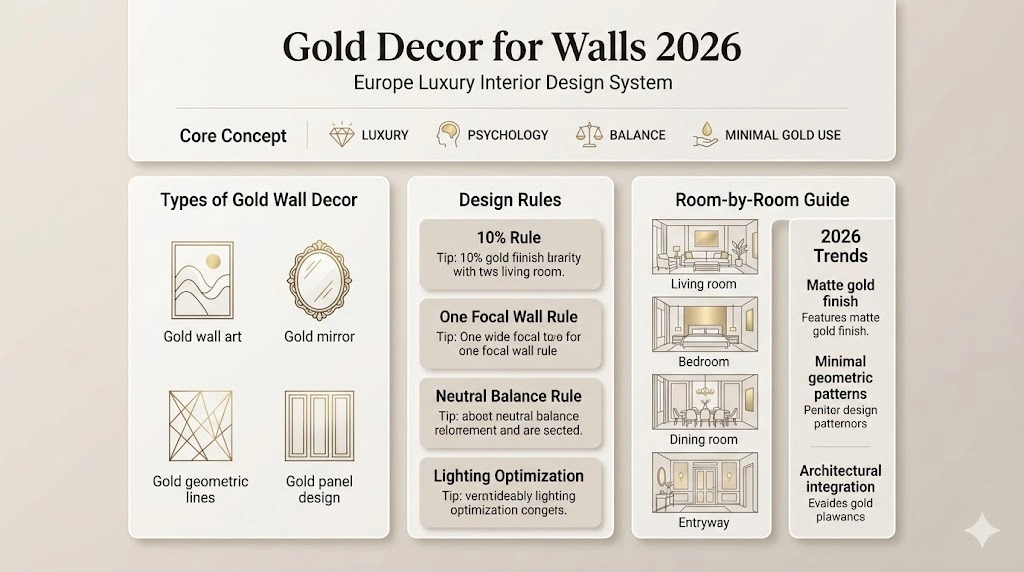
Gold Wall Art
Gold wall art operates as a symbolic abstraction layer.
Best patterns:
- Abstract emotional forms
- Geometric symmetry
- Minimal brush intelligence strokes
Gold Mirrors
Gold mirrors function as:
- Space amplifiers
- Light redistributors
- Depth illusion generators
They modify perceived room volume.
Metal Wall Sculptures
These installations act as:
- Architectural focal entities
- Emotional anchors
- Luxury signal amplifiers
Gold Panels
Panels introduce:
- Rhythm in wall geometry
- Architectural segmentation
- Premium spatial framing
Gold Wallpaper Accents
Used in minimal interiors for:
- Soft luxury perception
- Non-intrusive elegance
- Ambient richness
Room-by-Room Gold Decor Strategy
Living Room
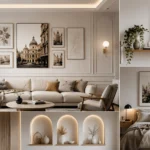
- Placement: Sofa backdrop or TV wall
- Purpose: Central identity definition
- Rule: Keep 80% neutral dominance
Bedroom
- Placement: Headboard area
- Purpose: Calm luxury signaling
- Avoid: Excess reflection near rest zones
Dining Room
- Placement: Dining backdrop wall
- Purpose: Warmth + gathering enhancement
Entryway
- Placement: Single statement piece
- Purpose: Instant luxury encoding
Hallways
- Use minimal gold frames
- Maintain directional visual flow
Modern European Trends 2026
Key Evolution Patterns
1. Matte Gold Dominance
Gloss reduction improves sophistication perception.
2. Geometric Minimalism
Thin-line structures replace heavy ornamentation.
3. Material Fusion Systems
- Wood + gold
- Stone + gold
- Fabric + gold
4. Built-in Architectural Gold
Gold becomes part of structure, not decoration.
5. Cognitive Minimalism Design
Focus on emotional clarity over visual density.
Common Mistakes in Gold Wall Design
- Overuse across multiple walls
- Mixing incompatible metallic tones
- Poor lighting calibration
- Oversized decorative dominance
- Lack of neutral balancing layers
Pros & Cons
Advantages
- High perceived luxury value
- Enhances ambient lighting
- Works across design styles
- Long-term aesthetic relevance
Disadvantages
- Easy to overuse
- Requires design discipline
- Lighting-sensitive material
- Can feel excessive if misapplied
Expert Styling Tips
- Apply gold as a secondary accent layer
- Maintain neutral visual ecosystem
- Use single focal wall strategy
- Integrate layered warm lighting
- Combine with natural textures
Future of Gold Decor for Walls
The future trajectory indicates:
- Smart adaptive lighting integration
- Sustainable metallic composites
- Hybrid digital-physical wall systems
- AI-assisted interior personalization
Gold will persist, but in a reduced, intelligent, and adaptive form.
Frequently Asked Questions
Yes, especially when used in minimal European-style interiors.
Yes, but only as accents—not full-wall coverage.
White, beige, grey, and earthy tones work best.
Yes, but in matte and minimal geometric styles.
Overusing gold without balance or proper lighting.
Final Insight
Gold decor for walls in 2026 is no longer decorative excess—it is a structured visual intelligence system. When applied with precision, it enhances emotional perception, spatial harmony, and architectural luxury identity.