Gallery Wall Decor : European Design System, Layout Psychology & Advanced Styling Framework
Gallery wall decor has evolved into one of the most influential interior design systems across Europe in 2026. It is no longer treated as simple wall decoration or random arrangement of pictures. Instead, it has transformed into a structured visual communication system that reflects identity, emotion, memory, and spatial intelligence.
From compact urban apartments in Frankfurt and Berlin to minimalist Scandinavian homes and artistic Parisian interiors, gallery walls are now intentionally constructed using design logic rather than instinct.
In NLP (Neuro-Linguistic Programming) terms, a gallery wall is a visual anchoring system. It triggers emotional associations, memory recall, and subconscious perception of harmony or imbalance.
A well-designed gallery wall communicates:
- Emotional stability
- Personal storytelling
- Spatial intelligence
- Aesthetic discipline
But most importantly, it creates a perceived luxury effect without requiring expensive materials.
The Core Misunderstanding Most People Have
Many homeowners believe gallery walls are about:
- Buying stylish frames
- Collecting random artwork
- Filling empty wall space
However, in professional European interior design, this approach is considered outdated.
The reality is:
A visually powerful gallery wall is not built on decoration—it is built on systematic spatial reasoning, psychological balance, and structured composition rules.
This guide will break down that system completely.
What is Gallery Wall Decor?
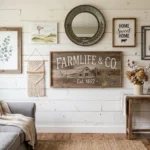
Gallery wall decor refers to a curated multi-element visual composition system applied to vertical surfaces, combining:
- Photography
- Art prints
- Textural objects
- Visual memories
- Graphic elements
These components are arranged into a coherent visual narrative field.
Modern European Interpretation
In modern European interior design thinking, gallery walls follow these principles:
Intentional visual structuring
Psychological balance of weight and spacing
Narrative-driven composition
Integration with lighting and furniture geometry
Traditional vs Modern System
| Traditional Approach | Modern European System |
| Decorative filling | Intentional composition |
| Random placement | Structured layout logic |
| Matching frames only | Controlled variation |
| Static visuals | Emotional storytelling system |
The shift is from “decoration mindset” to “design intelligence mindset.”
Why Gallery Wall Decor is Dominating Europe in 2026
The rise of gallery walls is not accidental. It is driven by deep cultural and psychological shifts across Europe.
1. Urban Living Optimization
Smaller apartments require vertical space utilization systems, making gallery walls ideal for compact environments.
2. Emotional Design Demand
Modern homeowners want interiors that reflect:
- Identity
- Memory
- Lifestyle
- Emotional resonance
3. Minimalism Evolution
Minimalism is no longer empty space—it is meaningful minimalism, where fewer objects carry more significance.
4. Social Media Influence
Platforms like Instagram and Pinterest have normalized:
- Curated walls
- Aesthetic storytelling
- Interior “visual identity branding”
5. Cultural Shift Toward “Curated Living”
Homes are now seen as:
“personal museums of experience”
Gallery Wall Psychology
Gallery wall decor works because it interacts with human perception systems.
1. Visual Anchoring Principle
The brain naturally assigns meaning to dominant visual elements.
A strong central artwork becomes a psychological anchor, guiding interpretation of surrounding elements.
2. Cognitive Balance Response
Humans subconsciously prefer:
- Balanced weight distribution
- Predictable spacing rhythm
- Controlled asymmetry
When imbalance occurs, discomfort is perceived—even without conscious awareness.
3. Controlled Complexity Effect
Luxury perception is created through:
Structured variation
Not perfect symmetry
Intentional irregularity
Too perfect = artificial
Too random = chaotic
Controlled variation = premium aesthetic signal
4. Emotional Encoding System
Each frame acts as an emotional trigger unit, activating:
- Memory recall
- Mood association
- Identity reinforcement
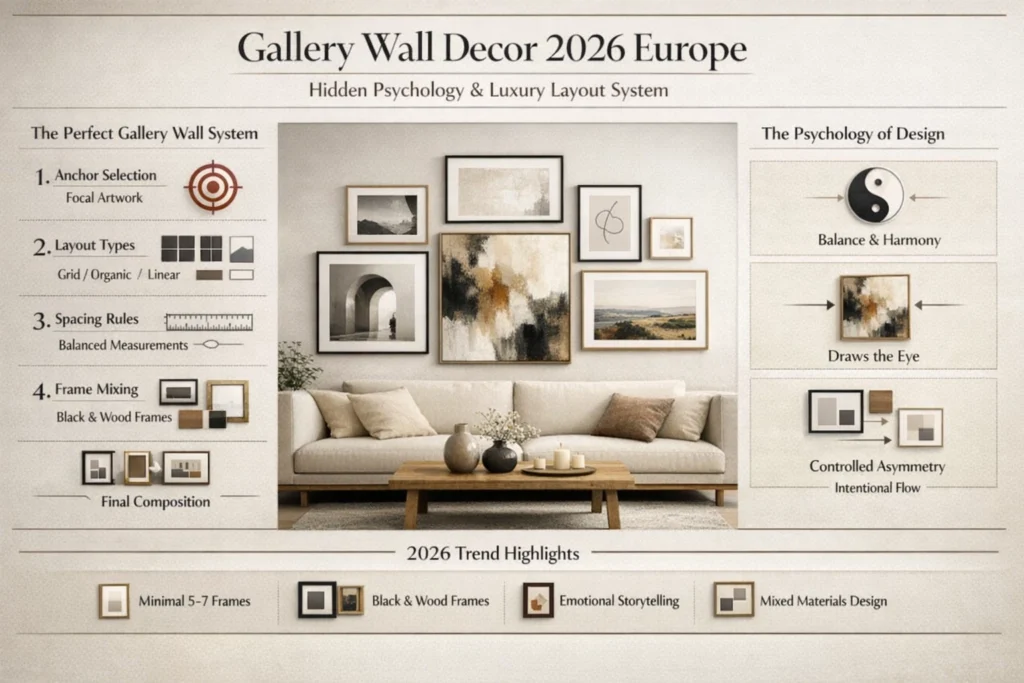
Step-by-Step Gallery Wall Decor System
This is a structured design algorithm used by interior professionals.
1: Anchor Selection
Choose the most emotionally or visually dominant element.
Examples:
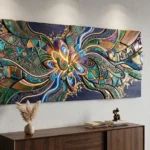
- Large abstract canvas
- Black & white portrait
- Architectural photography
This becomes your visual command center
2: Layout Strategy Selection
There are three dominant European systems:
1. Grid System
- Perfect alignment
- Equal spacing
- Mathematical symmetry
Best for:
- Offices
- Minimalist interiors
2. Organic Flow System
- Asymmetrical balance
- Fluid composition
- Emotional arrangement
Best for:
- Living rooms
- Creative spaces
3. Linear Narrative System
- Horizontal progression
- Directional storytelling
- Spatial movement effect
Best for:
- Hallways
- Staircases
3: Spacing Intelligence Rule
Spacing is the most critical design variable.
| Wall Type | Recommended Spacing | Effect |
| Small wall | 3–5 cm | Compact refinement |
| Medium wall | 5–8 cm | Balanced structure |
| Large wall | 8–12 cm | Gallery-style openness |
Consistency is more important than exact measurement.
4: Frame System Optimization
Avoid uniformity.
Instead apply:
- 2–3 frame material types maximum
- Shared color palette
- Controlled variation in thickness
This creates visual depth layering.
5: Expansion from Anchor Principle
Build outward using:
- Medium frames near anchor
- Small frames on edges
- Visual rhythm repetition
Think of it as emotional expansion waves
Gallery Wall Layout Systems
Grid Layout
- Structured geometry
- Minimalist discipline
- High visual order
Organic Layout
- Emotional asymmetry
- Flow-based structure
- Artistic unpredictability
Linear Layout
- Horizontal storytelling
- Motion illusion
- Spatial elongation
Room-by-Room Gallery Wall Strategy
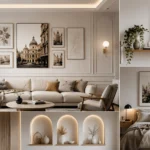
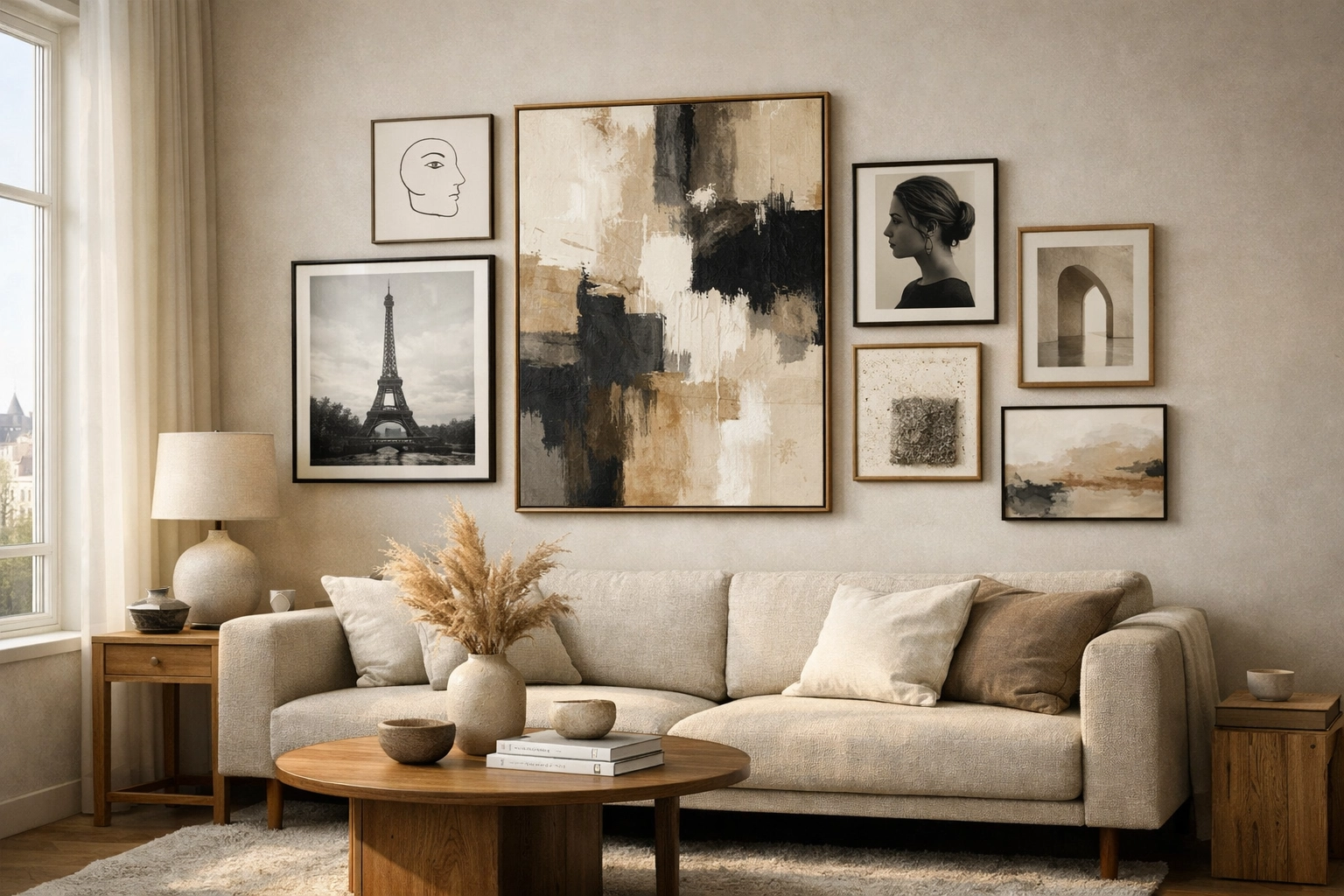
Living Room
This is the most important visual area in the home.
Key principles:
- Large anchor above sofa
- Balanced asymmetry
- Mixed media integration
Style direction:
- Neutral tones
- Black thin frames
- Abstract + photography mix
Bedroom
Focus:
- Calmness
- Cognitive relaxation
- Minimal stimulation
Guidelines:
- Soft colors
- Symmetrical layout preferred
- Nature imagery
Hallway
Focus:
- Movement storytelling
- Sequential visual flow
Rules:
- Linear arrangement
- Repetition pattern
- Equal spacing rhythm
Dining Area
Focus:
- Warmth
- Conversation stimulation
Best visuals:
- Food photography
- Cultural imagery
- Warm-toned artwork
Common Gallery Wall Design Errors
Avoid these structural mistakes:
Absence of focal anchor
Random spatial placement
Inconsistent spacing logic
Overcrowding visual field
Excessive frame diversity
These disrupt cognitive harmony instantly.
2026 European Gallery Wall Trends
Leading trends include:
- Black + natural wood combinations
- Monochrome visual sets
- Emotional narrative compositions
- Mixed-material wall systems
- Minimal 5–7 piece layouts
- Architectural photography dominance
The dominant direction is reduction with meaning increase
Gallery Wall Planning Framework
| Step | Action | Outcome |
| 1 | Select anchor | Visual dominance |
| 2 | Choose layout | Structural logic |
| 3 | Define spacing | Harmony control |
| 4 | Frame system | Depth creation |
| 5 | Build outward | Final composition |
Advanced Designer Secrets
Professional interior designers apply hidden cognitive rules:
Always begin with largest visual element
Layout frames on floor before installation
Maintain breathing space between elements
Use odd-number composition (3, 5, 7)
Limit material types to maximum three
These micro-decisions produce macro luxury perception.
Advantages & Limitations
Advantages
- Enhances personal identity expression
- Works in all spatial sizes
- Flexible and scalable system
- Budget-friendly transformation method
- Strong emotional impact
Limitations
- Requires planning discipline
- Poor execution leads to visual chaos
- Needs periodic adjustment
Implementation Mindset Shift
Gallery wall decor is not about decoration—it is about system-based visual intelligence.
When you apply:
- Spatial psychology
- Layout engineering
- NLP-based perception control
- European design logic
You don’t decorate walls
You engineer emotional environments
FAQs
Organic layouts are most popular in modern European homes because they feel natural and balanced.
Usually 5–9 frames work best for a balanced look.
No. Modern design prefers coordinated variation instead of identical frames.
Between 5–10 cm depending on wall size.
Yes. Small spaces often benefit the most from smart gallery wall design.
Final Conclusion
Gallery wall decor in 2026 represents a shift from decorative randomness to structured visual intelligence.
When executed correctly, it becomes:
- A psychological anchor system
- A storytelling medium
- A spatial harmony framework
In modern European design philosophy, a wall is no longer a surface
It is a structured emotional language system