Introduction
In 2026, the bathroom has completely transformed from a purely functional utility zone into a highly curated wellness environment.
Across major European design capitals such as Berlin, Paris, Milan, Amsterdam, Vienna, and Copenhagen, bathrooms are now considered:
- Personal relaxation sanctuaries
- Mini spa-inspired interiors
- Emotional reset environments
- Lifestyle expression zones
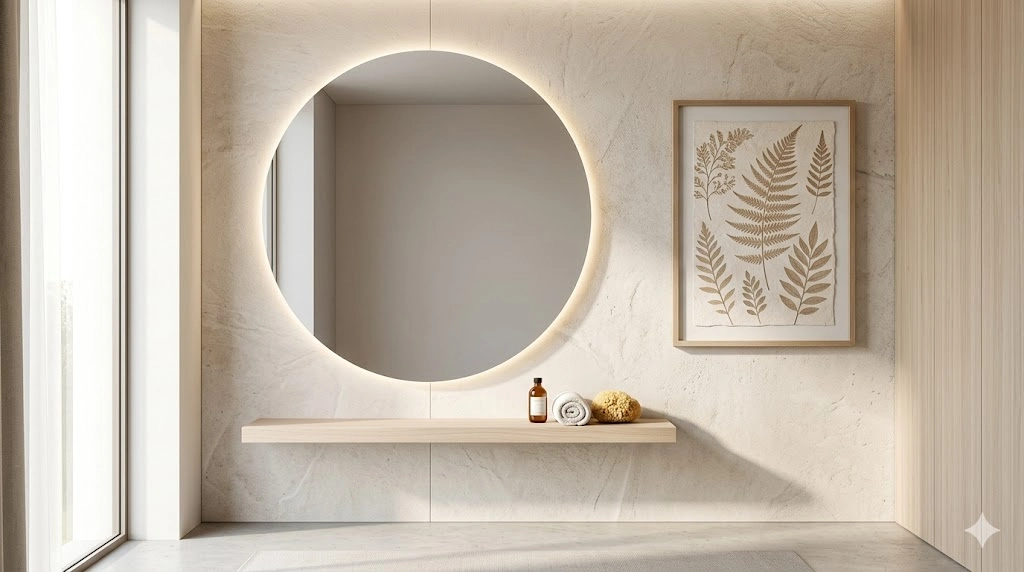
This transformation has made wall decorations bathroom design one of the most essential aspects of modern interior architecture.
However, most online sources still provide overly simplistic advice such as:
- “Add mirrors for space”
- “Use wall art for beauty”
- “Place plants for freshness”
These suggestions lack structural depth.
What is missing is the systematic European design methodology that professionals actually use.
This guide reveals the complete European Bathroom Wall Design System (2026) with advanced principles, placement logic, material science, and psychological impact strategies.
Why Wall Decorations Bathroom Design Matters in 2026
Modern European interiors operate on a fundamental philosophy:
A space must not only appear visually appealing but also emotionally resonate with its user.
Bathrooms hold special significance because they are used at the beginning and end of daily life.
They influence:
- Morning mindset activation
- Evening relaxation quality
- Stress reduction levels
- Mental clarity and emotional balance
In 2026, bathrooms are no longer hidden utility corners.
They are designed as:
Wellness-Focused Spaces
Where mental calmness and relaxation are prioritized.
Emotional Recovery Zones
Where psychological pressure is reduced.
Aesthetic Lifestyle Statements
Where personal taste and identity are expressed.
Thus, bathroom wall decoration planning has become a critical part of European interior design thinking.
The European Bathroom Wall Design System
European designers avoid random decoration. Instead, they follow structured spatial logic systems that regulate:
- Visual harmony
- Material coherence
- Emotional influence
- Spatial movement
Let’s explore the core framework.
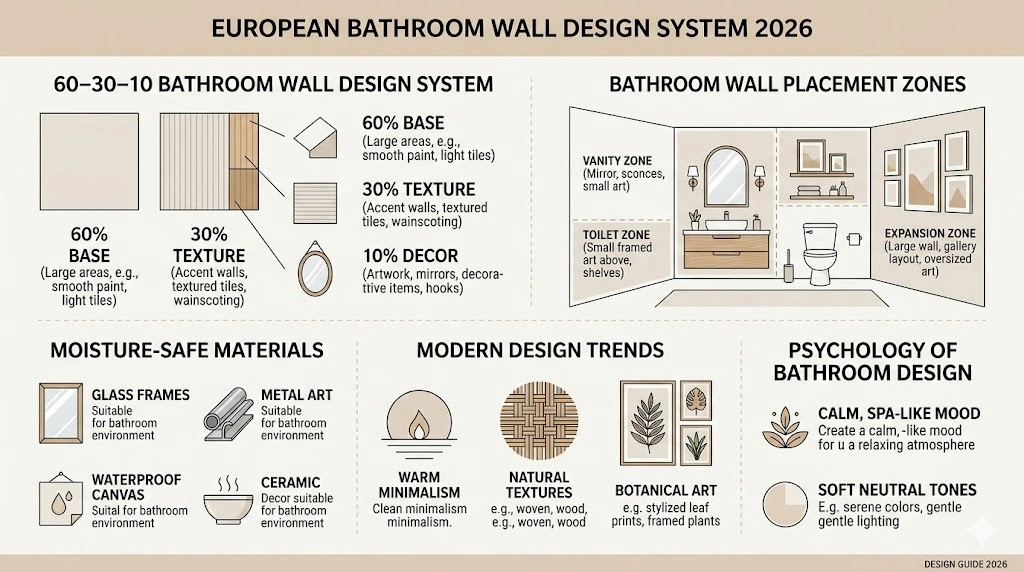
The 60–30–10 Wall Composition Rule
This rule is the foundation of professional European bathroom interiors.
60% Base Layer
This includes:
- Ceramic tiles
- Waterproof wall paint
- Marble surfaces
- Natural stone finishes
This layer defines durability, stability, and overall mood.
30% Secondary Texture Layer
This layer introduces depth and warmth:
- Wooden paneling
- Stone cladding
- Textured plaster finishes
- Architectural relief surfaces
This prevents the bathroom from appearing flat or sterile.
10% Decorative Accent Layer
This is where styling occurs:
- Framed artwork
- Mirrors
- Sculptural décor
- Minimal wall accents
Key principle:
Overloading this zone destroys visual harmony.
Minimalism always creates premium perception.
Bathroom Wall Placement Zones
Placement is more important than decoration itself.
European designers divide bathroom walls into functional zones:
Above Toilet Zone
Best suited for:
- Small framed artworks
- Minimalist visuals
- Light decorative elements
Rules:
- Center alignment is mandatory
- Eye-level placement (~145 cm height)
- Keep visual simplicity
This is considered a “quiet visual zone.”
Vanity Wall Zone
This is the primary focal point.
Includes:
- Mirror installation
- Lighting integration
- Side decorative elements
Rules:
- Maintain symmetry or controlled asymmetry
- Avoid overcrowding
- Ensure breathing space around objects
This zone defines first visual impression.
Empty Expansion Zone
Often ignored, yet highly impactful.
Used for:
- Vertical art pieces
- Tall decorative elements
- Linear visual structures
Purpose: enhances perceived ceiling height and spatial openness.
Scale Rules
Scale determines whether a bathroom appears:
- Luxurious or cheap
- Balanced or chaotic
- Professional or amateur
| Bathroom Size | Decoration Strategy | Rule |
| Small | Minimal | One focal object only |
| Medium | Balanced | Mirror + 1–2 accents |
| Large | Expressive | Feature wall allowed |
Incorrect scale usage creates visual disorder even with expensive décor.
Best Wall Decorations Bathroom Ideas
Now let’s explore dominant European styling directions.
Botanical Wall Art Trend
Nature-inspired visuals dominate European interiors.
Why it works:
- Reduces mental stress
- Creates organic freshness
- Complements natural materials
Popular themes:
- Leaf patterns
- Fern illustrations
- Soft botanical sketches
Ideal for Scandinavian-inspired bathrooms.
Minimalist Abstract Artwork
Minimalism remains a dominant design language in 2026.
Characteristics:
- Neutral color palette
- Simple geometric forms
- Low visual complexity
Best suited for:
- Luxury apartments
- Modern interiors
- Calm environments
Statement Mirrors as Functional Art
Mirrors serve dual roles:
- Functional utility
- Decorative focal point
Benefits:
- Enhances light distribution
- Expands visual space
- Adds premium aesthetic value
Trending styles:
- Round Nordic mirrors
- Frameless designs
- Brass or matte black frames
Textured Wall Surfaces
Texture is a major 2026 trend.
Materials include:
- Natural wood
- Stone panels
- 3D ceramic tiles
Adds architectural depth without clutter.
Functional Decorative Elements
Modern European bathrooms combine utility and aesthetics.
Examples:
- Floating shelves
- Designer hooks
- Integrated storage décor
Functionality is now a luxury design element.
Bathroom Wall Materials That Actually Work
Bathrooms require moisture-resistant solutions.
Safe Material Options
- Waterproof canvas prints
- Glass-framed artwork
- Metal décor elements
- Ceramic accessories
Materials to Avoid
- Paper-based posters
- Untreated wood near steam
- Low-quality fabric prints
Humidity quickly damages weak materials.
Bathroom Wall Psychology
Design directly influences mental state.
Spa Effect Principle
European designers use sensory calming techniques:
- Soft colors reduce anxiety
- Natural textures improve relaxation
- Minimal composition prevents cognitive overload
Psychological Color Palette
- Warm white
- Soft beige
- Misty blue
- Light sage green
These tones dominate modern European bathroom interiors.
2026 European Bathroom Wall Design Trends
Warm Minimalism
Cold grey aesthetics are declining.
New direction:
- Beige dominance
- Clay-based tones
- Warm neutral palettes
Natural Material Revival
Luxury now equals authenticity:
- Wood surfaces
- Stone textures
- Handmade ceramics
Organic Imperfection Style
Perfect symmetry is being replaced by:
- Natural asymmetry
- Handmade textures
- Soft irregular balance
This creates emotional comfort and realism.
Small Bathroom Wall Decoration Strategy
Small European bathrooms require precision.
Core principle:
Less elements, greater intention.
Best practices:
- One focal art piece
- Vertical visual expansion
- Light tonal palette
Avoid:
- Over-decoration
- Dark visual weight
- Excess framing
Professional Bathroom Styling Formula
European designers use a simple equation:
(Mirror + Art + Texture) × Balance = Premium Bathroom Interior
Example:
- Round mirror
- Botanical artwork
- Wood texture panel
Result: spa-like luxury environment.
Common Mistakes in Bathroom Wall Decoration
Avoid these errors:
- Overcrowding walls
- Ignoring humidity resistance
- Incorrect scaling
- Mixing unrelated styles
- Poor placement height
Even expensive décor fails without structural logic.
Bathroom Wall Decoration Style Comparison
| Style | Effect | Best Use | Risk |
| Minimalist | Calm & clean | Small bathrooms | Low |
| Botanical | Natural & soft | Spa spaces | Low |
| Luxury Modern | Bold elegance | Villas | Medium |
| Textured | Deep visual richness | Large bathrooms | Medium |
| Functional | Practical beauty | Urban homes | Low |
Step-by-Step Bathroom Wall Decoration System
1: Identify Space Size
Small, medium, or large categorization.
2: Select Design Direction
Minimal, botanical, or luxury modern.
3: Apply 60–30–10 Rule
Establish visual structure.
4: Define Placement Zones
Mirror, toilet, and expansion zones.
5: Choose Moisture-Safe Materials
Ensure durability.
6: Add One Key Focal Element
Avoid clutter.
7: Final Balance Evaluation
Check spatial harmony.
FAQs
Water-resistant framed prints, ceramic pieces, and metal artwork perform best.
Yes, but only waterproof sealed canvas placed away from moisture exposure.
Minimalist and vertically oriented designs are most effective.
They use natural materials, soft colors, and minimal spa-inspired compositions.
Warm beige, misty blue, soft green, and neutral white tones dominate.
Conclusion
The future of wall decorations bathroom design in 2026 is no longer about filling empty surfaces.
It is about:
- Structured composition
- Emotional intelligence
- Material authenticity
- Spatial balance
- Psychological comfort
When the European design system is applied correctly, even a small bathroom transforms into:
- A luxury spa environment
- A calm emotional retreat
- A modern architectural statement
That is the true essence of bathroom wall design evolution in 2026.