Introduction
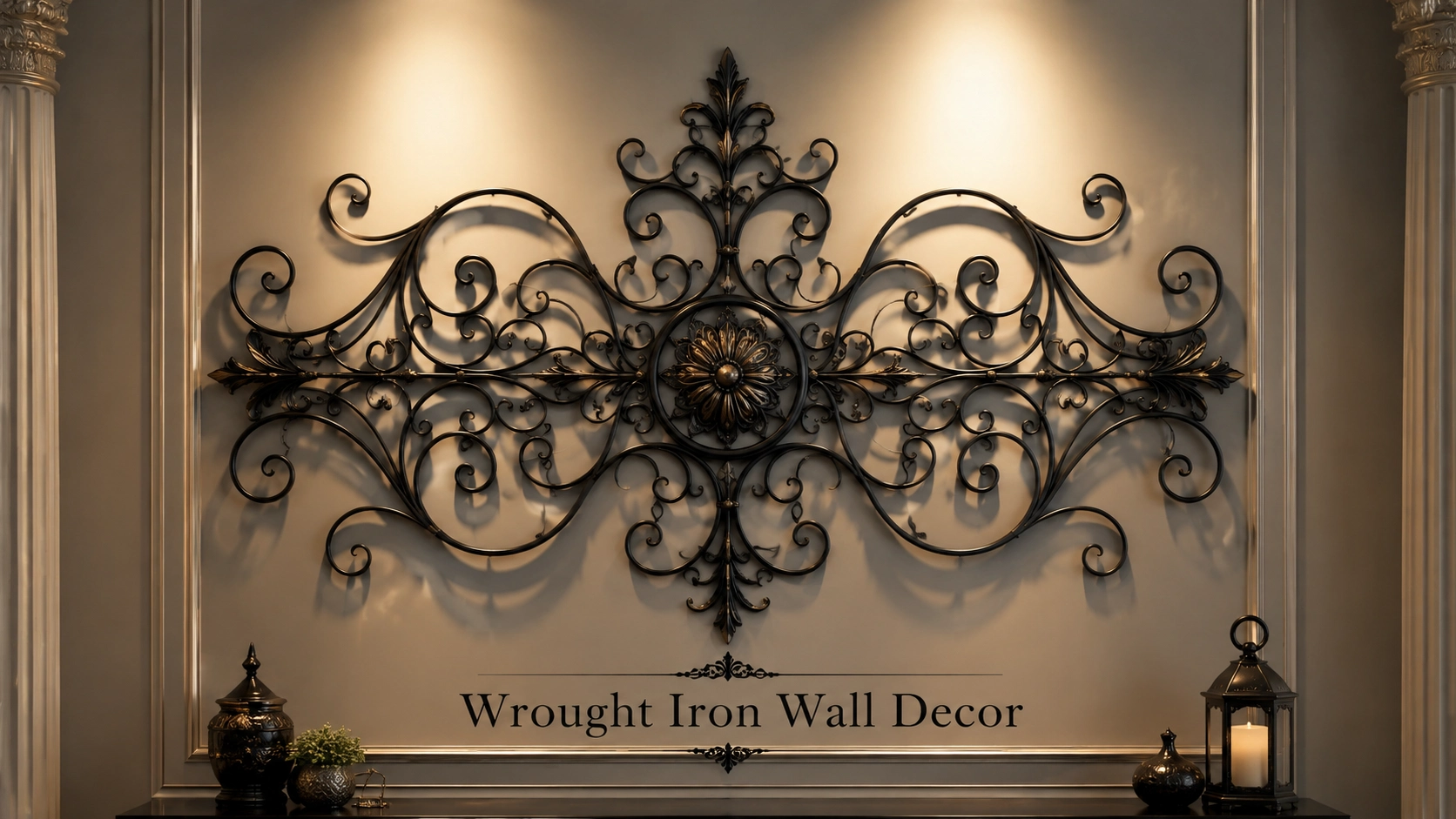
In 2026, wrought iron wall decor has evolved far beyond simple ornamentation or decorative wall filling. It is now recognized as a full-scale European architectural language used across luxury residences, boutique hotels, contemporary apartments, heritage restorations, and high-end interior environments.
Unlike traditional framed artwork, posters, or printed canvases, wrought iron introduces a fundamentally different spatial experience. It is not a flat visual object; it is a dimensional structure that interacts with light, shadow, and architectural geometry.
Key experiential qualities include:
- Strong three-dimensional depth perception
- Dynamic shadow projection across surfaces
- Sculptural identity integrated into architecture
- Long-lasting material permanence and durability
Rather than simply being placed on a wall, wrought iron becomes part of the wall’s identity. It merges with the architectural surface and transforms it into an expressive design feature.
Across Europe—particularly in France, Italy, Spain, Germany, and Central European regions—wrought iron carries deep historical and cultural significance. It has been used for centuries in castles, palaces, balconies, gates, stair railings, and aristocratic residences. Today, contemporary designers are reinterpreting this heritage material into modern interior environments with a refined philosophy:
Walls are no longer passive surfaces. They are active architectural experiences.
This comprehensive guide explains the complete European luxury system of wrought iron wall decor, including design psychology, spatial rules, stylistic classifications, material logic, placement frameworks, and expert-level interior strategies.
What Is Wrought Iron Wall Decor?
Wrought iron wall decor refers to artistically forged or industrially shaped iron compositions mounted onto vertical architectural surfaces to introduce texture, depth, structure, and visual hierarchy.
However, in modern interior design theory, its meaning extends far beyond decoration.
Core Design Identity
Wrought iron wall decor functions as:
- A three-dimensional architectural surface intervention
- A generator of controlled light-shadow interaction
- A structural focal anchor within interior composition
- A material expression of luxury craftsmanship
Essential Characteristics
✔ Strong tactile and visual texture ✔ Exceptional durability and structural integrity ✔ Reactive shadow behavior under lighting ✔ Sculptural, non-flat spatial presence ✔ Compatibility with both modern and classical interiors
Comparison: Wrought Iron vs Traditional Wall Art
| Feature | Wrought Iron Wall Decor | Canvas / Printed Art |
| Dimensionality | 3D architectural form | Flat visual surface |
| Material | Forged metal (iron) | Fabric / paper / ink |
| Shadow Interaction | High dynamic shadow play | Minimal or none |
| Durability | Extremely long-lasting | Moderate lifespan |
| Design Function | Architectural integration | Decorative enhancement |
Key Insight
Wrought iron wall decor should not be interpreted as “art placed on a wall.” Instead, it should be understood as “architecture embedded into a wall.”
European Heritage Behind Wrought Iron Design
The luxury identity of wrought iron is deeply rooted in European architectural history.
French Influence: Ornamental Luxury Expression
France played a critical role in shaping decorative iron traditions across aristocratic architecture.
Common applications included:
- Royal palaces
- Château interiors
- Grand staircases
- Decorative balconies
Design characteristics:
- Floral and botanical curves
- Baroque-inspired richness
- Symmetrical ornamental compositions
- Romantic and expressive detailing
This established wrought iron as a symbol of refinement and prestige.
Italian Influence: Structural Precision and Balance
Italian design philosophy introduced a more disciplined and architectural approach.
Key traits include:
- Renaissance proportional systems
- Geometric alignment and harmony
- Clean forged structural lines
- Mathematical spatial balance
Italian wrought iron emphasizes engineering clarity rather than decorative excess.
Spanish & Mediterranean Influence: Organic Expression
Southern European traditions contributed warmth and fluidity.
Features include:
- Sun-inspired motifs
- Organic flowing curves
- Rustic handcrafted aesthetics
- Emotional material texture
Modern European Synthesis (2020–2026)
Contemporary European interiors merge all historical influences into a unified modern language:
- Minimal luxury environments
- Industrial-modern fusion spaces
- Sculptural wall installations
- Architectural composition-based interiors
Why Wrought Iron Wall Decor Is Trending in 2026
Modern interior design trends strongly favor tactile, material-rich environments over flat visual decoration.
Key Drivers of Popularity
1. Shift Toward Textural Interiors
Homeowners increasingly prefer walls that feel physically expressive rather than visually printed.
2. Need for Strong Focal Anchors
Minimalist interiors require dominant statement elements to avoid visual emptiness.
3. Return to Authentic Materials
Natural and industrial materials like iron are perceived as more honest and timeless.
4. Architectural Wall Thinking
Walls are now treated as design structures rather than simple partitions.
5. Emotional Interior Design
Wrought iron introduces mood, atmosphere, and narrative depth.
European Design System for Wrought Iron Wall Decor
This section defines the structural methodology behind professional application.
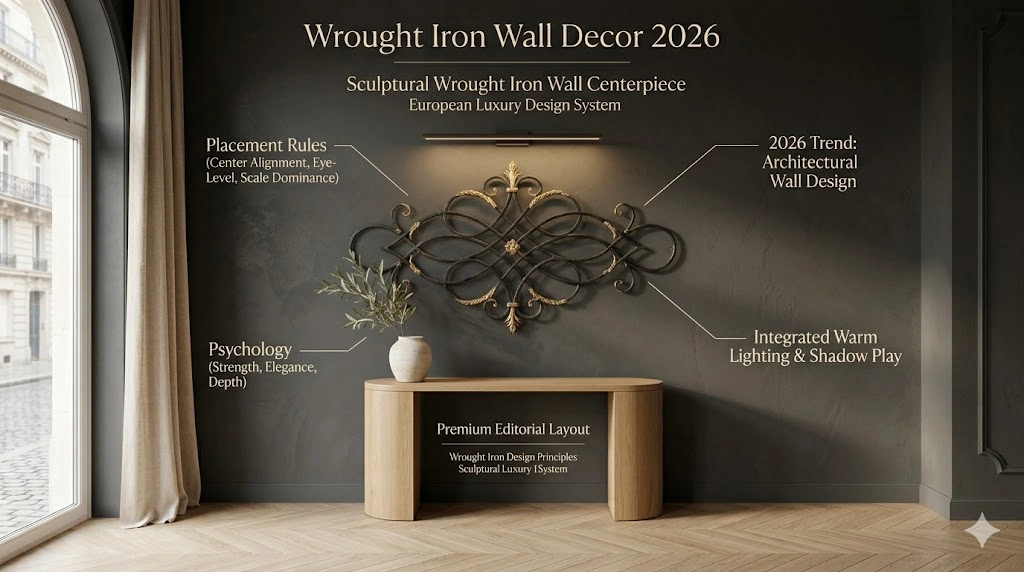
1. Structural Balance Principle
Iron placement must align with architectural geometry:
- Sofa center axis
- Bed alignment line
- Door symmetry axis
- Wall proportional structure
2. Negative Space Strategy
Luxury design relies heavily on controlled emptiness.
- Excess iron creates visual chaos
- Balanced spacing enhances elegance
3. Shadow Composition Principle
Lighting becomes an active design element.
- Warm lighting creates softness
- Side lighting enhances drama
- Ceiling lighting adds depth layering
4. Scale Dominance Rule
One dominant piece is preferred over multiple fragmented elements.
Types of Wrought Iron Wall Decor 2026 Styles
1. Minimalist Geometry Iron Art
- Linear compositions
- Grid-based design
- Scandinavian influence
2. Botanical Iron Sculptures
- Leaf motifs
- Vine structures
- Organic elegance
3. Vintage European Iron Panels
- Château-inspired aesthetics
- Classical symmetry
- Antique detailing
4. Industrial Modern Iron Walls
- Raw black finishes
- Urban loft styling
- Bold structural presence
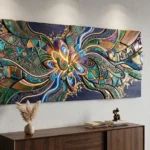
5. Sculptural Luxury Installations
- Multi-layered iron forms
- Gallery-inspired compositions
- High-end artistic expression
Placement Rules
Golden Placement Formula
- 60–75% wall coverage principle
- Center-aligned positioning
- Eye-level height (145–160 cm)
- Lighting integration required
Room-Based Application
Living Room: Large central installation behind sofa
Bedroom: Headboard-style iron structure
Dining Room: Vertical elegant iron panels
Entryway: Statement sculpture for first impression
Psychological Impact of Wrought Iron
Wrought iron evokes strong emotional associations:
- Stability and strength
- Luxury authority perception
- Authentic handcrafted identity
- Mystery through shadow depth
Psychological interpretation:
The space communicates permanence, intention, and refined control.
Materials & Finishes 2026 Trends
- Matte black iron
- Antique bronze
- Brushed gold accents
- Natural oxidized iron
Emotional Mapping
- Black: authority and modernity
- Gold: richness and luxury
- Bronze: warmth and tradition
- Raw iron: authenticity and strength
Material Comparison Overview
Wrought iron outperforms other decorative materials when architectural impact is required.
- Canvas: visual storytelling
- Wood: natural warmth
- Iron: structural luxury dominance
Advantages and Limitations
Advantages
- High durability
- Luxury aesthetic value
- Architectural integration
- Lighting enhancement capability
Limitations
- Requires strong installation
- Heavy material handling
- Needs lighting coordination
- Not suitable for very small spaces
Room-Based Styling System
Each room requires a different Proportional strategy:
- Living room: bold centerpiece
- Bedroom: soft integrated design
- Dining room: vertical elegance
- Entryway: statement identity piece
Buying Strategy Framework
Selection depends on:
- Wall dimensions
- Interior style direction
- Lighting availability
- Color palette harmony
- Desired visual dominance
Rule:
Minimal interiors require bold iron. Complex interiors require subtle iron.
Common Design Mistakes
- Overuse of small elements
- Lack of lighting planning
- Improper scale selection
- Misaligned placement
- Mixed stylistic confusion
Maintenance Guidelines
- Occasional dust cleaning
- Avoid moisture exposure
- Secure mounting checks
- Dry environment maintenance
FAQs
Yes, it is increasingly popular due to architectural and sculptural design trends.
Yes, it integrates well into modern, minimalist, and industrial spaces.
Yes, if scaled appropriately and minimally designed.
Yes, lighting enhances its shadow architecture.
Conclusion
Wrought iron wall decor in 2026 is more than a decorative choice—it is a refined European architectural design system that blends heritage craftsmanship with modern interior thinking. Its strength lies in creating depth, structure, and emotional atmosphere through material, light, and shadow rather than flat visual appeal.
When applied with correct scale, placement, and lighting, it transforms ordinary walls into timeless luxury statements that feel both artistic and architectural.