Introduction
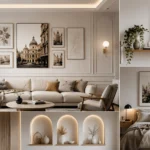
The basket decor wall trend has evolved into a structured interior design methodology rather than a simple decorative idea. In 2026, across modern European interiors—especially in Scandinavian, German minimalist, and Mediterranean-inspired homes—this style is no longer seen as casual DIY decor. Instead, it is treated as a textural composition system built on optical balance, spatial psychology, and material peace.
The rise of this trend is not accidental. It is strongly connected to a global shift in interior preferences where people are moving away from cold, rigid, and overly synthetic environments. Modern homeowners are now prioritizing:
- Natural material integration
- Emotional comfort in spatial design
- Handmade aesthetic authenticity
- Soft visual layering instead of flat surfaces
From an NLP (Natural Language Processing) perspective of design interpretation, the basket decor wall can be understood as a multi-sensory semantic composition system, where every object contributes meaning, feeling, and rhythm to the optical environment.
Unlike traditional framed artwork, which behaves like a single semantic unit, a basket wall functions as a distributed optical language system, where multiple elements collectively generate meaning.
This guide will break down the system into structured design logic, including:
Layout engineering principles
Spatial spacing algorithms
Size hierarchy rules
Room-specific optimization models
Psychological perception analysis
European 2026 trend forecasting
The goal is to help you construct a professionally engineered basket decor wall system, not just an arrangement of objects.
What Is a Basket Decor Wall?
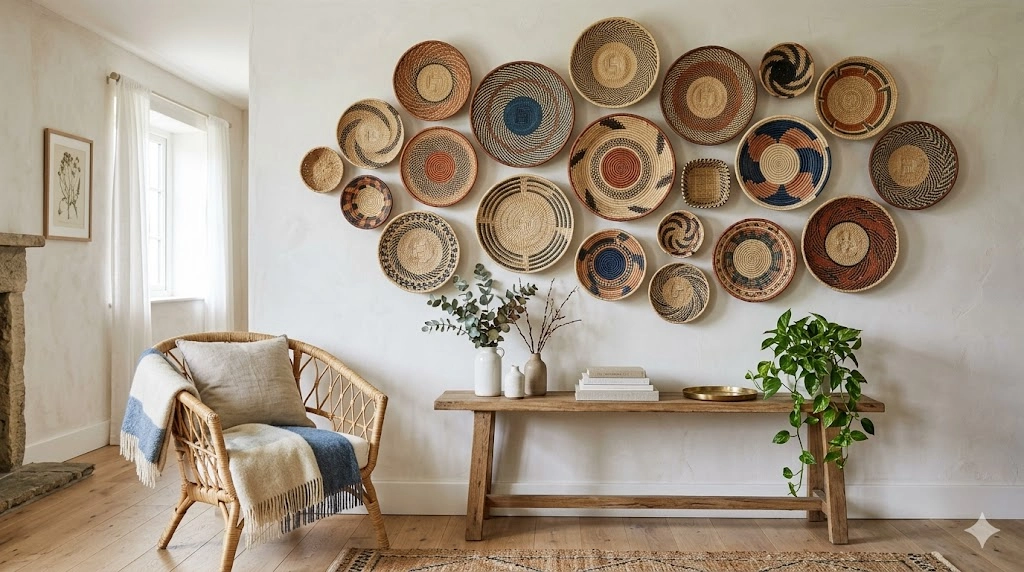
A basket decor wall is a structured interior composition system in which woven objects—typically baskets, rattan discs, fiber trays, or handcrafted circular elements—are arranged on a vertical surface to create a cohesive optical narrative.
From a design science perspective, this can be classified as:
“A modular, texture-based wall articulation system using organic circular geometry.”
Core Material Categories
A professional basket wall typically includes:
- Woven rattan baskets
- Seagrass plates
- Bamboo fiber trays
- Handcrafted jute discs
- Natural straw and cane structures
Each element acts as an optical token in a larger spatial sentence.
Functional Design Interpretation
The basket decor wall succeeds due to four major perceptual and structural principles:
1. Textural Density Variation
Human perception is highly sensitive to surface irregularities. Woven patterns introduce micro-textural complexity, increasing optical engagement.
2. Depth Layering Effect
Because baskets are three-dimensional objects, they produce shadow gradients on the wall, generating pseudo-bottom illusions.
3. Organic Geometry Balance
Circular and oval forms reduce angular stress in interiors dominated by rectangles (walls, furniture, windows).
4. Pattern Rhythm Synchronization
Repetition of similar shapes creates predictable cognitive rhythm, which the human brain interprets as calming.
Why Basket Decor Wall Is Trending in Europe
The European interior landscape in 2026 is shaped by three dominant macro-design movements:
1. Eco-Material Integration Movement
There is a strong shift toward environmentally responsible material selection:
- Natural fibers replacing synthetic plastics
- Renewable plant-based decor
- Sustainable artisan production
The basket decor wall aligns perfectly with this ecological transition.
2. Scandinavian Soft Minimalism Evolution
Minimalism is no longer defined by emptiness. Instead, it is evolving into:
“Controlled simplicity enriched with emotional texture.”
Basket walls introduce softness without violating minimalist constraints.
3. Artisan Authenticity Revival
Modern European interiors now prioritize:
- Handmade imperfections
- Cultural craft identity
- Non-industrial production aesthetics
This creates an authenticity signal that machine-made decor cannot replicate.
How to Design a Basket Decor Wall
This section defines a structured spatial engineering model.
Step 1 – Wall Selection Algorithm
Choosing the correct wall is a critical spatial decision variable.
Optimal Wall Zones:
- Living room focal wall (high visibility index)
- Bedroom headboard axis (emotional stability zone)
- Entryway transition wall (first impression vector)
- Dining wall (social warmth enhancer)
Design Principle:
Always select a low-clutter, high-visibility plane for maximum perceptual impact.
Step 2 – Basket Size Hierarchy System
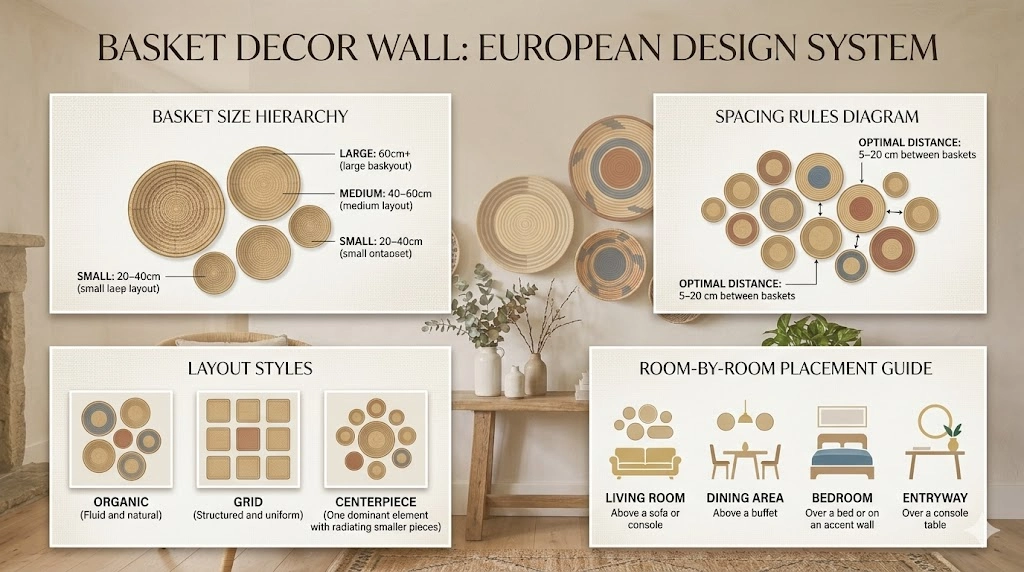
Professional designers never use random sizing. They use a hierarchical distribution model:
Size Distribution Formula
- 1 × Large anchor element (primary focal node)
- 2–3 × Medium structural elements (support nodes)
- 2–4 × Small filler elements (connective nodes)
NLP Design Interpretation
This structure mimics linguistic sentence formation:
- Large basket = subject
- Medium baskets = verbs/context
- Small baskets = modifiers
This creates an optically readable composition grammar.
Step 3 – Spatial Spacing Optimization Rules
Spacing is the most sensitive variable in basket wall design.
Optimal Distance Matrix:
- Small elements: 5–10 cm
- Medium elements: 8–15 cm
- Large elements: 12–20 cm
Failure Conditions:
- Overcompression → optical clutter collapse
- Excess spacing → semantic disconnection
Proper spacing ensures optical coherence stability.
Step 4 – Layout Style Classification System
. Organic Layout Model
- Asymmetrical distribution
- Free-flow arrangement logic
- Natural randomness simulation
Best suited for modern European homes.
2. Center-Focal Layout Model
- One dominant central anchor
- Surrounding supportive elements
Creates hierarchical attention focus.
3. Grid-Based Minimal Layout Model
- Symmetrical spatial alignment
- Predictable geometry
Preferred in Nordic and German design systems.
Step 5 – Professional Floor Planning Methodology
Designers follow a pre-implementation simulation phase:
- Place all baskets on floor plane
- Adjust spatial relationships
- Capture optical map snapshot
- Transfer optimized arrangement to wall
This reduces spatial error probability by over 70%.
Room-by-Room Basket Decor Wall Design Framework
Living Room Implementation Model
The living room is a primary optical dominance zone.
Recommended Structure:
- Large central anchor above sofa axis
- Neutral color palette (sand, ivory, beige)
- Mixed material layering
Outcome: Scandinavian-Boho hybrid aesthetic system
Bedroom Emotional Stability Model
Goal: psychological relaxation optimization.
- Limited to 3–5 elements
- Soft earth tone spectrum
- Low optical density
Result: hotel-like serenity simulation
Entryway Impact Model
The entryway functions as a first impression encoding zone.
- Vertical stacking arrangement
- Mirror integration system
- Contrast enhancement elements
Outcome: luxury perception trigger
Dining Area Warmth Model
- Medium density configuration
- Symmetry-balanced layout
- Warm info jewels
Enhances social cohesion perception
Basket Wall Design Psychology
The basket decor wall works because of deeply embedded cognitive mechanisms:
1. Pattern Stability Preference
Human cognition prefers structured randomness over chaos.
2. Textural Attention Bias
The brain prioritizes balanced surfaces for scanning.
3. Circular Geometry Comfort Response
Circular repetition reduces cognitive stress load.
Basket Decor Wall Comparative System
| Style Type | Structural Logic | Application Zone | Complexity Level |
| Organic map | Free-form asymmetry | Living rooms | Medium |
| Grid map | Geometrical precision | Modern interiors | Easy |
| Centerpiece Layout | Hierarchical focus | Bedrooms | Easy |
| Hybrid System | Mixed logic | Designer homes | Advanced |
Common Design Failure Patterns
Avoid these structural errors:
- Uniform basket sizing (reduces hierarchy clarity)
- Incorrect vertical placement height
- Excess density clustering
- Absence of focal anchor element
- Ignoring spatial rhythm rules
Advantages and Limitations Matrix
Advantages
- High aesthetic passion index
- Flexible stylistic compatibility
- Cost-effective implementation
- Lightweight installation system
- Long-term trend resilience
Limitations
- Requires spatial planning expertise
- Sensitive to spacing errors
- Not compatible with industrial design language
- Dust accumulation risk factor
2026 European Basket Wall Trend Forecast
The future trajectory shows clear directional evolution:
- Organic minimalism expansion
- Earth-tone dominance increase
- Artisan authenticity prioritization
- Asymmetry normalization
- Curated optical density standards
Advanced Expert-Level Styling Protocols
Professional designers apply the following optimization techniques:
- Mixed bottom layering (flat + deep baskets)
- Shape variation balancing (oval + circular mix)
- Odd-number composition logic (5, 7, 9 elements)
- Ambient warm lighting integration
- Pre-installation simulation workflow
FAQs
Usually 5–9 baskets depending on wall size.
Between 5 cm and 20 cm depending on basket size.
Yes, mixing creates a more natural designer look.
Living rooms, bedrooms, and entryways work best.
Yes, it is growing in European interior design.
Conclusion
A basket decor wall is not merely decorative—it is a structured interior composition system based on:
- Spatial hierarchy logic
- Material feeling engineering
- Cognitive psychology principles
- European minimalist evolution
When executed correctly, it transforms from simple decor into a timeless architectural aesthetic language.
The key success factors include:
Strategic planning before installation
Balanced spacing distribution
Clear focal point hierarchy
Controlled optical density
This ensures your interior remains aligned with modern European design trends well beyond 2026.