Introduction
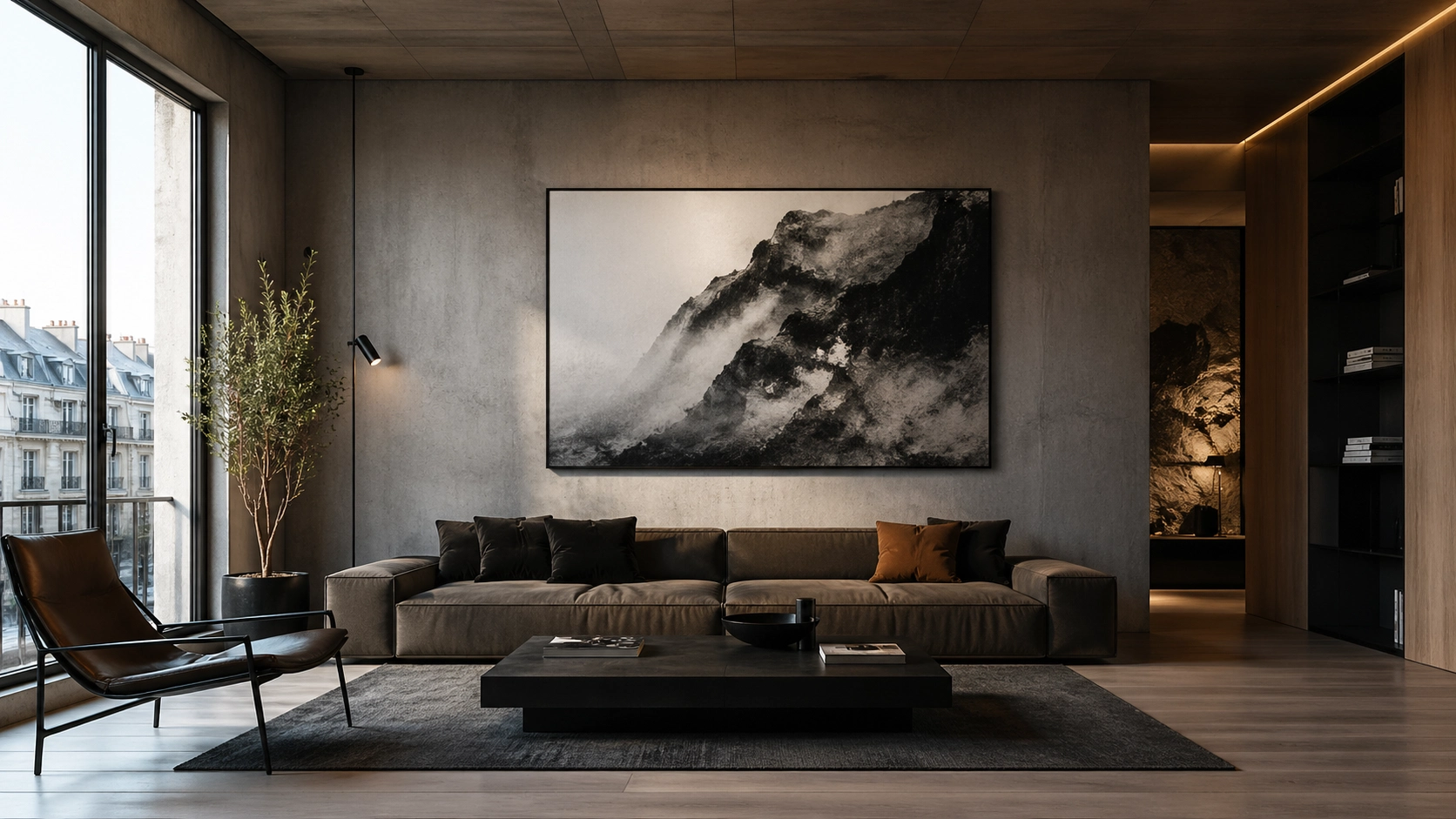
In the contemporary design landscape of 2026, wall art for men has evolved far beyond simple decoration or aesthetic enhancement. It has become a structured expression of identity architecture, psychological reinforcement, and lifestyle positioning.
Across Europe—from compact Scandinavian apartments to expansive Berlin industrial lofts—interior environments are increasingly curated with intention, emotional awareness, and functional clarity. Masculine interiors are no longer defined by cluttered aggression or random decoration. Instead, they are shaped through controlled visual language, tonal discipline, and meaningful artistic selection.
Modern men now design their living spaces with purpose. Walls are not empty boundaries; they are cognitive surfaces that influence behavior, mood, and self-perception. Every visual element communicates subconscious signals to the mind.
A masculine interior today expresses:
- Cognitive clarity and focus orientation
- Emotional equilibrium and controlled expression
- Structured ambition and goal-driven thinking
- Personal narrative and identity reinforcement
- Aesthetic discipline and minimal visual noise
Scientific research in environmental psychology confirms that repeated visual exposure directly influences neural response patterns. This means that what surrounds an individual daily becomes part of their mental conditioning system.
Therefore, choosing masculine wall art is no longer a decorative decision—it is a strategic psychological design process.
This comprehensive guide explores:
- Psychological foundations of masculine art perception
- European design evolution and stylistic direction
- Room-specific visual planning strategies
- Material intelligence in modern interiors
- Common design failures and optimization techniques
- Advanced styling frameworks for masculine spaces
Let’s construct a deeper understanding of how visual environments shape masculine identity in modern living spaces.
Psychological Foundations of Wall Art for Men
Why Visual Environments Shape Masculine Cognition
Human perception is continuously shaped by environmental stimuli. Walls, colors, shapes, and spatial compositions directly affect cognitive processing, emotional regulation, and behavioral output.
In masculine interior design, wall art becomes a silent psychological system that influences:
- Attention span and mental clarity
- Stress regulation and emotional stability
- Decision-making efficiency
- Self-confidence and identity reinforcement
- Productivity cycles and focus depth
Psychological Mechanisms Behind Masculine Wall Art
Different visual categories activate distinct neurological responses:
Minimalist Visual Structures
Minimalist compositions reduce sensory overload and eliminate unnecessary cognitive load. This leads to improved mental clarity and reduced anxiety response.
Dark and Neutral Tonal Systems
Dark palettes such as black, charcoal, navy, and deep grey create grounding effects. They enhance focus orientation and produce a controlled psychological environment.
Large-Scale Statement Artwork
Oversized visual pieces establish dominance perception within a space. This increases confidence levels and enhances perceived authority within personal environments.
Nature-Inspired Visual Elements
Natural imagery such as forests, mountains, and water landscapes reduces cortisol levels and supports emotional recovery cycles.
Geometric and Structured Art Forms
Geometric symmetry activates logical thinking patterns and supports analytical cognition, making it ideal for workspaces.
Identity Formation Through Wall Art
Interior environments act as externalized identity systems. What a person chooses to display visually becomes part of their subconscious self-definition.
In modern European design philosophy, especially in Scandinavian and German traditions, simplicity is not emptiness—it is intentional reduction for mental optimization.
Modern Styles of Wall Art for Men 2026 Trends
Minimalist Masculine Wall Art
Minimalism remains the dominant European interior direction due to its psychological efficiency and visual discipline.
Key Characteristics:
- Neutral chromatic palettes
- Spatial emptiness with intentional balance
- Reduced visual complexity
- Clean structural composition
Psychological Outcome:
- Reduced cognitive overload
- Improved focus and attention stability
- Enhanced mental calmness
Industrial Masculine Wall Art
Inspired by metropolitan environments such as Berlin, London, and Amsterdam, industrial design reflects structural strength and urban realism.
Features:
- Raw textures (metal, concrete, steel)
- Architectural photography
- Urban decay aesthetics
- Mechanical and structural themes
Psychological Outcome:
- Strength perception
- Productivity enhancement
- Resilience-oriented mindset
Black & White Photography Art
This style remains timeless due to its emotional neutrality and depth of contrast.
Common Themes:
- Urban landscapes
- Architectural compositions
- Human expression portraits
- Street photography narratives
Psychological Outcome:
- Emotional depth activation
- Seriousness and discipline reinforcement
- Focus enhancement
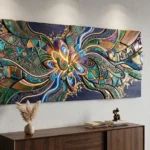
Abstract Masculine Art
Abstract design is widely used in modern luxury interiors across Europe.
Features:
- Non-representational structure
- Brush-based expression
- Controlled chaos composition
- Monochrome or dual-tone palette
Psychological Outcome:
- Creativity stimulation
- Flexible cognitive thinking
- Emotional interpretation development
Travel-Inspired Masculine Art
A growing trend among modern global professionals.
Includes:
- World maps
- Travel photography
- Cultural landmark imagery
Psychological Outcome:
- Identity expansion
- Memory reinforcement
- Experience-based emotional connection
Room-by-Room Strategy for Masculine Wall Art
Each interior space requires a distinct psychological function.
Bedroom Wall Art for Men
The bedroom serves as a recovery and emotional reset zone.
Recommended Styles:
- Soft abstract compositions
- Nature-inspired visuals
- Minimal monochrome artwork
Avoid:
- High-intensity visuals
- Overly aggressive imagery
- Excessive contrast
Functional Objective:
- Emotional decompression
- Sleep enhancement
- Mental recovery
Office Wall Art for Men
Workspaces require structured cognitive stimulation.
Recommended Styles:
- Urban skyline photography
- Geometric compositions
- Minimal typography designs
Functional Objective:
- Productivity increase
- Cognitive focus
- Motivation reinforcement
Living Room Wall Art for Men
This space represents identity projection and social expression.
Recommended Styles:
- Large centerpiece artwork
- Abstract focal pieces
- Multi-panel industrial compositions
Functional Objective:
- Personality expression
- Social impression building
- Identity representation
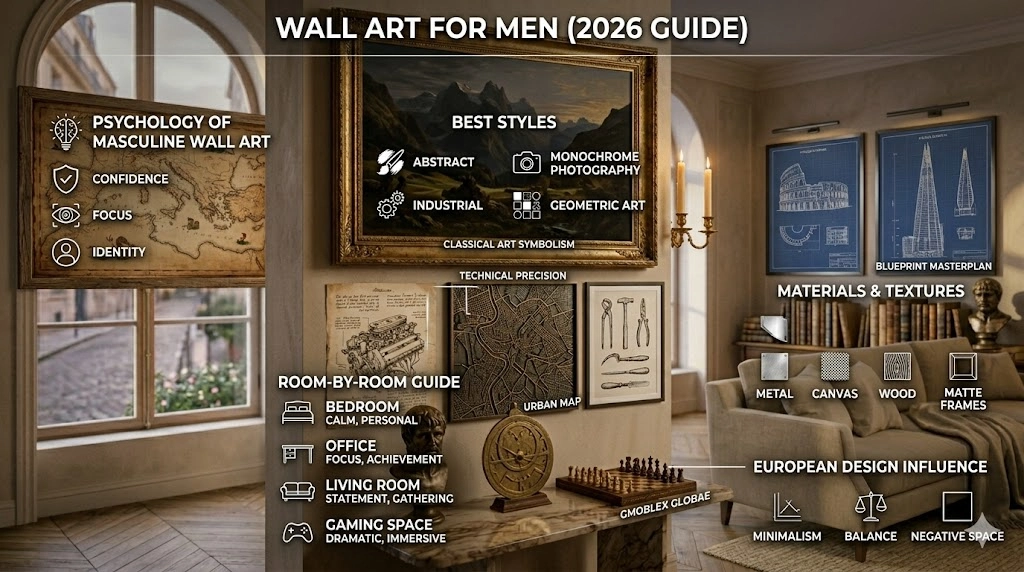
Gaming / Creative Room
This is a high-energy cognitive stimulation environment.
Recommended Styles:
- Neon-inspired visuals
- Dynamic abstract compositions
- Digital culture references
Functional Objective:
- Creative stimulation
- Engagement enhancement
- Immersive experience
Materials That Define Masculine Wall Art
Material selection significantly influences emotional perception of a space.
Key Material Categories:
| Material | Psychological Effect | Ideal Usage |
| Wood | Warmth and grounding | Bedrooms, living rooms |
| Metal | Strength and structure | Offices, industrial spaces |
| Canvas | Neutral versatility | Universal application |
| Concrete texture | Raw urban energy | Studios |
| Glass/Acrylic | Modern sophistication | Minimalist interiors |
Key Insight:
The most effective masculine interiors often combine wood and metal to achieve equilibrium between warmth and structural strength.
Systematic Selection of Wall Art for Men
Rather than random selection, masculine interiors should follow structured decision logic.
1: Personality Classification
- Analytical thinker
- Creative innovator
- Business-oriented strategist
- Adventure-driven personality
2: Emotional Design Objective
- Calmness (bedroom)
- Focus (office)
- Expression (living room)
- Creativity (studio)
3: Spatial Function Alignment
| Room | Purpose | Recommended Art Type |
| Bedroom | Rest | Nature, soft abstraction |
| Office | Work | Geometric, city visuals |
| Living Room | Social identity | Bold statement pieces |
| Studio | Creation | Experimental visuals |
Common Mistakes in Masculine Wall Design
Frequent Errors:
- Excessive fragmentation of artwork
- Mixing incompatible design styles
- Ignoring lighting conditions
- Over-darkening entire environment
- Lack of emotional coherence
Correct Strategy:
- Use fewer but larger visual elements
- Maintain consistent thematic direction
- Balance illumination and shadow
- Select emotionally meaningful artwork
Comparative Analysis of Masculine Wall Art Styles
| Style | Strength | Limitation | Ideal Application |
| Minimalist | Clarity | Potential emptiness | Bedrooms |
| Industrial | Strength | Coldness risk | Lofts |
| Abstract | Creativity | Interpretation variance | Living rooms |
| Photography | Realism | Less symbolic | Offices |
| Travel-based | Personal meaning | Niche appeal | Private rooms |
European Influence on Masculine Interior Design
European design philosophy plays a dominant role in shaping global masculine aesthetics.
Scandinavian Approach
- Minimalism
- Natural light optimization
- Neutral tonal systems
German Industrial Philosophy
- Structural precision
- Functional clarity
- Urban realism
French Modern Aesthetic
- Balanced elegance
- Artistic refinement
- Subtle emotional layering
Italian Luxury Direction
- Bold visual statements
- Premium material usage
- Artistic richness
Emotional Intelligence of Wall Art for Men
Properly selected wall art influences:
- Confidence development
- Stress reduction
- Identity clarity
- Productivity enhancement
- Emotional stability
A masculine interior becomes a cognitive support system rather than a passive environment.
FAQs
Minimalist, industrial, black-and-white photography, and abstract styles are most popular.
Black, grey, navy, beige, and earthy tones work best.
Yes. Minimal designs reduce distraction and improve focus.
Yes. It affects sleep quality and emotional relaxation.
It focuses on minimalism, function, natural materials, and emotional simplicity.
Conclusion
Modern wall art for men is not merely aesthetic enhancement—it is an integrated system of psychological design, identity construction, and environmental intelligence.
European interior philosophy consistently demonstrates a core principle:
Less visual noise, more cognitive meaning.
A well-curated masculine wall transforms not only a room—but also thinking patterns, emotional stability, and lifestyle behavior.
In 2026, masculine interior design is no longer about decoration.
It is about intentional living through visual structure.